Thirty years after his first illegal curb cut, a desert neighborhood cools its streets with a million gallons of monsoon runoff a year.
Our culture isn’t used to planning ahead. And when the matter affects entire communities rather than individuals, we couldn’t care less as a civilization. Why plant a tree whose shade will make an impact after we’re gone?
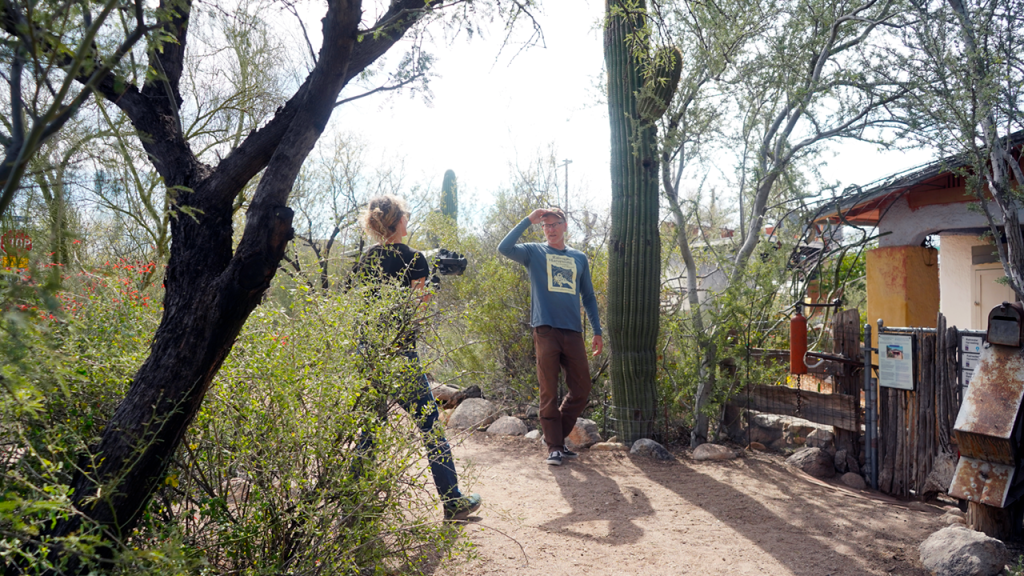
Yet there’s always been a type of misfit working ahead of time to help adapt local systems to a new reality, improving the dysfunction at the intersection of human and natural habitats, rather than patching short-term ailments over remediation.
This is why Brad Lancaster began “planting rain” in his area of Tucson in the Arizona desert, so not only he but the entire neighborhood would benefit from the shade and fruits of the native trees and vegetation thriving on the sidewalks that had been barren in the past.
Turning inhospitable places into an oasis
Not long ago, things were very different there. When the monsoons arrived every year, the aging bungalows built onto small lots in the neighborhood were something to avoid and shun, and the water from the sudden summer storms rushed down the streets, washing away instead of feeding gardens and filling the soil and aquifers so plants can regulate the quality of life at the scale that is needed.
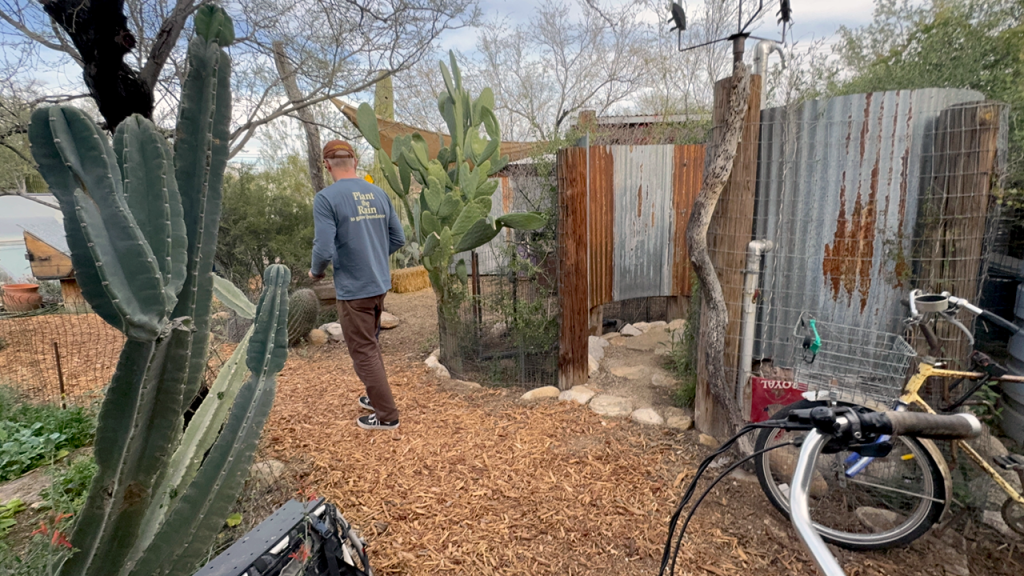
But the improvement didn’t come easy in the Dunbar/Spring neighborhood, a few blocks north of downtown Tucson. Thirty years ago, Brad Lancaster had to break the law on Sunday mornings with a concrete saw to allow water to enter the sidewalk basins he planted, so his neighborhood could harvest over a million gallons of stormwater a year.
Over time, neighbors and even the city recognized the benefits of such a small, economical intervention that could be carried out by local volunteers; what was then illegal is now encouraged, and the city offers rebates for stormwater reuse. Finally, “planting” and “harvesting” rain aren’t the rogue proposition of a bunch of idealists.
Though for that to happen, people and representatives needed to see the change firsthand. Because once things are banned, they enter the realm of “perceived reality you can’t change,” even when those same rules hurt communities.
Laws made to be outgrown
Many laws have criminalized gathering what nature gives away for free; the British Raj banned Indians from collecting the salt their own sea left on the shore, and a municipal code can do something similar with the rain that falls on a public street.
But, from Gandhi to Thoreau, there’s also a lineage of people who broke those laws and were proven right, and Brad Lancaster recognized himself in it. Rain on a street is perhaps the purest commons we have left, and when the code rushes it to the storm drain while the city pumps a shrinking aquifer to sell water back to its citizens, we aren’t talking about neutral engineering anymore, but about a monopoly with a permit. Some laws exist to be enforced, and others exist to be outgrown; judging by what happened in Msipane and in Dunbar/Spring, the fastest way to outgrow them is a shovel and a Sunday morning.
Brad’s approach to radical rainwater harvesting in homes, streets, and at city-scale environments suffering desertification came to be in an environment hostile to innovation and holistic approaches to life in the desert; instead of learning from the techniques that the Hohokam and their Tohono O’odham descendants had used to create edible abundance for centuries by channeling monsoon runoff, most of Tucson was a dusty and hot oven lacking any shade or habitat.
So Brad and others went the way of Gandhi’s Salt March. His bet (that the local ordinance would end up catching up with reality once sidewalk adaptation was recognized as a way to plant shade and retain water in the soil) was risky at first, but he understood, like Thoreau, or like NYC’s Green Guerillas planting vacant lots into community gardens in the seventies, that when local ordinances turn people into the agent of injustice, it’s legitimate to break them and build a better alternative to broken, outdated techniques.
127 degrees F on the tarmac
The first thing that hits you in a place like Tucson when it’s not pouring rain in summer is not the heat. It’s the tarmac. The dry air hits you at 108°F, and you want to drink something cold. The bare pavement makes the environment even more threatening, radiating at 127°F, which is why solar ovens like the one Brad uses at his small home (he calls it, among other things, a “shondo,” or a hybrid between an old shed and a condo) are popular: 127°F is roughly the temperature at which you can slow-cook a brisket and get your sun herbal tea ready.
At such temperatures, most people move fast between air-conditioned environments, paying little attention to the fact that, as it happens in Western Europe each time there’s a sudden, prolonged heat wave, many people with underlying conditions don’t make it through. In 2023, one heatwave in the already hot Arizona desert contributed to nearly 800 extra deaths.
Brad has demonstrated that, when you keep the soil unpaved along sidewalks and plant trees and understory in the curbside basins, the place becomes safer and more habitable for animals, pets, and people. Instead of destroying watersheds and draining the rain into storm sewers while keeping sidewalks paved, pumping aquifers that don’t get replenished and are used to water lawns, Brad Lancaster and others are pioneers trying to prevent our cities from killing us when it’s too hot and desolate out in the tarmac dystopia.
Goats, a shondo, and a decade between visits
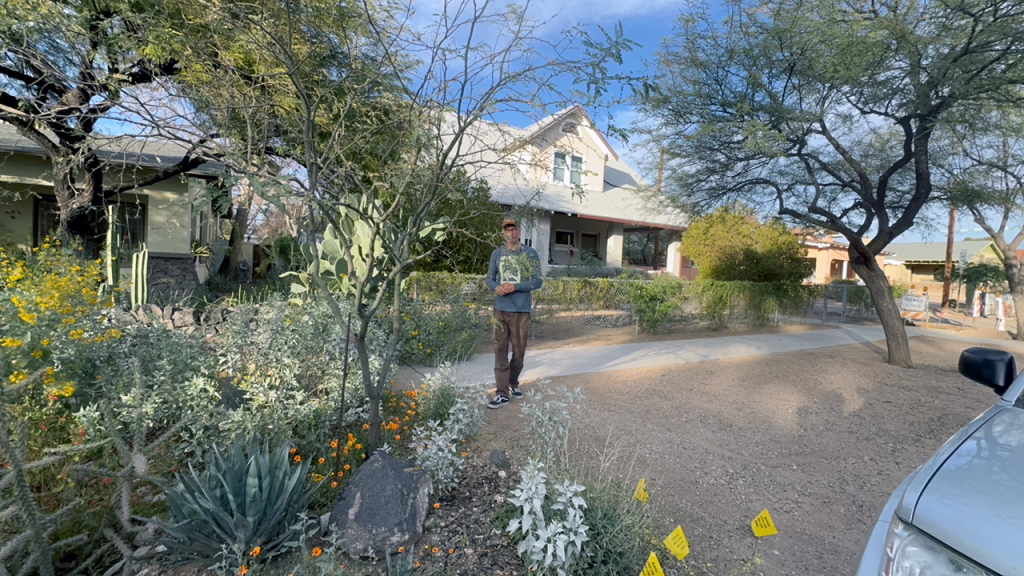
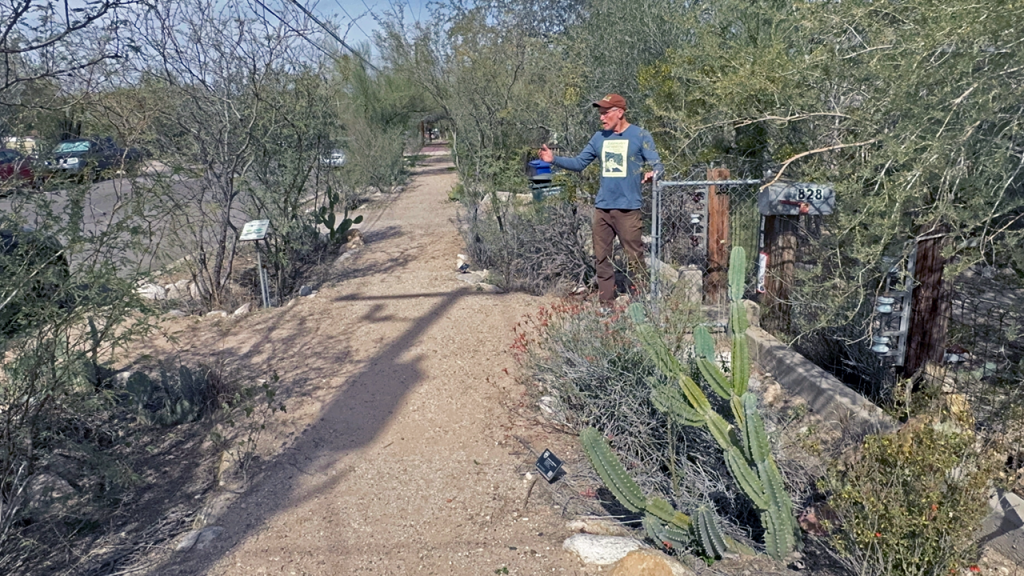
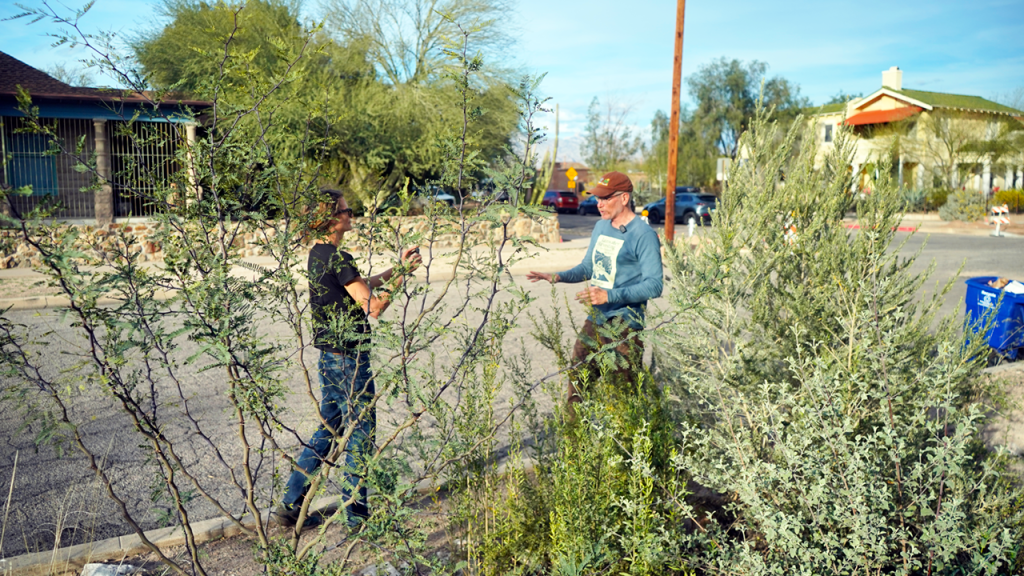
When you visit Brad, there’s no dystopia anymore. Approaching his “shondo,” the street narrows. Mesquite and ironwood canopy over the footpaths. The soil in the shaded basins beside the curb runs up to 30°F cooler than the exposed street.
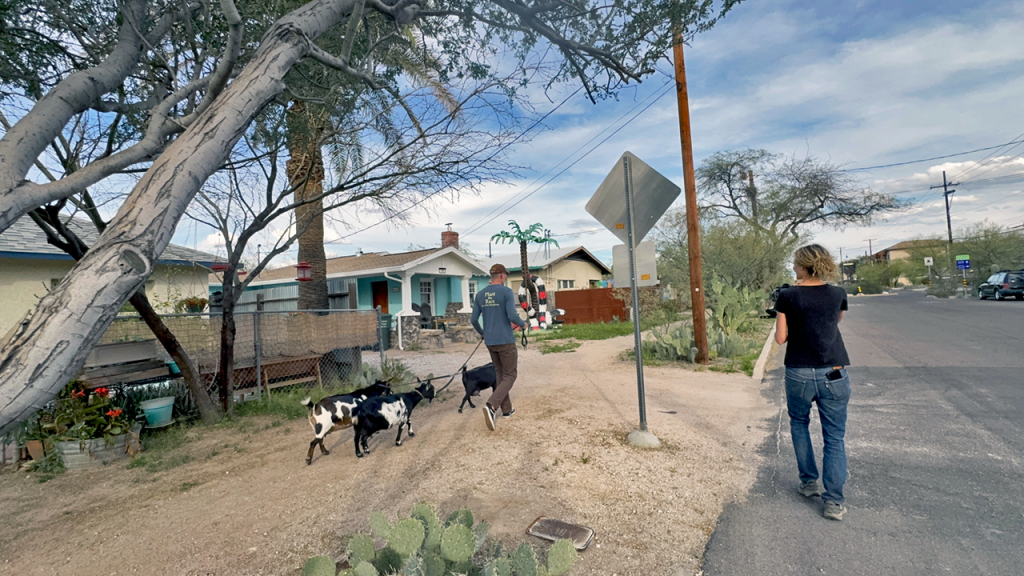
There are birds, actual songbirds, in downtown Tucson in July. And there is Brad Lancaster, on foot as always (he has been car-free for decades), walking two small Nigerian dwarf goats down the block like a man walking the thesis of his life’s work on a leash. It all makes sense once you experience it. It feels cooler, more livable, more active, less 24/7/365 AC-driven. It’s a declaration of working with the urban fabric to make it more habitable instead of living isolated and in fear, jumping from AC bubble to AC bubble.
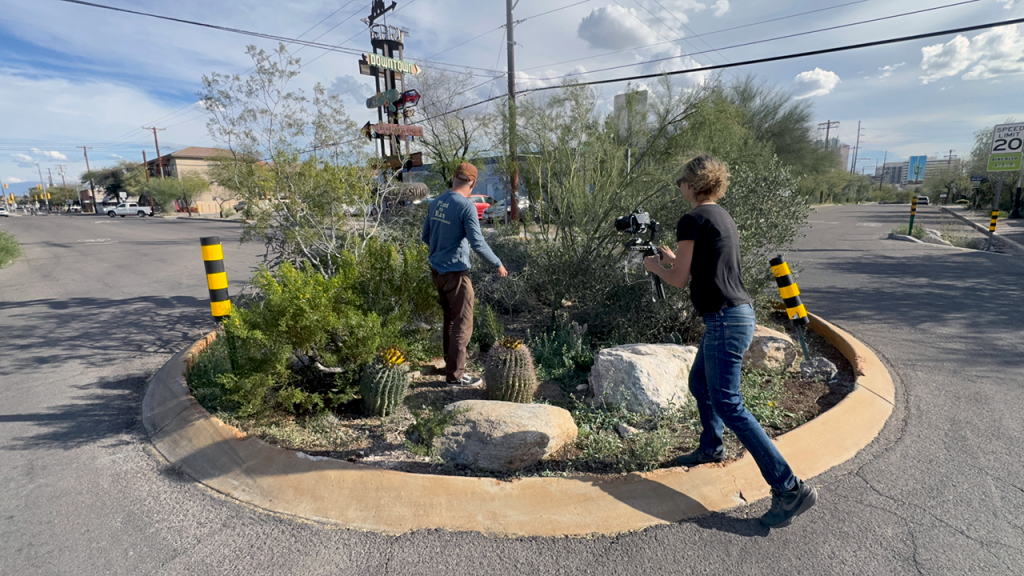
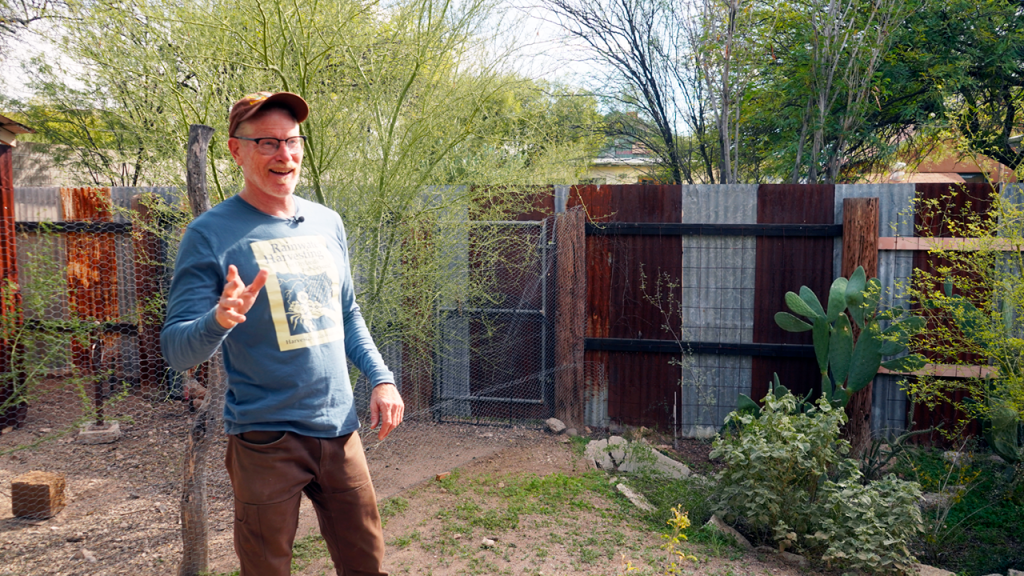
We visited Brad for the first time a decade ago, and dropped by again this late spring to see the updates at this place, in the neighborhood, and in the entire city. The goats are new since our first visit. They are pets, milk supply, and brush control, in that order, or perhaps the reverse, depending on the day. They have their own adapted place in the backyard that Brad shares with his brother’s family next door, but he walks them around the vicinity on a leash. When we do it with him, few people find it strange or even pay attention to the scene, though the miniature goats, naturally adapted to heat and scarcity, are no dog.
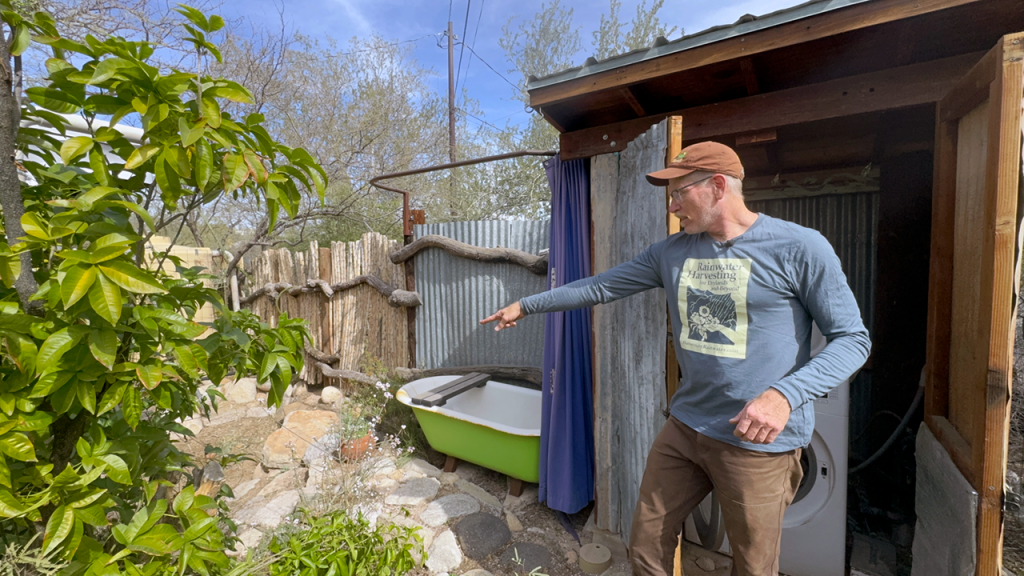
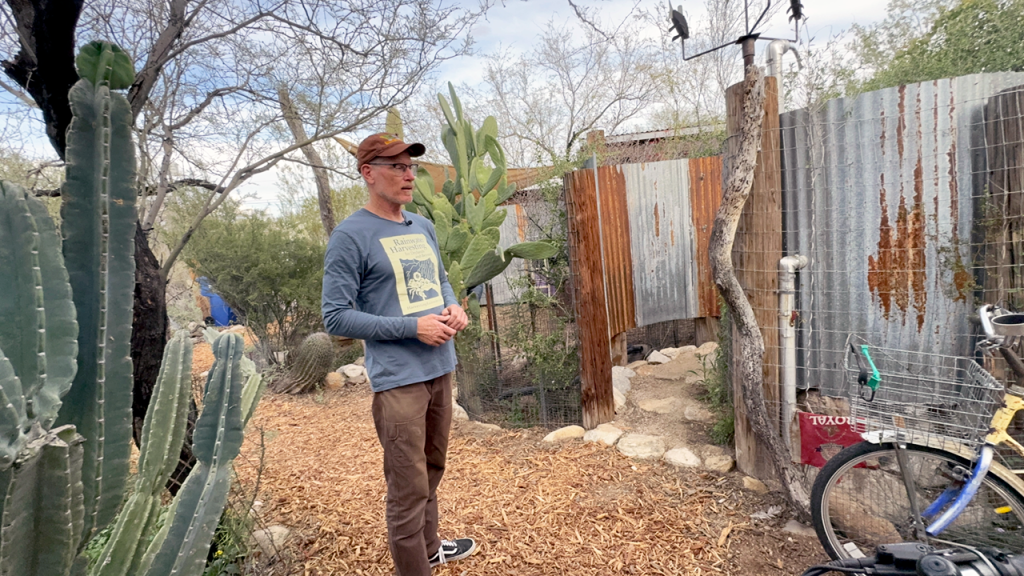
His “shondo,” the small structure on the eighth-acre property he shares with his brother’s family, has been improved again; nothing on this lot is ever finished, only iterating. The property itself, a run-down 740-square-foot adobe when the brothers bought it in 1994 because, as Brad puts it, it was all they could afford, now harvests around 100,000 gallons of rain and stormwater a year, on a lot and adjoining public right-of-way where the sky delivers barely 12 inches annually.
Other things have changed, too. In between our two visits, Brad Lancaster’s name kept surfacing in the places we filmed, and we heard countless times how much of an inspiration our first story with him had been. When we recently covered the Milagro cohousing community outside Tucson, whose walkable food forest turned a development into a village, its founders told us that Brad had consulted on their water-harvesting design. Such a small watershed design reminded us of his hands-on work and philosophy, indeed. Things flow toward him and out of him.
Sunday mornings with a concrete saw
The origin story deserves retelling because it inverts everything we assume about how infrastructure happens. In 1996, Brad and his neighbors started cutting holes in the city curbs. This was illegal. “We started on Sunday mornings, when no one from the city was watching,” Brad once told a University of Arizona alumni tour.
Then, in 2006, Brad published the first comprehensive practical guide to rainwater harvesting in the American Southwest. When he first contacted us through our website, the book had already reached a cult following, mainly local and small-scale. Once we understood what he was after (cities like Tucson benefiting from summer storms instead of suffering flash floods and runoff), we went to pay him a visit.
From the very first moment when we pulled up on his street, we knew there was a story to tell that could change people’s lives. Brad didn’t disappoint: tall and energetic, he welcomed our family and made our three kids, then very young, comfortable and seen since the very first instant of interaction. You can watch our first video with Brad to notice how engaged our children were, and they remember that experience to this day, because, like every good life lesson, it felt like purposeful play.
The water farmer of Zvishavane
The whole neighborhood was lush and hospitable, despite being a summer day in the desert. We learned that the idea of taking advantage of the monsoons by making small street interventions wasn’t his, and neither was the crime.
In 1995, recently out of university, Brad traveled to Zimbabwe and met Zephaniah Phiri Maseko, a farmer from the arid district of Zvishavane. The Rhodesian regime had detained and blacklisted Phiri for his politics years before, so he had to feed six children out of a poor plot at the edge of a seasonal wetland, and he did it by studying where the rain went and digging pits, terraces, and channels to keep it. For this, he was arrested three times, charged with “farming a waterway.”
The case ended in the most literal way possible: the magistrate wanted to see the land with his own eyes, walked among green terraces in a district of dust, and ruled against the government’s own land officer. A few years later, the same government was busing farmers to Phiri’s plot so they could learn his methods.
Phiri liked to say that he married the water to the soil so the land could raise a family of life, and that one has to plant the water before planting the trees. Brad returned to the Sonoran Desert carrying, in essence, an African technology: while the American Southwest kept betting on engineering hubris and concrete aqueducts, one of its most replicable water solutions came from a smallholder that the experts had prosecuted first and studied later.
Once sidewalk basins started collecting water, plants like mesquite and palo verde trees, as well as many local flowers, shrubs, and cacti, began growing at the fastest rate anyone remembered, and shade and habitat replaced barren, runoff-prone, dusty streets.
Can established realities adapt? From crime to code
The curb cuts worked. The city noticed and came to look, and instead of prosecuting anybody, it started a dialogue that lasted years. Today, the practice Brad pioneered illegally is legal, rebated, and in some cases mandatory, and in 2008, Tucson became the first city in the US to require commercial developments to harvest rainwater. What had been guerrilla work turned into ordinance language.
That thirty-year arc from crime to code was my first question for him. Walking those streets today, what does he see that even he didn’t predict?
His answer surprised me because it wasn’t about water at all. It was about parking.
“One of the things I see today, but didn’t predict,” he wrote, “was how these rain gardens would make the neighborhood much more walkable and bikeable.” In the old days, many neighbors (his own household included) parked their cars on the bare-dirt public pathways, so pedestrians had to walk on the street, and the street, emptied of parked cars, felt wider than it was, which invited drivers to speed through. When the basins and their vegetation went in, they became an accidental barrier: cars went back to parking on the street, the parked cars and the growing trees narrowed the feel of the road, traffic slowed down, and the plantings buffered the footpath from the vehicles. A hydrological intervention had turned into a traffic-calming device, a pedestrian amenity, and a wildlife corridor, all at the same time.
No line item for rabbits
“These rain gardens create a protective topography that harvests and holds seed and leaf drop where moisture collects,” he went on, “so they become mini-pocket forests of dense sheltering life where native rabbits, birds, and pollinators reside. We predicted the rain gardens would be more inviting and supportive of life, but they are far more effective than we predicted.”
This is what tends to happen when we work with living systems instead of against them: the returns compound in directions nobody had budgeted for. There was no line item for rabbits in any civil engineer’s spreadsheet.
Novelist and environmentalist Wallace Stegner, known as the dean of Western writers, wrote that to appreciate the landscape west of the Mississippi, you first “have to get over the color green.” Decades later, in 1986, Marc Reisner, an environmental writer in the tradition of Stegner and Aldo Leopold, documented the modern obsession with taming the brown West into an irrigated utopia at taxpayer expense: damming, draining, diverting, and canal-building. The title said it all: Cadillac Desert: The American West and Its Disappearing Water.
Brad’s work reads like the counter-thesis to that book: no dams, no canals, no water imported from a river three states away, just gravity, soil, and patience.
From shovels to backhoes
But the method has evolved, and the new generation of earthworks along Tucson’s 3rd Avenue, which Brad has been filming these days as the summer storms hit, shows how far it has come.
“When we began in 1996, all was done by hand by volunteers with shovels,” he told me in the interview for this article. “The early basins were much smaller because you can only push volunteers so much, and digging in our compact urban soils is very difficult.” Now a backhoe does the brutal work, the basins are far larger, water-harvesting contractors stabilize the banks, and the volunteers arrive for the part that matters most, which is the planting itself. “The volunteers grow deeper roots in their community as they work with their neighbors, all the while literally planting roots in the ground.”
Once accepted by local codes, “planting rain” is a thing in places like Tucson, centuries after the Native peoples of this same desert, the Hohokam and their O’odham descendants, as well as pre-Columbian civilizations in Mesoamerica and the Andes, had used similar techniques to stretch the little water they could get. Ancient “low” tech turned into “low high-tech,” as efficient, redundant, and repairable as it can get.
A neighborhood that metabolizes its own waste
The materials have changed as well, and in a direction I find quietly radical. Instead of trucking in mined rock to stabilize the basin banks, the neighborhood now uses “urbanite,” broken chunks of demolished sidewalk and concrete, along with storm-fallen logs from neighborhood trees. I asked whether that was cost-cutting or philosophy, and it turns out it’s both, though mostly philosophy.
“Using salvaged urbanite and storm-fallen branches turns ‘wastes’ into resources,” he wrote, “and shows the community that there are free resources we can use that do not need to be purchased and imported from elsewhere. What we need is already here, freely available, if we can just learn to see it and use it. The logs are also better habitat for lizards, insects, and soil-life.”
A neighborhood metabolizing its own waste stream; the same sidewalk that once sealed the watershed, broken up and repurposed to hold open the basins that heal it. If I had to choose a single image for the whole project, it would probably be that one.
Institutional judo
The part of Brad’s work that fascinates many people most, including us (perhaps because we spend our days looking at how land regulation shapes what gets built), is the institutional judo. Water-harvesting basins in the street double as traffic-calming chicanes and roundabouts, which means that the same hole in the ground answers to two city bureaucracies that famously don’t talk to each other: the transportation department, which sees stormwater as a nuisance to be drained, and the water department, which in a drying Tucson increasingly sees rain as supply.
How do you sell one piece of infrastructure to two agencies with opposite definitions of the same water?
“By looking at the larger whole, ‘problems’ can become solutions,” Brad answered. Stormwater directed off the street stops being transportation’s flooding problem and becomes the water department’s free irrigation. The vegetation it grows then shades the asphalt, “reducing vaporization, cracking, and potholing,” which hands transportation a maintenance win it never asked for. Surplus water sinks past the roots and recharges the aquifer everyone shares. “When speaking with city officials, I try to understand their challenges, and then help solve them with our community planting efforts.”
It sounds almost too diplomatic coming from a man who started out with an illegal saw, though it describes the full arc of any effective subversion: first you break the law to prove the concept, then you learn to speak fluent bureaucrat to scale it.
“We need to make it easier to do the right thing and harder to do the wrong thing,” he wrote when I asked which fight comes next. “Legalize and incentivize life-giving practices, while making it much more difficult to continue with life-taking practices.”
Sun-baked parking lots that pave the watershed and drain away the rain don’t make sense; lots shaded by native trees irrigated with their own runoff make more sense; retrofitting car-dominated neighborhoods until fewer lots are needed at all makes the most sense of all.
Why pass the hat after thirty years
Which brings us to the fundraiser, and to the question I felt slightly rude asking: after three decades, books translated into Arabic and Turkish and soon Spanish, an international lecture circuit, and a model so proven the city wrote it into law, why is Brad Lancaster crowdfunding?
His answer is a small civics lesson for 2026. “The city is under-resourced and making cuts to its budgets, and rebates are shrinking,” he wrote. The crowdfunding, run through the Ma Earth platform under the banner Plant the Rain, is a workaround and a demonstration at once: independent money lets the Dunbar/Spring Neighborhood Foresters build cheaper, more progressive designs than the city’s own standards allow, which then become pilot projects the city can copy. “It enables our community efforts to scale up and prove how much more effective we can be, in a way that shares the designs, process, and knowledge with other neighborhoods so they can do the same or better without having to reinvent the wheel.”
Unlike most campaigns of this kind, the $100,000 goal is itemized down to the detail: new basins, chicanes, and roundabouts built with urbanite and storm logs; advocacy for parking-lot canopy mandates and simpler greywater ordinances; three new books, including a children’s book; multilingual plant signage; wildlife surveys; and pre-paying local native-plant growers to raise rare species, which removes the grower’s risk entirely. Even the plant procurement is designed as a regenerative loop.
There’s also a deadline that matters: donations up to $15,000 made by July 21 are doubled by a matching grant, enough to fund the next phase of water-harvesting traffic-calming in the neighborhood. The campaign continues after that date, but the match doesn’t.
I’ll say plainly what Brad is too courteous to say: the ideas that fill our feeds with hope, the videos of curb cuts and desert food forests that channels like ours, Andrew Millison’s, and Crime Pays But Botany Doesn’t have carried to millions of viewers, are made by a handful of people working on shoestrings while the ideas travel for free. Every once in a while, the shoestring deserves reinforcement.
Two people, one shovel, one tree
I’m writing this from the Mediterranean coast of Catalonia, a landscape that has spent recent years lurching in and out of drought emergency, where reservoirs made the evening news the way stock indexes do, and some towns had to truck in their drinking water. Tucson’s 12 inches of rain a year is an extreme case, but the logic of Dunbar/Spring is not exotic here, and it isn’t exotic anywhere people have paved their watersheds, which nowadays means almost everywhere.
So I asked Brad the question I’d want answered if I were reading this in Barcelona, Lisbon, or Phoenix: what is step one, and what is the mistake everyone makes?
“It only takes two people, one shovel, and one tree to start a community tree planting project,” he wrote. But the tree must be native to your area and microclimate, and its reasoning goes beyond survival rates and sounds almost like an ecological syllogism: over 90% of most baby birds’ food is caterpillars, and the caterpillars of native butterflies and moths cannot eat non-native plants, whose chemical defenses they never evolved to handle. “If you do not have native plants you will not have baby birds, nor the adults they become.” Planting an ornamental from another continent is, in this sense, like planting a statue.
As for the universal mistake? “They don’t plant the rain before they plant the plant.” Shape the earth first so the sky becomes your free irrigation, and you’ll never need to buy the drip lines, the timer, or the water bill that comes attached to them. It’s Phiri’s old lesson, one generation and one hemisphere later, unchanged because it was correct.
An oasis at the expense of none
Late in our second visit to Brad last spring, somewhere between the goats and the improved shondo and the cisterns, I thought about the word oasis, which the Southwest has abused perhaps more than any other. In Scottsdale, a swimming pool passes for an oasis; outside Las Vegas, a golf course does. Every one of them is a transfer: water taken from a river, from an aquifer, from a future, and displayed as if it had been conjured out of nothing.
My last question to Brad was about abundance, what the word means to him after thirty years of harvesting a desert sky. His answer is the closest thing the movement has to a creed, and I’ll leave it nearly whole.
“Regenerative abundance is joy,” he wrote. “It is the joy that comes from knowing I am contributing to the life around me at the expense of none. I am not taking water away from others to have an artificial oasis. Regenerative abundance is helping grow, steward, and learn from a TRUE oasis that takes from no one, that does not extract and import resources from elsewhere, but instead nudges and leverages what is already freely at hand to grow its potential and capacity for the benefit and greater health of all.”
An oasis at the expense of none: in an economy, a politics, and a climate built almost entirely on oases at somebody’s expense, that may well be the most subversive thing Brad Lancaster has ever cut into a curb.
Brad’s fundraiser is called Plant the Rain. Donations up to $15,000 made by July 21 are matched dollar for dollar, and the campaign continues after that date. Our new video from this latest visit with Brad is coming soon; the first one, from a decade ago, is where this story began.