Rankings keep crowning the Danish capital. A few days there recently, sleeping among somebody else’s books, suggested the secret is less mysterious than it sounds.
The snowbird migration now runs in reverse when the Mediterranean gets too hot: a summer visit to Copenhagen. Just as Scandinavians chase the sun in winter, we flew north to cool down in mid-July, trading heat for a lived-in flat in Vesterbro.
The term “snowbird” is well known in North America. In the United States, people who seasonally travel from the northern states to the Sun Belt to enjoy the winter are called snowbirds.
Commonly perceived as a retiree phenomenon, it also includes younger cohorts who can work remotely or choose a precariat lifestyle by working seasonally or attending educational programs down south when it’s too cold up north, and vice versa.
Many Canadians own property or visit places down south, seasonally traveling to sun-bathed places when it’s too harsh back home, though this reality is being put to the test by the perceived animosity of the US Administration towards its immediate neighbors and partners.
Europe has snowbirds too
But snowbirds aren’t only a North American phenomenon. Low-fare travel, a common currency, and an increasingly harmonized legal framework have increased seasonal travel between Northern and Southern Europe, with Britons, Germans, Benelux residents, or Scandinavians visiting spots in Iberia and the Mediterranean for days or even weeks during the harshest moments of winter, and Southern Europeans choosing to leave the heat and tourist high season of the summer to get to know places up north.
And so, if Barcelona, Lisbon, Valencia, or Rome get busy in winter with intra-European travelers escaping the cold, many places up north like Copenhagen, Oslo, Gothenburg, Stockholm, or Helsinki increasingly attract meridional Europeans in summer, who enjoy the comparatively mild weather, lack of massification, and cultural or culinary experience.
Reversing our own migration
Since our family moved to California from France in the summer of 2022, we reversed our travel rationale, staying in North America for most of the year and traveling to Europe for the winter and summer vacations.
And, without planning it, we’ve come to realize that our place outside Barcelona (next to a vibrant city, not far from great ski and cultural activities, as well as friends and family) is of great family value in the cold months, whereas, during summer, as temperatures rise and Northern Europeans flock en masse to the Mediterranean coast and even the interior in search of their blend of sun, gastronomy, and cultural experiences, we often like to escape the humidity and temperature rise and stay a few days in places like Copenhagen.
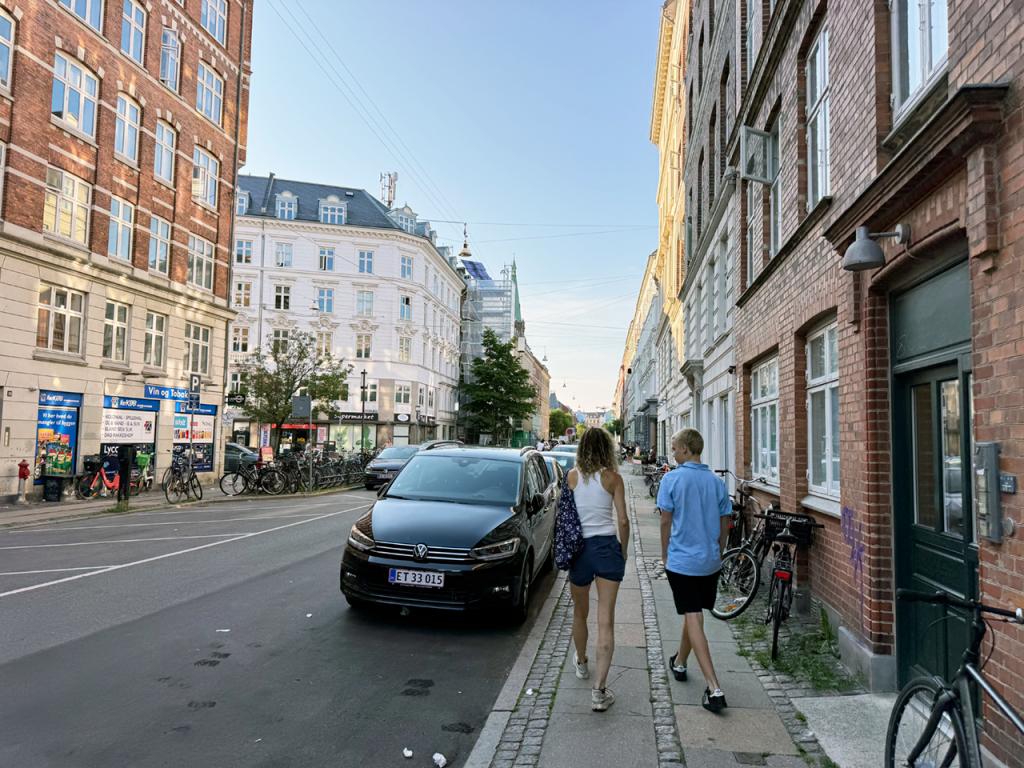
Consider our latest unplanned escape to Scandinavia: after we had the chance to visit my family and enjoy a few days of rest in Penedès, the wine-making valley about one hour southwest of Barcelona, we took a flight to Copenhagen and decided to rent an apartment in a conventional building on Valdemarsgade, a common street in Vesterbro, currently a vibrant district in what was once a rough working-class and red-light zone, instead of going to a hotel.
A city that still feels like itself
Many authors have explored the trend in the world towards the homogenization of urban and suburban landscapes, often through the unstoppable expansion and pervasiveness of branding, certain typographies, and muted colors.
French anthropologist Marc Augé theorized about “non-places,” spaces of transit and consumption that emanate (and generate) no identity, no relations, no history. It was first felt in airports, malls, chain hotels, highways, etc. Then it spread to exurban and suburban enclaves, as well as the outskirts of cities, but it’s now present even in urban cores.
Similarly, German-Korean philosopher Byung-Chul Han describes how globalized digital culture shortens any distance and erases uniqueness: everything becomes comparable, consumable, “the same.” Things become non-things. Wary of such feelings, I enjoy the difficult-to-translate signals that make every place unique, and Copenhagen hasn’t lost its authenticity.
Life at 0.75x
To somebody who grew up in Barcelona but also traveled, read, and watched movies, it’s easy to feel that the farther north one goes in Europe, the duller the chromatism and the more textured the light seem to be.
This time, I couldn’t help but think that many people seemed to bike, walk, or talk calmly, at a speed that, if we were to measure in podcast play pace, would rank between 0.5 and 0.9x, whereas I get an opposite feeling in places like Paris or New York, where things play to Kirsten’s taste: it all seems to happen at 1.5x.
I joked with Kirsten, especially when we ventured outside Copenhagen, heading both west toward Jutland and east across the Øresund bridge into Sweden: many people looked and moved so calmly that it felt like they were missing a coffee or two.
Or is it the other way around? Is the vigor I sometimes feel in the jam-packed roads of the San Francisco Bay Area almost like a pulsion to survive, a way to culturally demonstrate one isn’t a laggard? Being “fast” or “efficient” isn’t a compliment in many parts of Europe, and that seems to be working alright in many areas.
The lived-in rental
We got the place for its price: it was a new listing and lacked any reviews, but the internal messaging with the host gave us confidence; for one, the apartment was a low pied-à-terre which probably lacked light in wintertime, but what’s an inconvenience in winter felt like a perk in summer, especially coming from our hot-and-humid-in-July place in Catalonia. Plus it was among the most affordable places to stay.
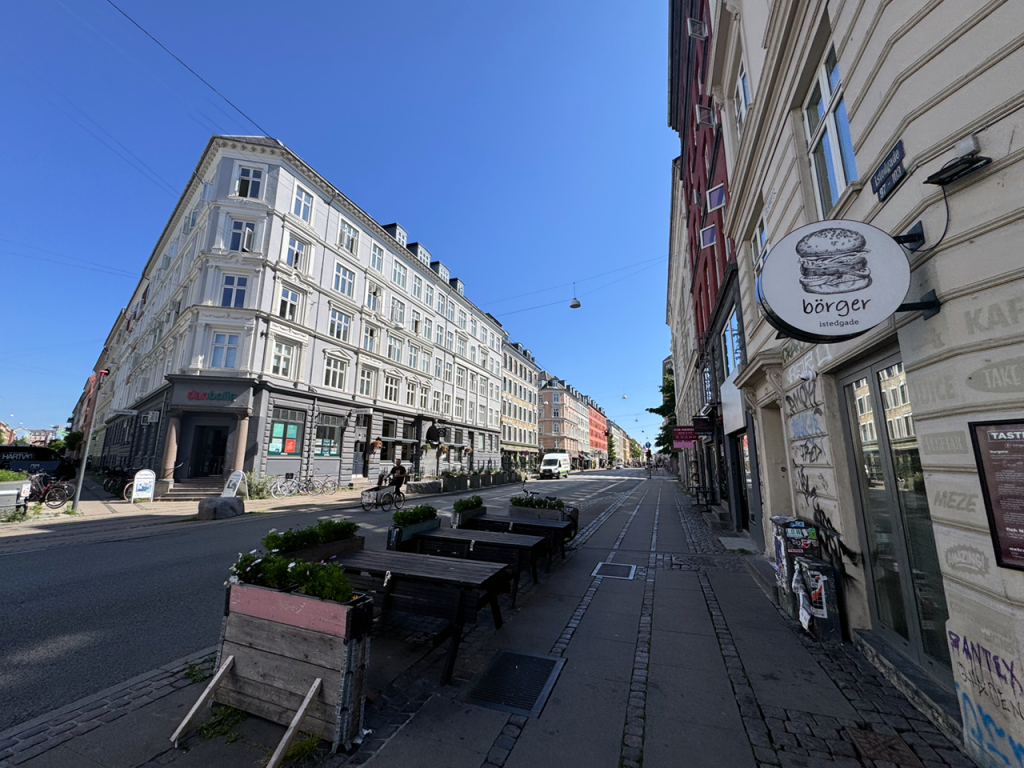
It was even better than expected: our rental ended up being obviously the shared apartment of two or three locals; we couldn’t tell how many. The ground-level flat was located in a conventional early-twentieth-century mid-rise apartment building on a small street leading to Istedgade, the vibrant nightlife artery of the Vesterbro district. It had two bedrooms and a light-filled open kitchen opening into a living room with well-sorted shelves.
There was an old-school hi-fi system next to a variety of vinyls of all genres, and an impressive assortment of books on a wide range of topics (including Noma 2.0: Vegetable, Forest, Ocean by René Redzepi, a book on Japanese knives, another on mushrooms, etc.). It felt a bit like having an assortment on par with a Taschen store in Berlin or Paris, just in an apartment inhabited by precarious youngsters.
The thing is: if this is the precariat in Copenhagen, it’s one enjoying a great quality of life. The kitchen was well-stocked with a magnetic strip of specialty knives, the pots and pans were quality, and the cutlery had patina and taste. These weren’t kids reheating premade food but ones cooking and perhaps experimenting, given the books they displayed not far from the stove.
A teenager takes notes
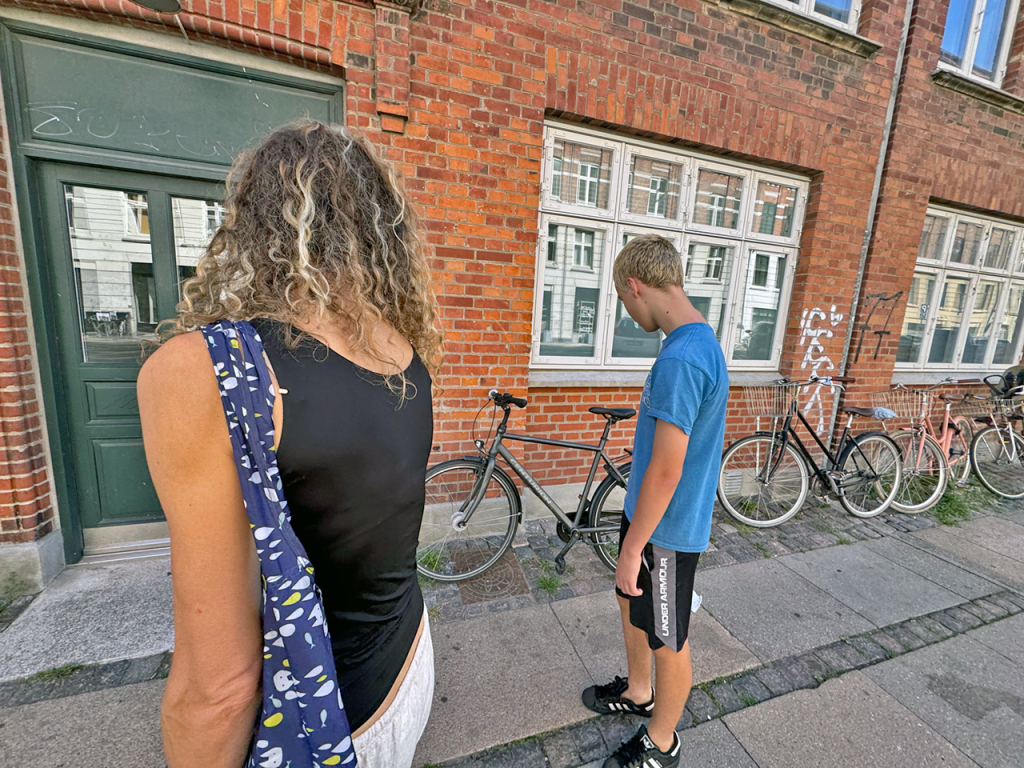
Our son, who traveled with the two of us while our two daughters were in Paris on a summer camp activity and a college internship, respectively, was also curious about the pictures on the walls and books (in Danish and English) he found in the room he stayed in.
He was careful not to misplace any of the many things in the place, which had been tidied up, and was especially interested in a pile of black notepads that one of the hosts had filled with drawings, texts, diagrams, song lyrics, poems, pranks, and whatnot, all in a very stylish fashion.
I’m glad he was exposed to it right before starting high school in a mere few weeks; I could feel his recognition and excitement. Perhaps a bedroom in Copenhagen, the real bedroom of a twenty-something living in the Danish capital, will inspire him more than any mentoring or adult rant, since teenagers know instinctively how to weigh the signal they are attuned to.
Streets at 22 degrees
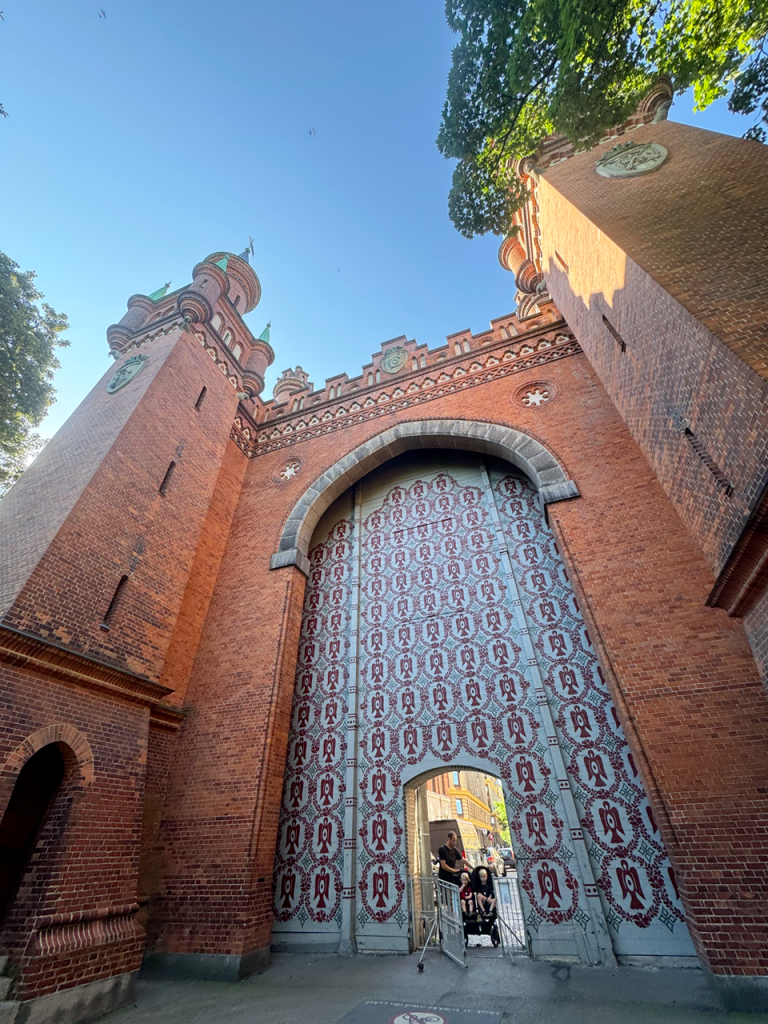
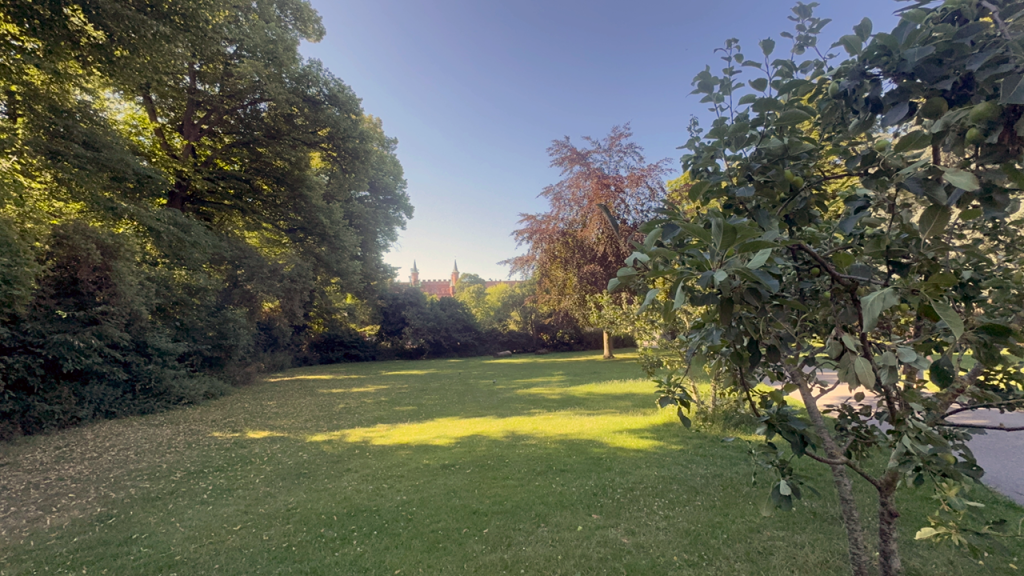
Outside the apartment: think people packing the sitting-out terraces of cafes and bistros, bikes cruising up and down, walkable areas leading to well-stocked children’s parks and tree-sheltered gardens inside old gates (like Legepladsen i Skydebanehaven, with its impressive Neo-Gothic gate, built in 1887), and pacified transit. All at a 22-ish-degree-Celsius (low 70s) temperature and an on-and-off sunny-cloudy sky, ideal to seek the sun instead of fencing it off as a matter of survival.
Light-wise, flying from Barcelona to Copenhagen in a day would feel a bit like having an early breakfast in Northern California and landing for lunch in Alberta, Canada: daylight lasts longer into the night in summertime, though it’s a more textured, less intense light, inviting people to get as much of it as possible instead of blocking it.
A morning at the lakes
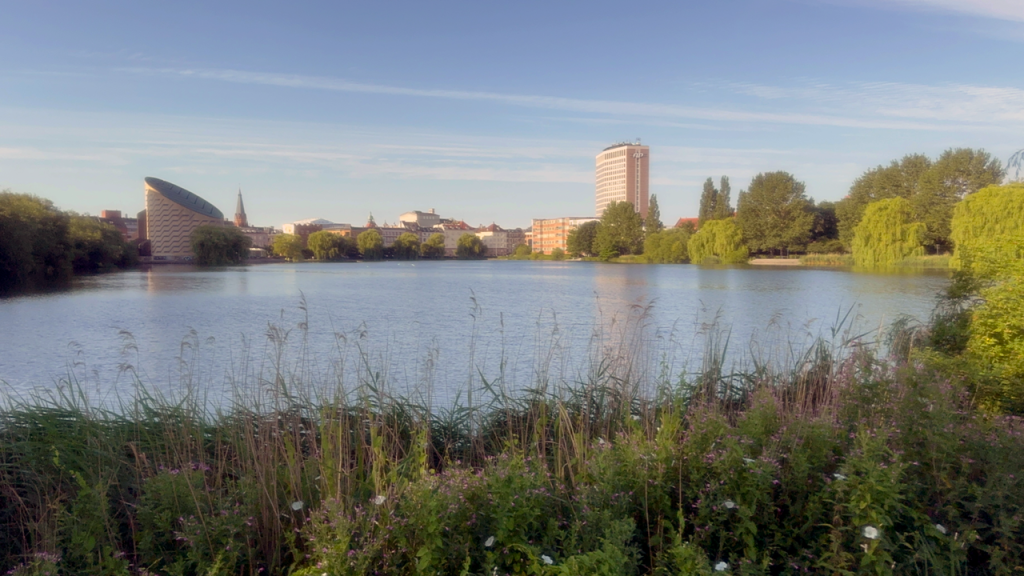
As it got late on our first day in town, I asked about a place worth exploring on my morning run, and someone recommended “the lakes” to me. Look up the lakes, he said. I imagined a set of actual lakes and wondered whether this person understood that I wanted to leave the place I was staying and start running, but it took me a quick search to understand that what Copenhageners know as “the lakes,” Søerne in Danish, is a vibrant, rectilinear 6.4-kilometer (3.9-mile) recreational loop around three interconnected artificial bodies of water.
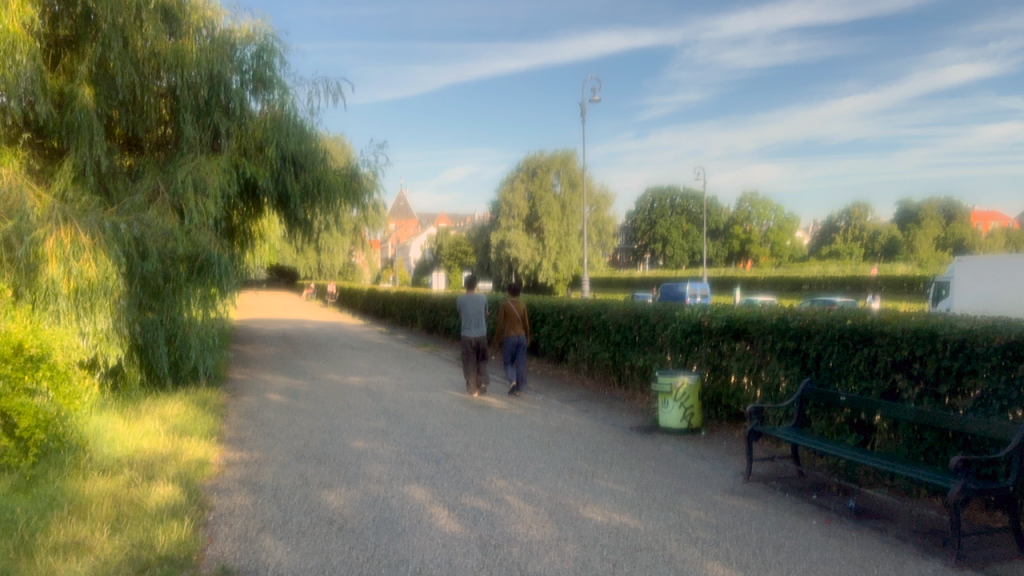
After my search, I looked at the map and was glad to see they were 15 minutes from our place, so I headed to this haven for walking and running early in the morning; the temperature was perfect, and the gravel paths were already packed with people of all ages.
Along the banks are houses with a few charming private gardens and old buildings, and as I approached intersections, I could see city landmarks like church towers nearby. Then, I’d turn my gaze to the path and the water and see swans and ducks getting their morning bath.
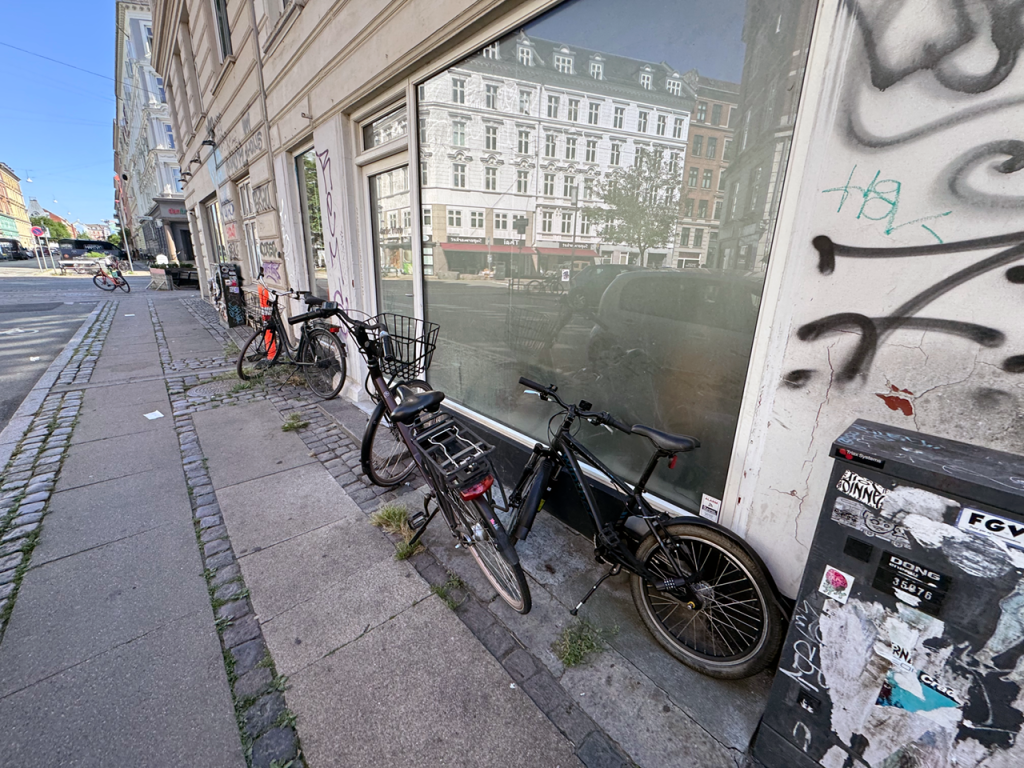
It was a weekday, so I figured that many of the young people doing the loop with me were heading to work later, but I saw little rush and not a single grim face. Then I learned that most Danish bikes carry a frame-mounted ring lock over the rear wheel, a small horseshoe bolt that blocks the wheel from spinning, something nearly invisible if you don’t know to look for it. This might be part of the reason bikes lean against facades with no chains (I also know that, in other places, people would lift the bikes and get them in the back of a van, then deal with the lock).
This is the north, and in winter there’s not much light; in fact, the same “lakes” I was looping freeze in the coldest weeks of winter, becoming walking and skating areas, a bit like the paintings by the Flemish and Dutch masters, Winter Landscape with Skaters and a Bird Trap by Pieter Bruegel the Elder, Winter Landscape with Skaters by Hendrick Avercamp, and Winter in Holland by Aert van der Neer.
These works are known not only for their mastery, but because they inadvertently documented for posterity the Little Ice Age of the 16th and 17th centuries, a moment frozen in time like an ancient insect trapped in amber. To me, a meridional European, the scenes feel both exotic and familiar at once.
Brick facades, shared courtyards
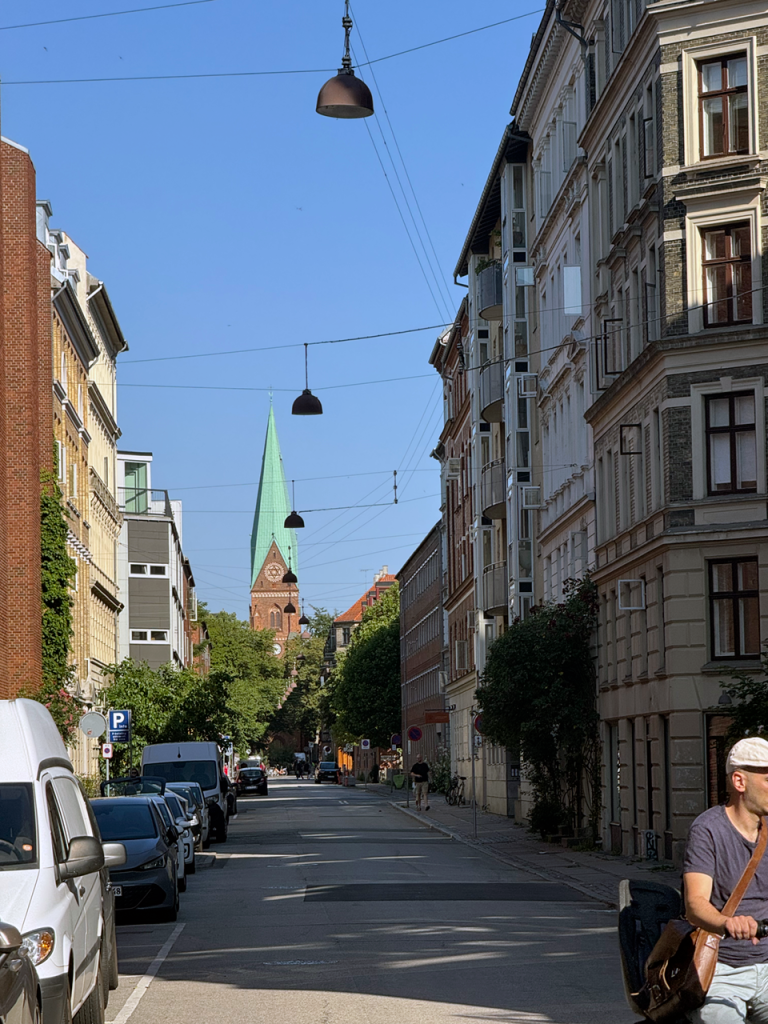
Vesterbro, west of the central station, is one of the brokvarterer, the bridge quarters Copenhagen threw up in a few speculative decades after building outside the old ramparts was finally allowed in the 1850s. The area surrounding Valdemarsgade looks like most of the district does: unassuming five-story brick facades in muted reds and ochres, against which neighbors leave their bicycles (many of the old ones seemed unlocked, or at least I didn’t notice their discreet mechanism at first).
However, what I liked most about our street and many of the others I had the chance to explore a bit was a second, more local, degree of public use beyond each apartment: the shared courtyard. Ours had trees and many bushes buzzing with pollinators and birds, tidy clotheslines and picnic tables that I marveled to see used freely. Neighbors, mostly young, would come into the courtyard to have lunch, dinner, or a drink, carrying their own plates and silverware, then cleaning up after themselves.
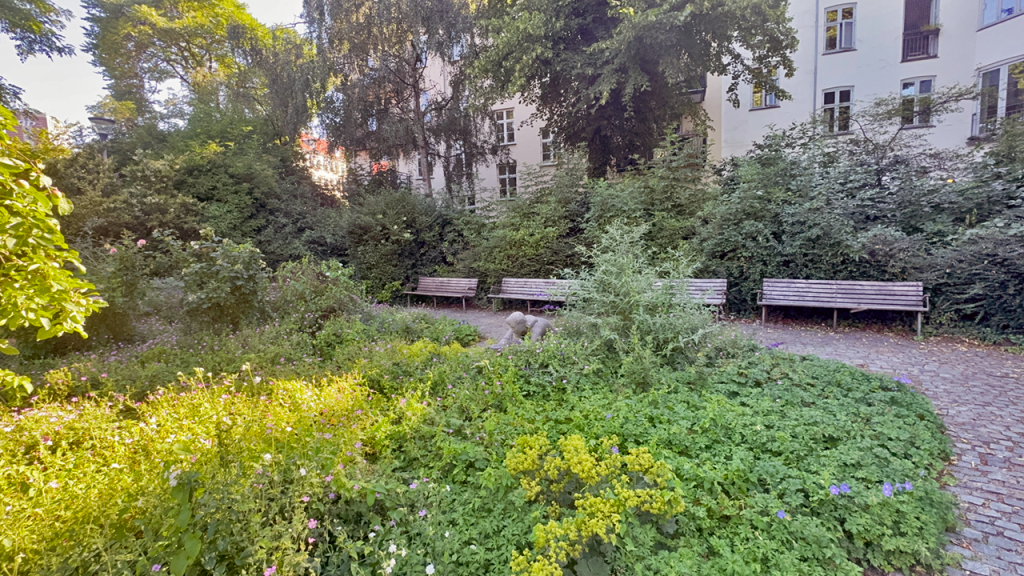
We’ve lived in the city centers of very busy European cities, Barcelona and Paris, and we’ve learned the hard way that such arrangements can only work when whole communities behave.
Trust without a rulebook
I noticed that our Copenhagen courtyard had neither the rule-enforcement lists one sees in US communities with similar arrangements nor the permissiveness that ruins them elsewhere, where no one seems to want to give up the yelling and partying over other people’s right not to be disrupted. This impression is based on a few days, but I saw how every morning and evening the picnic table just outside our kitchen-living room was used by a different group of people each time, and despite having our windows cranked open, we never needed to raise our voices or close the windows.
Upon reading about the same area we were staying in, I realized that these were the same cramped workers’ tenements that had decayed into the city’s no-go area until the early 1990s, when the city undertook one of Europe’s most successful urban renewal programs. Small flats were joined into bigger ones with actual bathrooms, and back buildings came down so the courtyards could breathe. What survived is a district that gentrified without being flattened.
I enjoyed the city, but the apartment gave us a peek into the lives of local youngsters, their literary and musical tastes, their culinary preferences, the shoes and clothes they wear, the pictures they pin to the wall and fridge; that was my favorite part, perhaps because I’m aware of the magic of such early adult years, which our older daughter is already discovering.
The happiest-city question
Our experience in Copenhagen got me curious, so when we flew back to Barcelona, before finally heading to Paris for a few days before returning to California a few days ago, I read a piece by Mike MacEacheran in National Geographic Traveller (UK), written to answer the obvious question: why does this city keep topping happiness rankings?
Apparently, the author spent part of his reporting in a kayak, pulling beer cans and a stray pair of swim trunks out of the Inner Harbor while locals bathed nude off the quays. The boat came from GreenKayak, a nonprofit that lends kayaks for free in exchange for a bucket of collected litter. The detail says more than the rankings do. The harbor of a European capital is clean enough that swimming in it is ordinary, and picking trash out of it feels worth an hour of anyone’s vacation.
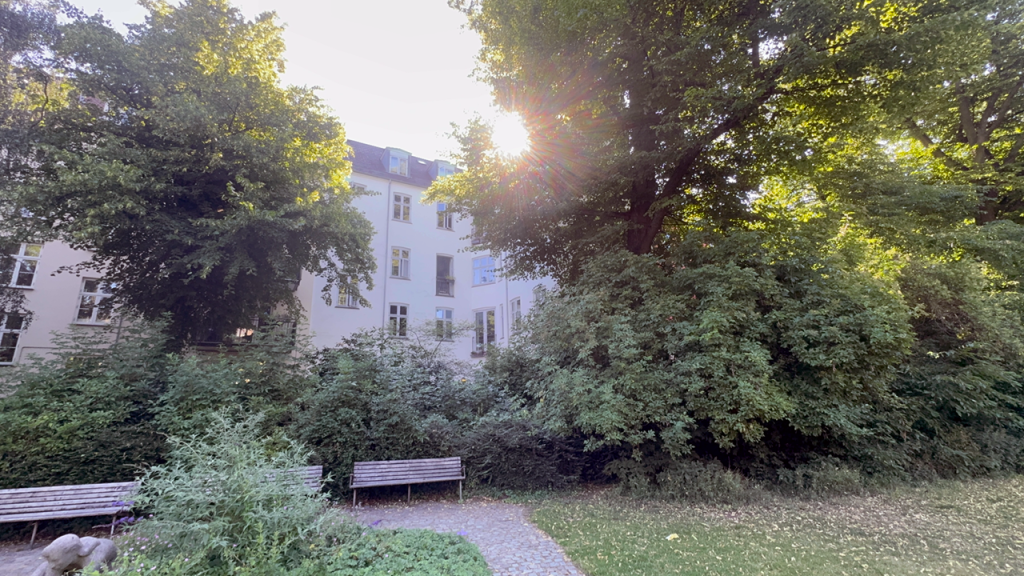
This tells you something: sometimes, you can afford to create shared spaces for everyone to enjoy, without hitting the so-called tragedy of the commons. And, of course, many argue that what places like Copenhagen can do is due to their relatively small size and the fact that they represent the most visible, cosmopolitan side of society that remains comparatively homogeneous and enjoys high levels of development, social coverage, and trust.
But to think that only small, relatively egalitarian high-income countries can create such environments is naïve: it only takes a bit of patience and a car to, for example, visit many small to medium-sized towns and cities in places like Spain to realize the quality of life is as high in many regards. Soria, Logroño, Pontevedra, or Palencia are no cosmopolitan havens, but people there enjoy high-trust environments at a fraction of the price, though, of course, they lack the cosmopolitanism of the more expensive and less gentle Madrid, Barcelona, or Valencia. In California terms, it’d be a bit like comparing San Luis Obispo and Los Angeles.
Tryghed, not happiness
The rankings are real, in any case. The Happy City Index, compiled by the London-based Institute for Quality of Life from 64 indicators, put Copenhagen first again in 2026, ahead of Helsinki (slightly colder and darker in winter months) and the prohibitively expensive Geneva.
Despite its latitude, Denmark has spent a decade at or near the top of the UN’s World Happiness Report (the Happiness Research Institute, the think tank that helped export the word hygge to the world’s bookstores around 2016, keeps its office in the city). Happiness in Copenhagen is almost an industry, which is reason enough for suspicion. That’s why, I was told, Danes themselves rarely use the word.
What comes up instead is tryghed, usually translated as security. Healthcare, university, childcare and unemployment insurance are covered, and the bill is also highlighted by those who argue that European countries, even the most successful ones, lack dynamism: some of the highest income taxes in the world plus a 25 percent VAT on almost everything. Most Danes seem to treat the arrangement less as a sacrifice than as a subscription that renews without drama.
Gehl’s city, Illich’s bicycle
None of that explains why the city feels so good to move through. That part has authors and dates. In 1962 Copenhagen pedestrianized Strøget, its main shopping street, against loud predictions of commercial ruin. A young architect named Jan Gehl began counting what happened next: where people walked and where they lingered. His conclusion, refined over decades in books like Life Between Buildings, was that people attract people, and that postwar cities had been handed to traffic engineers by mistake.
This is the part I most like about certain Northern European cities we’ve visited. Among them, Copenhagen listened earlier and more thoroughly than anywhere else, and it shows in summer, when the weather is nicest and the days long.
Today, most trips to work or school inside the city happen by bicycle, on raised lanes wide enough that eight-year-olds pedal to class next to commuters. Ivan Illich argued in the 1970s that the bicycle was the rare tool that extends human freedom without creating dependence or hierarchy. Copenhagen is the closest thing to a capital built on that idea.
The circle closes
After a few days there, I guess that the rankings measure something humbler than joy: how much friction a city removes from an ordinary day. By that measure, everything we touched pointed the same way, from the bike lanes and the courtyard table to the swimmable harbor and the gravel path around the lakes.
Our haul was modest: a few mid-July days at 22 degrees, and a teenager quietly taking notes on how a Copenhagen twenty-something furnishes a life.
And our hosts, presumably, were somewhere doing the same in reverse, spending July in someone else’s summer. When Copenhagen goes dark by mid-afternoon, some of them will fly south and rent a flat full of strange books in Barcelona or Valencia, and the circle will close.
The European snowbird now flies both ways. The etiquette is identical at either end: swap cities when the season turns, and leave the shelves as you found them.