A bad translation ruined The Odyssey for me in high school. Emily Wilson’s superb English translation brought it back, along with a manual for midlife.
There’s a foundational blueprint in world literature for the “road trip,” the psychological comeback, and the messy process of rebuilding a life in middle age. For these reasons, The Odyssey should be a more popular read for men of all ages, especially those facing difficulties.
For some reason, The Odyssey fell out of favor with young readers a long time ago, even though the story feels modern in many ways. For one, it starts in the middle of a crisis and uses flashbacks to piece together why things unraveled, where the protagonist went for years, and why getting back home is so tricky.
Odysseus also feels human: he’s described as reliant on wit (metis), but he’s also fallible and falls into the usual traps of a man his age. He’s the archetype of the war veteran fighting to avoid deep, justified cynicism about existence as he grows older and more battered.
Homework, not adventure
Somehow, The Odyssey didn’t make it into the competitive world of pop literature the way Tolkien’s books, for example, did. Tell a teenager he is obliged to read an old book about the erratic trip home of a war veteran of a conflict lost to time, and he’ll see it as work, and therefore he’ll seldom enjoy the experience.
This might be because there’s a type of self-reflective travel literature that is more associated with the intricacies of middle age than with hot-blooded masculine initiatory adventures: we can imagine how rhapsodes of the time of Homer would be more successful with young audiences when singing verses of the Iliad due to the glory-seeking adrenaline of battle.
If young men are drawn to the promise of glory of battle, middle-aged men live in the aftermath, which is precisely where The Odyssey begins once the focus leaves his son Telemachus and his wife Penelope, who is fending off suitors pressing her to accept that Odysseus is dead so one of them can marry her. The Odyssey is less an adventure story and more a blueprint for the transition that midlife signifies for men.
A dead language, twice
Perhaps my younger self sensed the book wasn’t for him yet. I certainly struggled with it in high school, when I had to read an antiquated, pedantic and unfortunate translation (into Castilian Spanish), as I chose to take two years of classical Greek.
In my first year, we read The Odyssey and translated some of its passages from the original, and in the second year it was time for The Iliad. Neither experience was as life-defining as other reads at that age.
I never re-read either book; I figured that what I knew about them was enough to get by, and certainly not something I could enjoy or learn from. I was mistaken.
Then, Christopher Nolan’s film came out, which got many people interested in a story I had translated in chunks during high school. Back then, I enjoyed bringing an old portion of a text to life more than reading the whole story, translated by some boring, bored professor in Spain many decades ago, in a language that seemed more dead than the original.
Sometimes, being forced to read a classic in an unfortunate translation packed with erudition but lacking the rhythm and soul of great reads can ruin a potentially initiatory experience for anyone. In a way, we don’t “find” many of the important books, but they find us if and when we are ready for them.
In Why Read the Classics?, Italo Calvino notes that reading in youth can be fruitless, due to impatience, distraction, and lack of experience. I’d add, perhaps especially, every youngster’s need to rebel against what adults and institutions mandate. Force-feeding a book can make it uncool for years. Calvino’s consolation:
“…to read a great book for the first time in one’s maturity is an extraordinary pleasure, different from (though one cannot say greater or lesser than) the pleasure of having read it in one’s youth.”
Back to the singers
I get Calvino’s point, especially as I began reading and enjoying Emily Wilson’s translation of The Odyssey: it’s in blank verse, which on paper could feel a bit demanding and arduous to those not accustomed to verse, but in this case I think the opposite can ring true.
Why? For one, we aren’t even sure Homer was just one person, although we know the person or people we call Homer didn’t compose from scratch but drew on a vast body of oral poetry that was very popular and evolved with language in Greece’s pre-Classical era.
Two Harvard scholars, Milman Parry and Albert Lord, argued, in papers and in Lord’s book The Singer of Tales, that the epics came from a tradition of singers improvising with stock formulas that were easy to memorize, but also modify, reuse, and incrementally enlarge. Not unlike some types of expression teenagers are drawn to.
In other words, Emily Wilson’s translation hasn’t created a new type of work, but has revived the work’s origin, orality, and popular spirit by tapping into a fresh interpretation of the original. To do so, she uses plain, concise English so masterfully that I smiled through some pages, which flew by before me (a sign of seamless connection and engagement with a text I hadn’t felt lately).
Reading Emily Wilson’s The Odyssey feels a bit like listening to music that syncs with the times, a bit like the evolution from old folk music to the likes of Johnny Cash or Bob Dylan, and then acknowledging that the same spoken word evolved into new forms. It’s the same pull that got entire families into the musical Hamilton, regardless of age or cultural baggage.
Da-DUM
Of course, The Odyssey wasn’t originally composed in English. That said, a good translation can really turn something that feels remote and elitist into a text that feels as alive as a good song with lyrics grabbing our attention, and our children’s.
It’s not only about quality and simplicity, which can go a long way: Wilson’s English had to work when read aloud, to begin with, using a proven poetic meter in English, the iambic pentameter: five metrical feet per line, where each foot (here an iamb) pairs an unstressed syllable with a stressed one, giving the succession a rhythmic “heartbeat” cadence: da-DUM da-DUM da-DUM da-DUM da-DUM.
This structure carries the whole cadence of the poem. Here’s the opening:
Tell ME aBOUT a COMPliCATed MAN.
Homer, The Odyssey, translated by Emily Wilson (W. W. Norton, 2018); Book 1, lines 1-3.
Muse, TELL me HOW he WANdered AND was LOST
when HE had WRECKED the HOly TOWN of TROY,
(…)
Wilson wanted a steady beat that could be chanted aloud, like Homer’s lines, so she chose the English meter that comes closest to what his hexameter did in Greek. Iambic pentameter has a long record in English, from William Shakespeare and John Milton to modern musicals, and even (some) folk music and hip hop follow a similar pulse; listen to Bob Dylan, or a good rapper, or Lin-Manuel Miranda’s Hamilton rants, and you aren’t far from those same principles, although not strictly.
All this is to say that a bad translation or bad timing can ruin one’s view of a valuable story for years, or perhaps forever. Cultural critic Walter Benjamin stated that a real translation is transparent, that it does not cover or block the original’s light. The translation I encountered was bad, and certainly not meant for unsophisticated readers and teens (I was both).
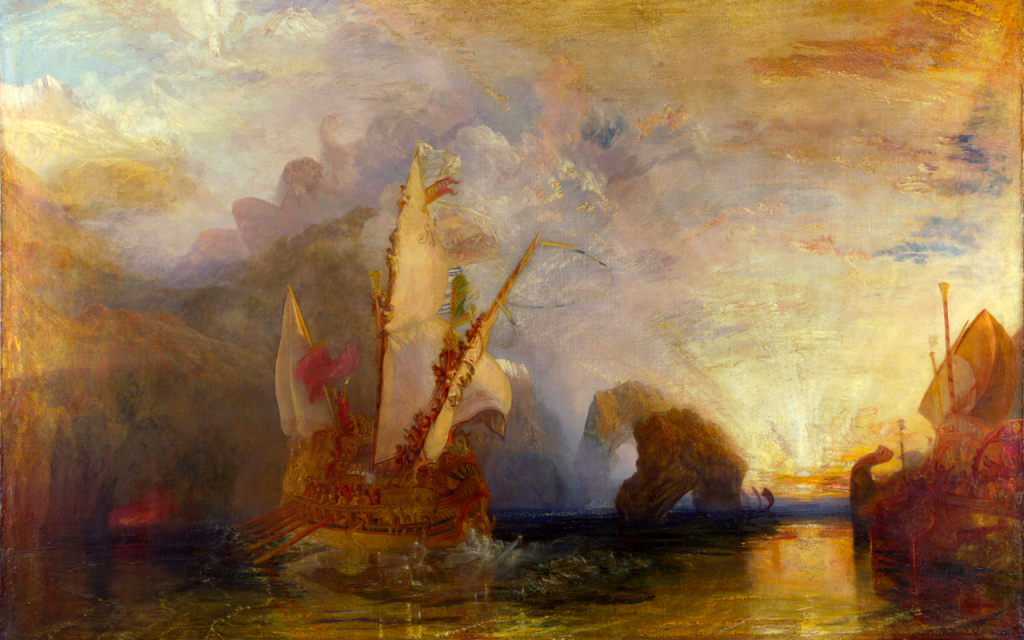
I’ve since been lucky enough to find Emily Wilson’s translation of The Odyssey, which demonstrates that language works best when you stop seeing it and see through it, concentrating on what the author intended you to envision in the first place. Or, as George Orwell put it in Why I Write (1946): “Good prose is like a windowpane.” In this case, good, simple, pristine verse that reads on the fly, just like good prose.
The poem didn’t change
Once I picked up the translation, and even though American English isn’t my mother tongue, the language stopped getting in the way, and I connected to the story. I started noticing things that my 16-year-old self had no way of seeing. Also, as a teenager, I translated chunks of an old poem and only saw strange descriptions of characters, odd repetitions, and a strange failed adventure with monsters.
The original poem hasn’t changed; I have. With a decent translation, the epic I’m reading now is about a man in his forties trying to get his life back and failing for years, until he succeeds.
From this angle, reading it (or listening to it, for those who prefer audiobooks) is better time spent than listening to podcasts and reading self-help titles that recommend dubious supplements and practices.
Seven years on a comfortable island
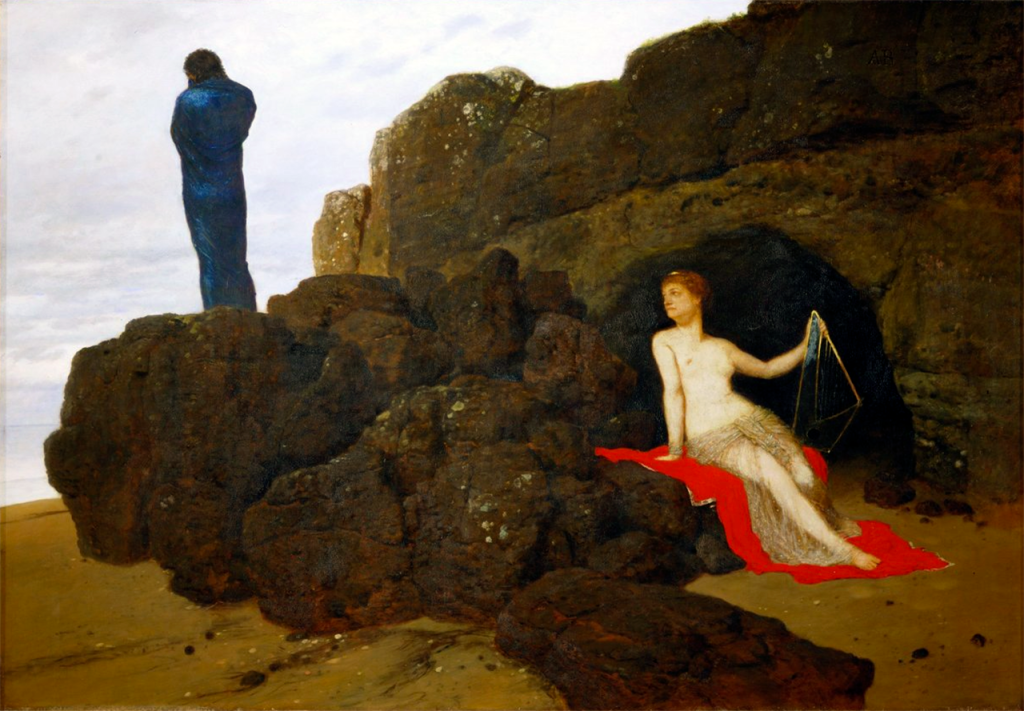
The book is also packed with deep metaphors and explanations that can teach us as much as sacred texts and pivotal philosophy books. In the episodes featuring the nymph Calypso (mainly Book 5), we find Odysseus on her island, and seven years (!) have passed. Calypso offers to make him immortal if he stays, but he wants to leave, crying every day from the shore.
She found him on the shore. His eyes were always
(Book 5, lines 151-158)
tearful; he wept sweet life away, in longing
to go back home, since she no longer pleased him.
He had no choice. He spent his nights with her
inside her hollow cave, not wanting her
though she still wanted him. By day he sat
out on the rocky beach, in tears and grief,
staring in heartbreak at the fruitless sea.
At 16, one reads this as a strange pause in the action, but it now reads like an honest portrait of midlife stagnation: a life that goes by as we immerse ourselves in unimportant errands, when the important stuff (our family, the substantial matters we appreciate) feel ever more remote as we lack the time and energy to enjoy them as they deserve.
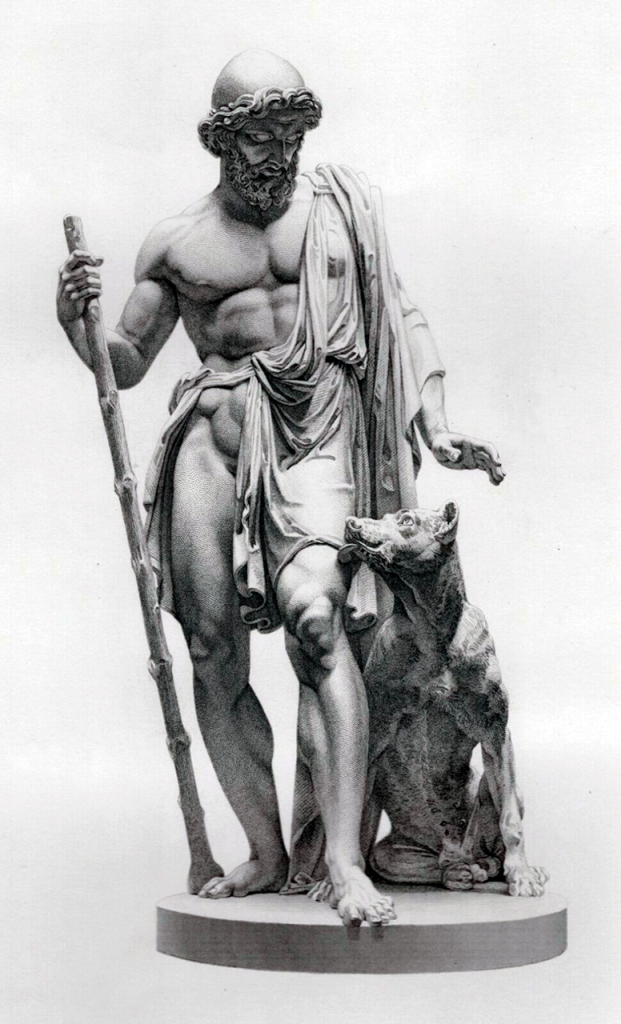
When Odysseus is finally allowed to leave, he chooses to remain mortal. He knows he’ll be aging and will return to his aging wife; he is certain that his house will be in disrepair, and he won’t even know his son. Still, he prefers to go back to it instead of staying on an island enjoying immortality, numb and comfortable.
So Odysseus, with tact,
(Book 5, lines 214-224)
said “Do not be enraged at me, great goddess.
You are quite right. I know my modest wife
Penelope could never match your beauty.
She is human; you are deathless, ageless.
But even so, I want to go back home,
and every day I hope that day will come.
If some god strikes me on the wine-dark sea,
I will endure it. By now I am used
to suffering—I have gone through so much,
at sea and the war. Let this come too.”
The sweet fruit of forgetting
Later, as a guest of the Phaeacians (a seafaring people who take in strangers), Odysseus tells how it all went wrong, starting with the Lotus-eaters (lotophagi). Despite being the shortest episode in the book, it’s the most modern and memorable, and a precursor of Aldous Huxley’s Brave New World (or Irvine Welsh’s Trainspotting, among other works on postmodern addiction and alienation).
The lotus-eaters live in a land dominated by a plant that bears “sweet delicious fruit,” which narcotizes them. No wonder the men Odysseus sends ahead take the fruit and forget they ever wanted to go home. They aren’t visibly harmed; they are just taking something that erases their sense of belonging and purpose, making them content. And that’s the danger. Odysseus has to haul his men back and tie them down.
(…)
(Book 9, lines 94-103)
they lost the will to come back and bring news
to me. They wanted only to stay there,
feeding on lotus with the Lotus-Eaters.
They had forgotten home. I dragged them back
in tears, forced them on board the hollow ships,
pushed them below the decks, and tied them up.
I told the other men, the loyal ones,
to get back in the ships, so no one else
would taste the lotus and forget about
our destination. (…)
When we imagine Odysseus pulling his men away from the lotus-eaters, we also imagine some of the struggles of postmodern society, when families try to pull their relatives from cults. Or think of the end of Apocalypse Now.
In Francis Ford Coppola’s film, Lance (the surfer on Captain Willard’s boat) has painted his face and gone rogue, is high most of the time, and has drifted into Kurtz’s compound as if he belongs there. After killing Colonel Kurtz (Marlon Brando’s character), Willard walks through the crowd and takes Lance by the hand, leading him to the boat. That’s Odysseus dragging his men back to the ships.
Many middle-aged people (and many army veterans) have lost long periods of time under the influence of substances that make them numb, hence the warning in the lotus-eaters episode. Odysseus never tastes the fruit, but he knows how easily his men could stay in that no man’s land of narcosis, and perhaps he could too.
The man who couldn’t stay Nobody
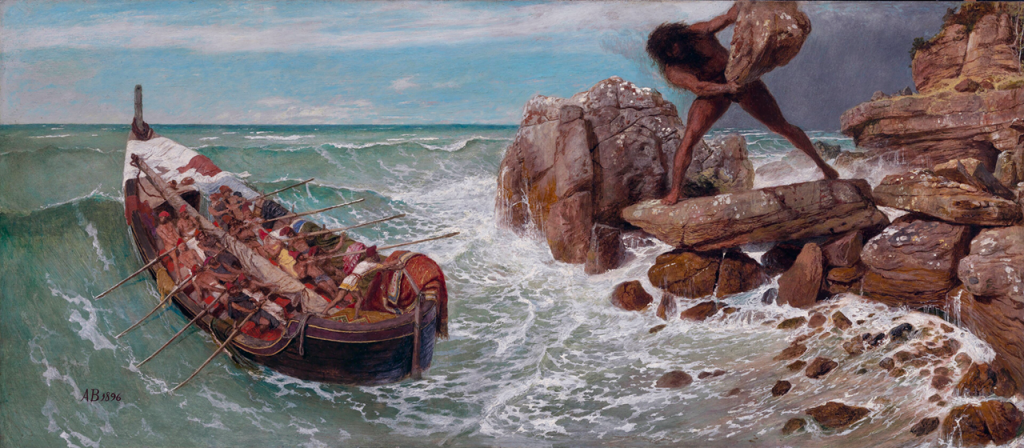
It’s a short passage that leads to the Cyclops, which is where Odysseus’s wit first saves him, but his ego nearly ruins him for good. We all know, or at least have some idea of, what happens: he tells one-eyed Polyphemus his name is Nobody, blinds him, and escapes.
So when the Cyclops is asked who did that to him, he says Nobody; it could have been the end of it, but upon escaping he shouts his real name back at the island, which will cost him years of wandering at sea and every one of his men, once Poseidon, Polyphemus’s father, punishes him.
‘Cyclops! If any mortal asks you how
(Book 9, lines 502-506)
your eye was mutilated and made blind,
say that Odysseus, the city-sacker,
Laertes’ son, who lives in Ithaca,
destroyed your sight.’
A stranger in his own house
It takes this improbable middle-aged hero every ounce of his inner strength and resolve to truly approach home. Athena (who at the book’s beginning advises Telemachus on how to get rid of his mother’s suitors) disguises Odysseus as an old beggar so he can return safely to Ithaca, and he walks into his own house as a stranger.
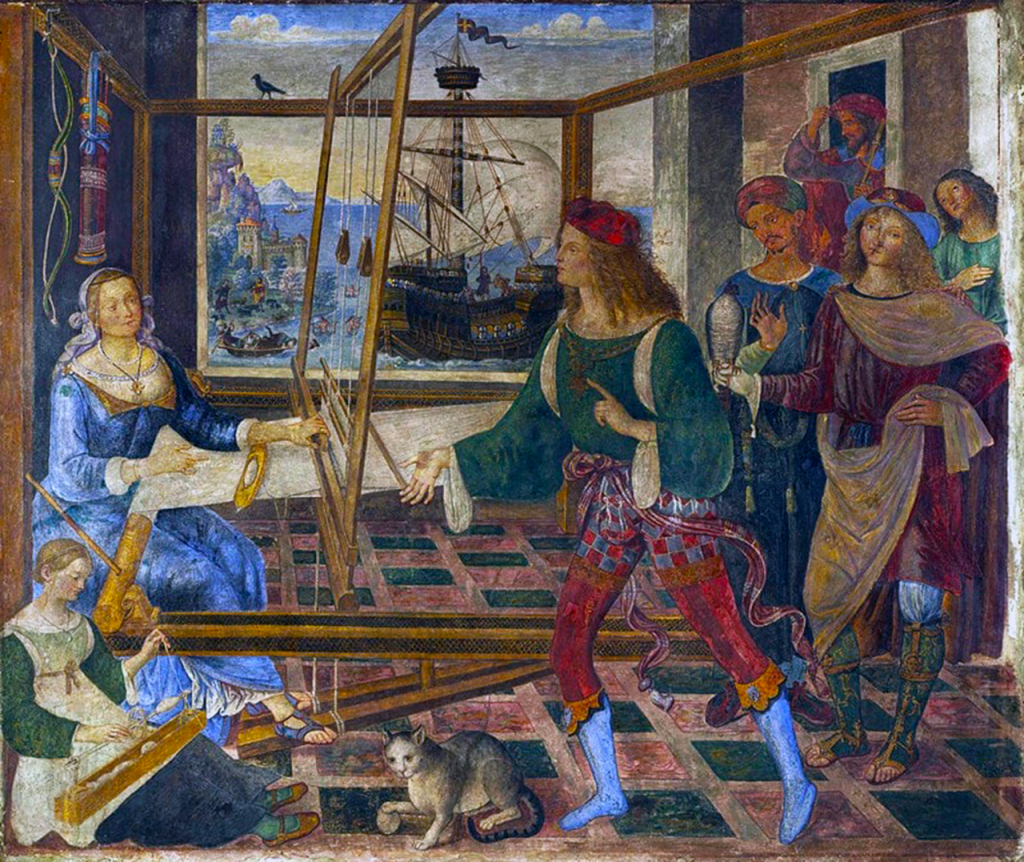
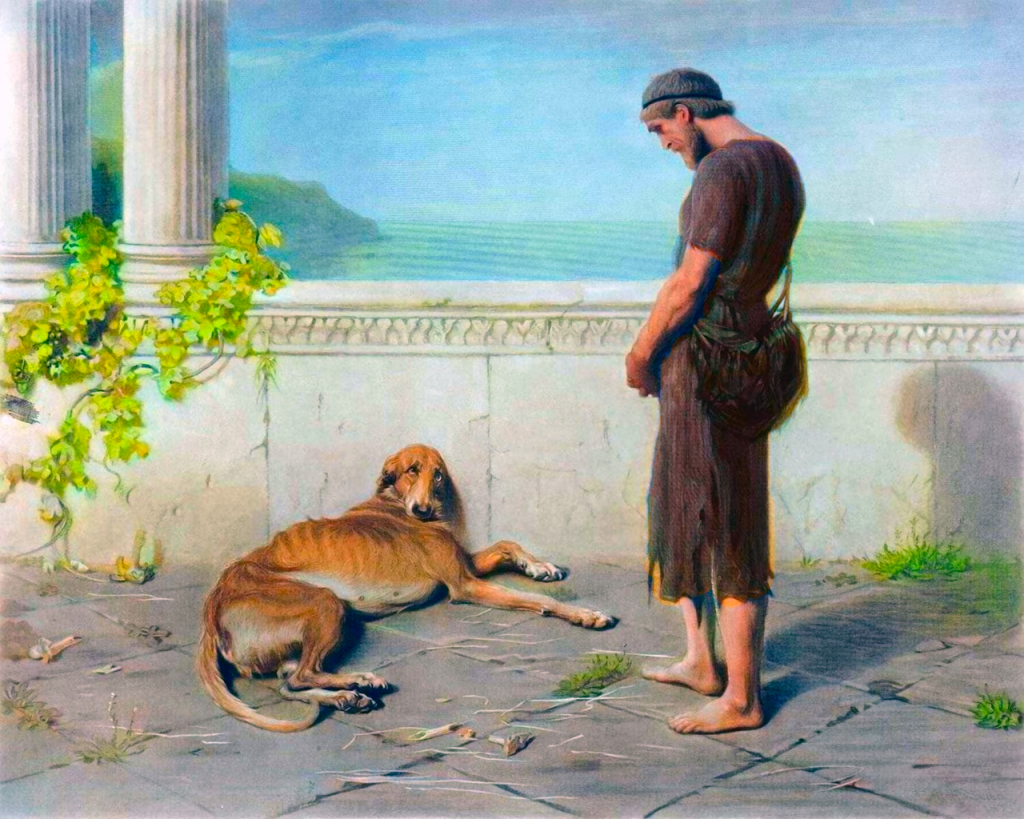
The suitors mock the beggar, throwing things at him, making him beg for scraps at his own table. His old dog, Argos, lying neglected on a dung heap at the gate, is the only one the hero can’t fool: the dog wags his tail when he recognizes his master, and dies, a credible thing for a loyal dog to do.
When we think of Argos, we imagine an old, noble dog (influenced perhaps by our image of Odysseus).
As they spoke,
(Book 17, lines 290-306)
Argos, the dog that lay there, raised his head
and ears. Odysseus had trained this dog
but with no benefit—he left too soon
to march on holy Troy. The master gone,
boys took the puppy out to hunt wild goats
and deer and hares. But now he lay neglected,
without an owner, in a pile of dung
from mules and cows—the slaves stored heaps of it
outside the door, until they fertilized
the large estate. So Argos lay there dirty,
covered with fleas. And when he realized
Odysseus was near, he wagged his tail,
and both his ears dropped back. He was too weak
to move towards his master. At a distance,
Odysseus had noticed, and he wiped
his tears away and hid them easily,
(…)
Odysseus fights the impulse to go and mourn the loyal animal, but he stays put and wipes a tear, for it’s not yet time to reveal who he is. It’s not a triumphant return. It’s slow, careful work. And even after he kills the suitors, Penelope tests him with a piece of furniture built by her husband with a secret only he would know.
“Woman! Your words have cut my heart! Who moved
(Book 23, lines 183-205)
my bed? It would be difficult for even
a master craftsman—though a god could do it
with ease. No man, however young and strong,
could pry it out. There’s a trick to how
this bed was made. I made it, no one else.
Inside the court there grew an olive tree
with delicate long leaves, full-grown and green,
as sturdy as a pillar, and I built
the room around it. I packed stones together,
and fixed a roof and fitted doors. At last
I trimmed the olive tree and used my bronze
to cut the branches off from root to tip
and planed it down and skillfully transformed
the trunk into a bedpost. With a drill,
I bored right through it. This was my first bedpost,
and then I made the other three, inlaid
with gold and silver and with ivory.
I stretched ox-leather straps across, dyed purple.
Now I have told the secret trick, the token.
But woman, wife, I do not know if someone—
a man—has cut the olive trunk and moved
my bed, or if it is still safe.”
All this doesn’t seem to be what a contemporary teenager would want from a story: it’s full of digressions, and it explains how a tired war veteran has to earn back, person by person, the trust that he had amassed many years before.
But that’s perhaps what rebuilding a life looks like at a certain age: you come back changed to a place that also changed without you, and you have to prove who you are to people who once took it for granted.
Late, but on time
Maybe that’s what Calvino meant. I just wasn’t the reader the book was waiting for. It contains many possibilities if you want to go for it. It includes passages that sound like Aesop’s fables, while others are as modern as Don Quixote (often considered the first modern novel); there are also fantasy and sci-fi passages and Tolkien-worthy moments, along with more obscure, Joseph Conrad-like parts.
It’s all there. You just have to let the light through it and be lucky with the translation, and you’ll find that many writers might have taken inspiration from it.