Rivers have a profound meaning in all civilizations, and any American, no matter the origin or ideology, will identify with the symbolic force of the Mississippi and its tributaries, in a collection of references going back to the Pre-Socratic philosophers, the Abrahamic sacred texts, epic stories and poems by the likes of Mark Twain and T.S. Eliot, and many, many pop culture references.
In the Old World, symbolically, rivers are borders and connections, rites of passage from one borderland to another, and head-and-tail rites of passage between the living and the afterlife. The Styx river was the primary boundary separating the living from the Underworld.
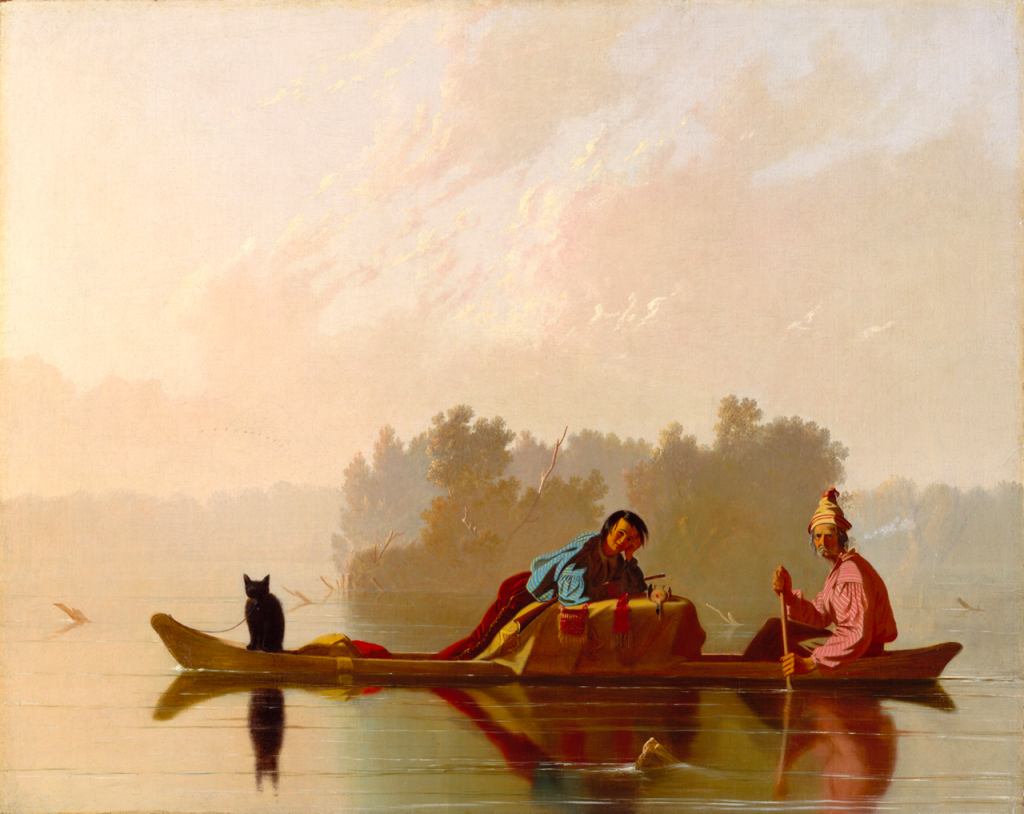
In the old Mississippian cosmos shared by many Native American tribes, rivers were a doorway connecting the visible world inhabited by humans and a more chaotic Beneath World, home of the Underwater Panther and the horned serpent, among other creatures. These beings, and their unleashed forces, entered the human world through springs, rivers, and lakes.
Untamed riverways and the American soul
T.S. Eliot, an American poet with an Anglicized accent that many relate only to the East Coast and London, was born in St. Louis, a mere four blocks from the river on 2635 Locust Street.
He opens his poem The Dry Salvages with a reference to the river force as an ancient, powerful, “strong brown god.”
I do not know much about gods; but I think that the river
The Dry Salvages, T.S. Eliot
Is a strong brown god—sullen, untamed and intractable,
Patient to some degree, at first recognised as a frontier;
Useful, untrustworthy, as a conveyor of commerce;
Then only a problem confronting the builder of bridges.
The Mississippi at St. Louis is famously silt-laden and brown, unlike the blue or green New England rivers. Yet he never forgot the muddy, fertile, time-bound American river of his childhood, never completely tamed, civilized, a blend of all the tributaries and their peoples from time immemorial.
The river, like the fields, ruined factories, dams, cities, and growing forests around it and its tributaries, recognizes the force of the ancient god but also carries a different stewardship strategy from pre-Columbian times to the present.
The portrait is hollowed out in some of its symbolic elements but always present, one way or another: the forgotten original Native American cities, surrounded by trails and fields interplanted with different types of corn, beans, and squash (three sisters), arranged on the river shores as some sort of early (original?) permaculture experiment, the constant fires to promote pastures and hunting grounds, the arrival of the first European travelers, the pioneer settlements and the subsequent Trail of Tears to displace 60,000 natives from the “five civilized tribes”… Finally, modernity transforming the big old river into the biggest navigable artery of a new country, spanning from the Gulf of * to the Great Lakes, the river St. Lawrence and the Atlantic shores of Terranova (a Latin name that checks with me, buried nowadays by the use of a more proper Newfoundland): agricultural and industrial heartland, first; monocrop empire and decaying Rust Belt in a later incarnation.
All happened around the river as the people, the cuisine, the music, the stories, the travels (on canoes, boats, steamboats, shantyboats) kept pushing their action downstream, as a sediment down to New Orleans and into the sea.
Secondary roads and old calendars
In the past few months, we’ve traveled extensively across several US states, both in the West and also across a decent chunk of the core Mississippi Basin region between Appalachia to the east and the western downslope of the Ozark Mountains, a rugged area that has shaped the character of both natives and settlers later on. The trip got me thinking about the complex, convoluted, polarized narratives of the United States in a year that should be celebratory, yet so far looks anything but.
The Ozarks, and also the Ouachita Mountains, another ancient fold-and-thrust mountain range with occasional rock formations, are their very own world of greenery, rolling hills, and varied accents that I only knew about through a few loose cultural references. Their tree-covered, deer-and-armadillo-packed, tick-infested, crumbled appearance is best described by a line from a mountaineer character in Harold Bell Wright’s The Shepherd of the Hills (1907):
“Ain’t nothin’ to a flat country nohow. A man jes naturally wear hisself plumb out a walkin’ on a level ‘thout ary downhill t’ spell him. An’ then look how much more there is of hit! Take forty acres o’ flat now an’ hit’s jest a forty, but you take forty acres o’ this here Ozark country an’ God ‘lmighty only knows how much ‘twould be if hit war rolled out flat. ‘Taint no wonder ‘t all, God rested when he made these here hills; he jes naturally had t’ quit, fer he done his beatenest an’ war plumb gin out.”
I was glad to right that wrong and get to know an area that still appreciates the rituals of analog living, where things feel slow and affordable compared to virtually any other outdoorsy region of North America with stunning, raw natural beauty.
One such reference I got from the travel writer William Least Heat-Moon, which mainly skips the region for good but has one reference that got me thinking. I recall Least Heat-Moon’s “calendar rule” when it comes to finding authentic venues to make meaningful stops when one travels, like those dusty cafés with memorable owners that don’t feel like one just keeps hitting the same bland non-place, for they all are one and the same.
I wonder whether his method for finding actual venues back in the seventies would hold today, perhaps using another tenet; for example, he sorts good small-town cafes from bad ones by counting the number and variety of wall calendars, recalling one time (from a pre-trip experience) when he got lucky passing by:
“One time I found a six-calendar cafe in the Ozarks, which served fried chicken, peach pie, and chocolate malts, that left me searching for another ever since.”
Reading the room in the heartland
Unlike with many other places I’ve also visited, I gladly realized that the old formations of crumbling rock west of Appalachia preserve a local character despite the universal advancement of the colorless, predictable array of businesses sprawling strategically all over.
During our travels, I rarely need to look for the long-gone mom-and-pop businesses where Least Heat-Moon was trying to get the pulse from a country, as many of the ones remaining are there just to commemorate what they once were. Nonetheless, we also visit places to document their people, and I’m also in the dubious business of trying to put stories together: there are many other ways to find and enjoy what places have to offer in particular. So, even as I try to focus on our work as much as possible, there are always parts of the experience that make us feel connected to what we see, read, hear about.
I wonder if Least Heat-Moon would make sense of it all in a book about America as rounded as Blue Highways, were he to start his journey in Columbia, Missouri, at the time you’re reading this text.
During the trip to an area that has fallen mostly in Republican hands, I’ve come to realize that this is an odd year to many people; and, wandering around the core of North America’s biggest river basin, the small towns we went through didn’t seem to be getting ready for something to cheer for amid cost-of-living hikes and many controversies, big and small. I saw little display of enthusiasm, little bragging. Fortunately, I met many worthy people, and we didn’t waste a second talking about all the things going badly, getting to know instead the places, gardens, flora and fauna, and the people (the salt of the Earth, as Brazilian photographer Sebastião Salgado reminded us) above all.
After driving quite a lot across small towns and on “blue highways,” I’ve seen little to zero references to the upcoming FIFA World Cup, which in rural America feels like what it is: an event agreed upon before our present delicate geopolitical moment, trying to bring together the three organizers (the US, Canada, and Mexico), and not setting them apart, each one with its own agenda, uncoordinated with the other two.
The apathy may vanish once the event starts, for it brings people together in a similar fashion that only the Olympics can do at such a global scale. Not surprisingly to anyone at this point, initial projections of international visitors attending World Cup matches in the US won’t be met amid a climate of fear, strict immigration policies, travel bans, and high costs.
The lack of references to the World Cup didn’t come as a surprise. What’s perhaps more extraordinary is that I’ve also seen little enthusiasm or preparatory buildup around the country’s 250th birthday, which will happen on July 4, 2026, which I read as a giant “read the room” sign to anyone trying to be overly celebratory ahead of time.
The other St. Louis
The cost of gas or groceries seems more important to many, whereas the word “celebratory” doesn’t fit the zeitgeist amid the quagmire of the Iran War. Whatever it is that concerns people in the areas we drove through, as we moved across secondary roads for hours at a time, we saw few signs that display celebration or concern (or protest).
I’m always glad to visit places from the American heartland, so I get to know people and walk forests and towns, check which magazines and papers are passed around at local grocery stores, and just try to get a pulse of things going before my eyes. I learned a good deal of trivial things, among them that the Spanish national team will set up their base camp in Chattanooga, Tennessee, at the Baylor School.
We drove near this place during our travels, though we soon headed northwest through Nashville and then Cairo, Illinois, at the confluence of the Ohio and the Mississippi River, taking small roads to the west and into the Ozarks in Missouri and Arkansas to the south. I was impressed by the vegetation, which reminded me of the tree-covered routes across the East Coast and South: the never-ending woods, slope after slope, the shades of green, and the almost vicious will to live and push forward of insects and life. And yes, some venomous snakes on the Tennessee River banks early on during the trip, and ticks, many, many ticks in the Ozarks to the west.
The forests and insects of today in vast areas of North America, which behave much more aggressively than, say, in the European wilderness, explain the story of the country celebrating its 250 years of existence. Curiously, we didn’t meet any Native Americans on our trip, but the thick forests and wildlife of today in many of the areas we visited are the byproduct of the controlled burns they performed on many of their prime hunting grounds like the Ozarks and Ouachita Mountains.
And so, the hollowed-out shape of their absence is felt everywhere: by managing the game on the mountains and valleys along the Mississippi basin, they allowed the megafauna to thrive and roam around, creating the largest cities before the arrival of Europeans not far from the places we visited. Cahokia, in Illinois facing St. Louis on the eastern shore of the Mississippi, was at its peak (1100 CE) larger than London at the time, boasting a population of 15,000 to 20,000 residents, with advanced urban planning and over 100 earthen mounds.
Hernando de Soto’s Ozarks
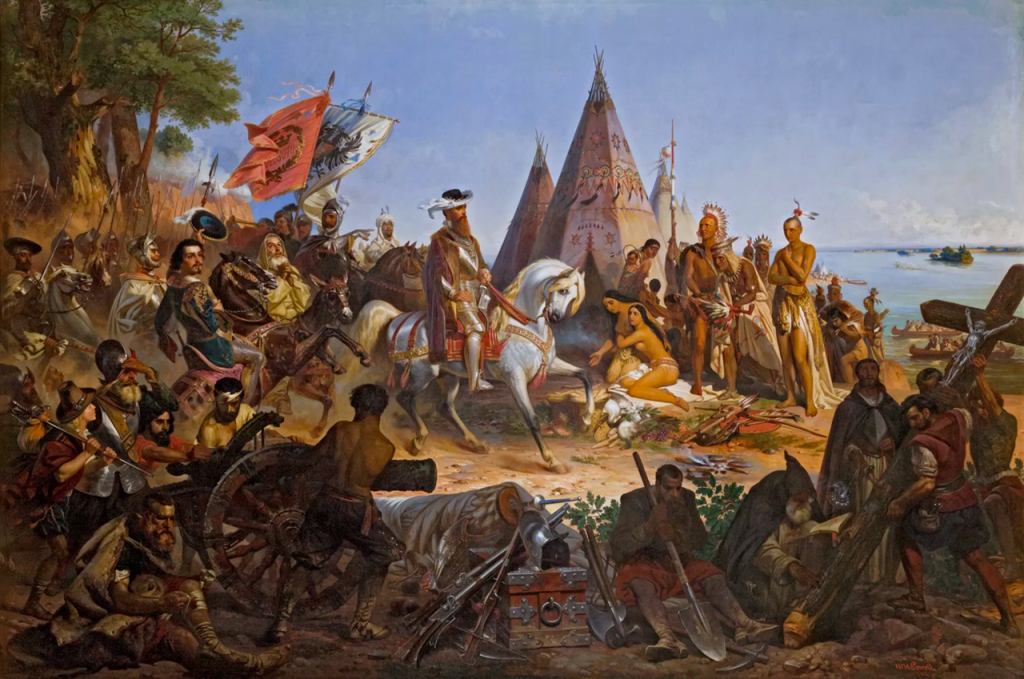
During our trip, we met several people who navigated plants and trees from the surroundings with such a command that I felt immersed in a field trip each time I stepped outside. It was easy to blend the references of the early Spanish expedition to the area by Hernando de Soto (especially as I learned that he died of fever beside the Mississippi in 1542, also in May, or 484 years ago) and their encounter with the local tribes (after reading books like Charles C. Mann’s 1491 or Jared Diamond’s Guns, Germs, and Steel, I’m sure European infections had preceded De Soto’s greetings to the already decimated locals), the French nameplaces reminding Americans of the Louisiana Purchase…
This trip got me thinking of whether I have a personal perspective on the US’ 250th anniversary of the Declaration of Independence, as I decided to marry an American and raised three dual Spanish-American kids. So, now my very patchy, biased part of the story, which has to do with Northern California more than the American heartland.
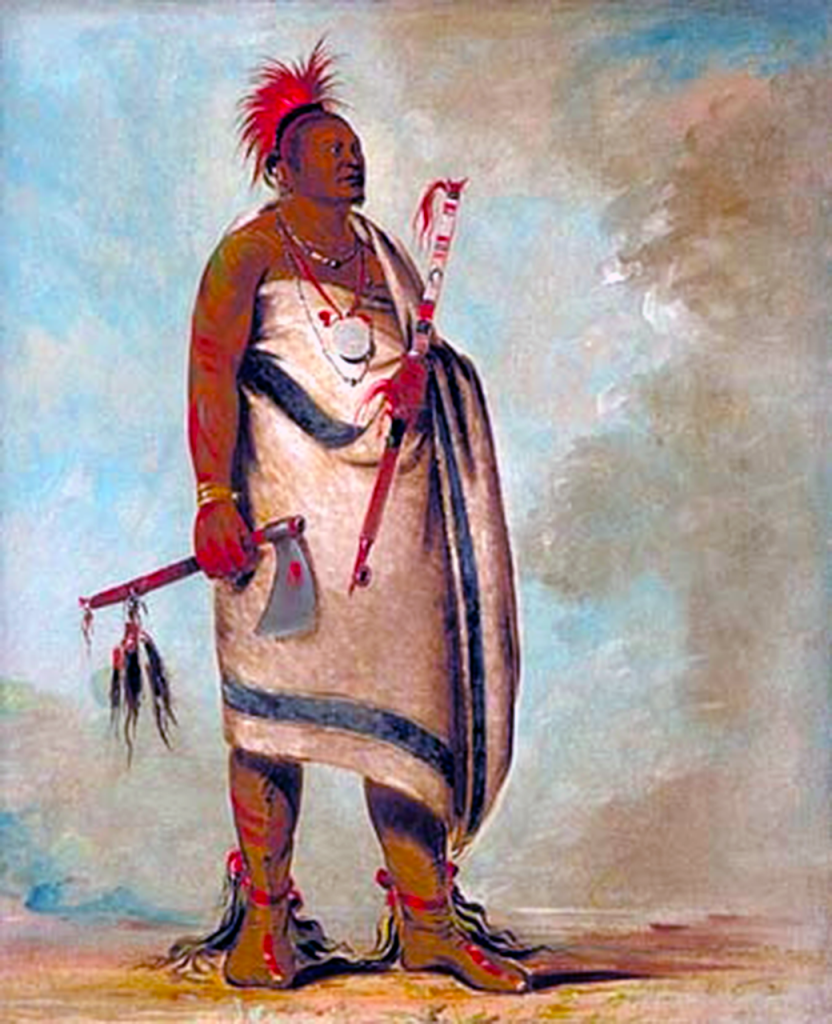
As the old Revolution discourse gets vindicated, it’s safe to say that no one will be concerned on highlighting the different souls of this country, as well as its old traces of the French Louisiana or Spanish America parts that merged into the Union; people like Whitman (see The Spanish Element in Our Nationality, July 20, 1883) didn’t have any issue recalling this heritage and wondered whether Spanish and other elements present then in the continent were also a part of the American experiment:
“We Americans have yet to really learn our own antecedents.”
Maybe Whitman was woke “avant la lettre,” y’all?
However, this debate closed a long time ago, and the fear of immigration (contamination?) has also affected the language of Cervantes. Make no mistake, the semiquincentennial celebration will be very East Coast, very English-language, very “heritage” driven. But only the right kind of heritage, it seems, which isn’t something new, only now it’s blatantly clear.
Back to the West Coast
My version of 1776 is more nuanced, and I once wrote a historical fiction book called Triskelion to explain it. It dwells in the simple fact that European Empires didn’t give much importance first to North America, as it was more dangerous and difficult to manage cash crops as it was in the Caribbean (for a while, Saint Domingue—current Haiti—, the most productive colony for a long time, provided France with the biggest part of its GDP), but then fought strategically to control the possible routes potentially opening navigable passage to the Pacific Ocean, as well as the fur trades.
So, when in Philadelphia on July 4, 1776, the Continental Congress declared the independence of the then Thirteen Colonies, the Spaniards were just a few weeks from founding the Presidio of San Francisco, just half an hour from our current residence. They registered it on September 17, 1776.
Three weeks later, on October 9, Mission San Francisco de Asís—Mission Dolores—was founded inland, not far from there. Same year, same continent, two opposite political acts: one nation being born by separation from a still-rising empire; another empire, a dwindling one, reaching its northern California limit to avoid incursions down the coast by the Russians (from the north) and the British.
Now, as it happens, Kirsten’s California side (her dad, of full German heritage) has its roots in Sausalito, whereas her mother’s side (Anglo-Saxon roots going back to the early colonial era, settled in New Hampshire) is a part of my skewed perception of this celebratory year.
Back to the Spanish early settlement of San Francisco in 1776: The expedition that founded San Francisco was led by Juan Bautista de Anza, born in Sonora to a father from Hernani in the Basque province of Gipuzkoa. His lieutenant, José Joaquín Moraga, raised the Presidio (always a church first, then a jail) in September of the same year. They quickly named many memorable places and accidents, so it doesn’t surprise me that, as they looked across the strait from the new fort, they spotted a nice little willow grove, a “Sauzalito” in Spanish. The toponym has outlived every government that owned it since.
Semiquincentennial
Spain entered the war in 1779 as a co-belligerent, since any enemy of Britain was potentially an ally of the French and the Spaniards in North America. Bernardo de Gálvez, governor of Spanish Louisiana, opened a southern front and took Mobile and Pensacola from the British. So there you go: Spain was, in those years, the only power simultaneously settling new ground in North America for its own crown and fighting Britain alongside the rebels. Yet, to the country’s collective unconscious, it’s France the only actual significant ally.
Of course, those three consequential events (Philadelphia in July 1776, San Francisco in September and October of the same year) are never in the same textbook, for they don’t belong to a sole narrative. But my family doesn’t belong to a single narrative, either. Not even Kirsten is fully the type of “heritage” American poised to be the poster child of the celebration next July 4: descendants of the Anglo-Saxon population of the Thirteen Colonies, for she’s half German (Frisian, very close to Denmark) from her dad’s side.
Our children will end up tapping into the mentioned stories and many others, for there’s nothing exclusive or exclusivist about the American experiment, no matter the efforts to make it so.
Following the intermingling paths of both the official history of this country and our family history (the people we come from, the places we’ve lived). In a way, the three stories I mentioned meet now in a Berkeley kitchen, when a father from Iberia and a mother from the Sausalito-German and the New Hampshire-Yankee lines are raising children who carry, in a way, every leg of the triangle.
That’s why it made sense to end this article from San Francisco, standing on the Presidio bluff and looking across to Sausalito.
By the way, the secret treaty that transferred Louisiana from France to Spain in 1763, which set up Gálvez’s whole southern campaign as an American rebel 16 years later, was signed in the Palace of Fontainebleau, a prequel to the Revolution nobody references, with ties to a village where we lived as a family for a few years.
History is never only on the books, as many families know in way more painful circumstances than us. Imagine being wiped out, walking across the Ozarks during the Trail of Tears; imagine having been brought to a new continent as a piece of property; imagine descending from the people who built the first transcontinental railway and remained non-citizens for generations, as it happens now with many people whose ancestors were probably in US territory before the first Columbus travel, before the Basque and English cod fishers that kept Newfoundland to themselves for generations, before the Norse trips to Vinland.
Those and many others and their descendants, as Americans as you and my wife or kids.