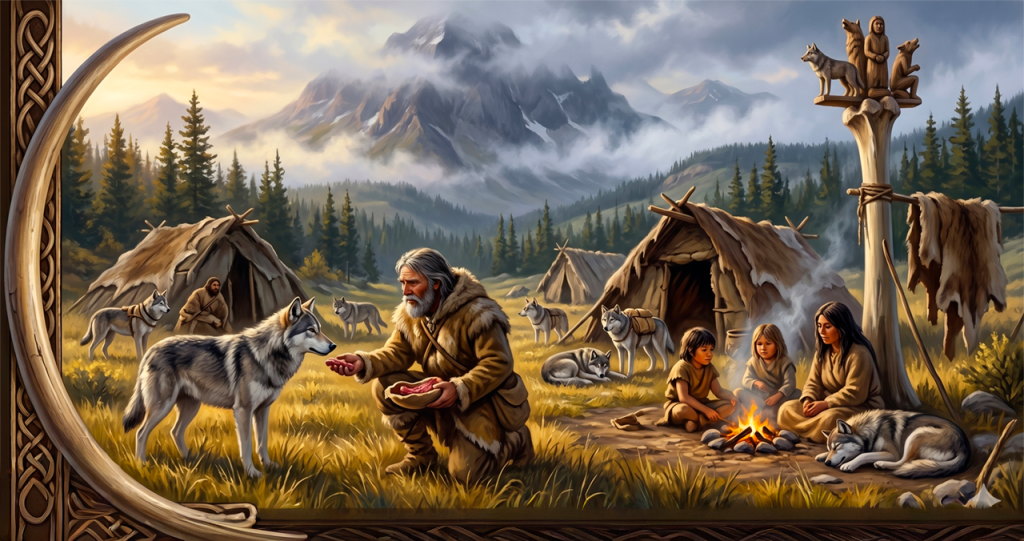
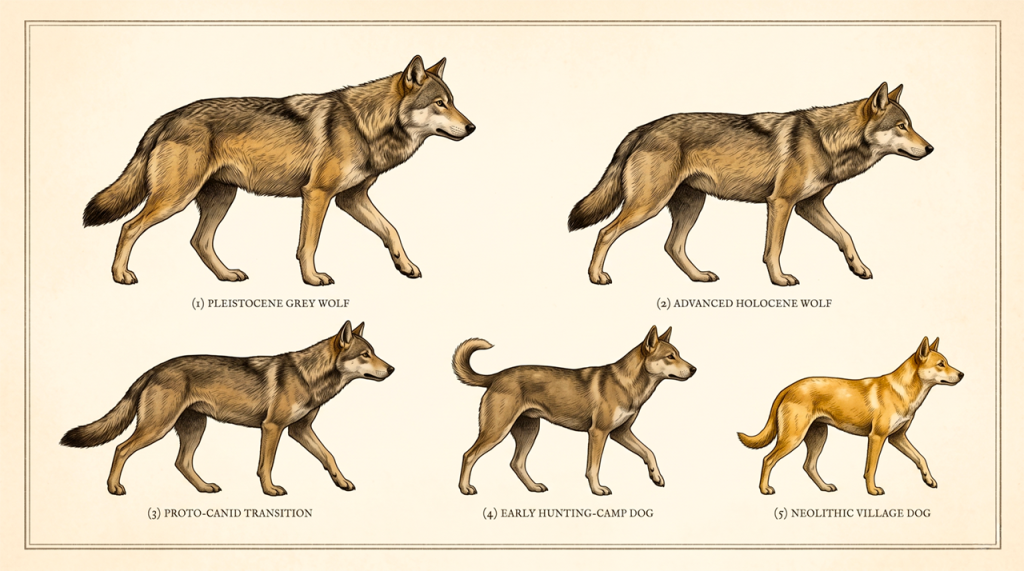
Long before agriculture, some wolves began moving closer to humans. Thousands of years later, dogs remain our most intimate companions.
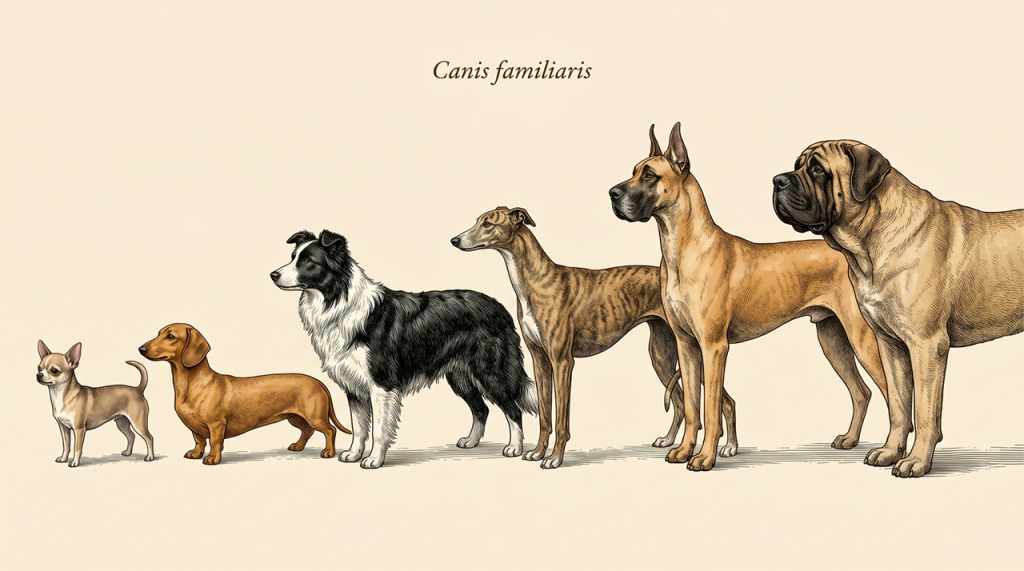
Many things fascinate us about dogs. There’s no other species that shows a greater willingness to be reshaped by humans, from their character to their very morphology.
No other domestic animal exists in such radical morphological extremes. A Chihuahua and a Great Dane are members of the same species.
I don’t want to play the tiny violin of life remorse, but one of the downsides of traveling often and spending long summers abroad, because we have family and friends on other continents, is that our family has purposefully missed out on something: having a pet.
Dogs walking owners
And, when it comes to domestic animals, there’s one species above all others, so loyal to us and noble that it can sometimes border on annoyance: dogs.
I’m not talking about online trends showing how people can mistake pets for people and overspend, let alone force society to put up with their animals, as they often want their dogs allowed inside public establishments. If some people can barely tolerate dealing with other people’s children around them in restaurants, should they be forced to have other people’s dogs by their side as they buy groceries, travel, eat out, or go to the movies?
I’m referring to the broad relation inter-species since the dawn of time. For some reason, our ancestors and the ancestors of dogs, wild canids most closely related to today’s remaining wolf species, chose to “collaborate” rather than have humans domesticate passive wolves to turn them into a food source, as humans did with many other species.
We all know a few dogs
Kirsten, who has six siblings, grew up in the Bay Area without a dog. My family didn’t own one when we were young either.
I still remember how one summer, as the vacations came to an end and, like many people in Spain, we had to go back home to the Barcelona area from the small town of one of my parents’ ancestors that we visited every year, a relative gave us kids a puppy, and we tried to convince our parents to take it home with us to our place in the city. It didn’t go our way, and the experience must have left its mark, for I still remember it vividly.
Finally, we got a dog when we were already teens. Our dog was a small one, a rescue Yorkshire-ish puppy, and she grew to be part of the family, seeing us leave the family nest and cheering our weekend visits as only dogs can. Then she died when we already had children, and my parents decided not to have any more pets.
Dogs in mythology, dogs in memory
My parents’ official reason was somewhat cold-blooded and pragmatic: dogs are a responsibility, and they suffer from travel, which they also do once or twice a year. Years later, I got the real motive: their pet had been a part of their family, living with us as we left the house, and it reminded them of that part of life, which Kirsten and I are now entering, when one has achieved financial stability and still feels young and energetic, though other people might not consider you “young” anymore.
My parents didn’t see that particular “dog” as just any pet that could be easily swapped for another; it was much more than that. So perhaps one way to stay loyal to those memories was not to adopt any other puppy. I wonder if there are any studies on how people’s relationships with their pets relate to the idea of impermanence: pets’ lifespans are much shorter than ours, and we also face our own mortality when we see them fade away four times as fast.
Many stories — known and private — about our intimate relationship with dogs abound across cultures and eras; dogs are present in mythology and in archaeological remains. The Odyssey, a book memorized and recited by Rhapsodes and hence close to cultural tradition, skilfully expresses the symbiotic relationship as Odysseus returns to Ithaca disguised as a beggar, so transformed that nobody, including his wife and son, recognizes him. But he doesn’t trick Argos, the old neglected dog he’d left as a puppy to go to war. Upon arrival, the dog lifts his head, wags his tail, and dies.
But dogs’ ability to stand by their owners isn’t a matter of mythology. There are many stories about dogs’ loyalty (even after their owners’ deaths) and their ability to sacrifice themselves to protect their human companions. Social media companies know that, and there’s a reason why AI videos are trying to replicate this deeply ingrained, reciprocal empathy of dogs and humans: people just fall for it because they’ve been around dogs, and also because our society —many sociologists would argue— often tilts towards alienation and hostility, so a companion whose only purpose is showing unconditional affection may feel at times a better fit than scrolling on screens or abusing antidepressants (or any other substance) just to cope.
Hachikō, and the dogs who refused to leave
When we visited Japan in the early summer of 2016, one day, we stumbled upon the bronze statue of a dog outside a big transportation hub in Tokyo’s center: Shibuya Station. Intrigued, I looked for any mention in the guide I carried or online, for that matter. And there it was: the statue celebrated Hachikō, an Akita, a spitz-type dog renowned for its protective nature.
Though Hachikō was not any Akita dog. His bond with his owner, university professor Hidesaburō Ueno, became a symbol to early-twentieth-century commuters. Born in mid-November 1923, one year later, Hachikō began to go outside the busy station to wait for the professor, but when Ueno died unexpectedly in 1925, Hachikō didn’t stop going to the station, which he continued to do every single day until his own death ten years later, in 1935.
Many would weigh whether the Akita dog’s loyalty had emerged from habit (a developed trait of smart dog breeds) or if one could attribute the behavior to the dog’s conscious agency, unable to lose all hope upon its human master and companion for as long as it could go on its own to the meeting point they had shared. The story seems shaped for a particularly developed (and successful), feel-good type of social media story.
Pay enough attention, and you’ll hear some story or another that may remind you of Hachikō, even if this Japanese dog was an especially stubborn, loyal member of its breed. In Edinburgh’s nineteenth century, Greyfriars Bobby was a Skye terrier among many — until his owner, John Gray, died; the dog ended up sleeping for fourteen years on Gray’s grave, until he himself died. A statue at the corner of Candlemaker Row commemorates the animal, even though some argue the story was exaggerated and has since become part of local folklore.
Other dogs weren’t lucky enough to know where to go to meet their gone human companion. Consider Shep, a sheepdog from Fort Benton: when the owner died in 1936, his coffin was loaded onto an eastbound train. From then on, Shep, who couldn’t understand the random cruelty of such machines, met every train —four a day— for over five years until he died, struck by a locomotive like Don Quixote had been dispatched by the windmill blades.
Finding the way back
Some dogs are also separated from the people they grow up around, yet they manage to find the way back, or die trying. Bobbie the Wonder Dog was one such animal. In 1923, the collie was stranded in Indiana and managed to find his way back home… all the way to Oregon: 2,500 miles in six months. To reach the West Coast, as the Oregon Humane Society documented later on, the dog embarked on a canine Odyssey: there were sightings of the collie walking alone across the Great Plains and the Rockies in winter.
In the town of Borgo San Lorenzo, Tuscany, Fido, a mixed-breed dog, was rescued from a ditch by Carlo Soriani in 1941, and since then, the dog waited for the bus bringing Carlo from the brick kiln where he worked. When in 1943 Soriani was killed by an Allied bombing, Fido kept meeting the bus, every evening, for fourteen years until he died in 1958.
There are many more outliers, including those animals that not only stood by their owners but also decided to sacrifice themselves if it came to that point. Ruswarp, a 14-year-old Welsh Border collie, accompanied Graham Nuttall on a hike in the Cambrian Mountains, but on that day in 1990, Nuttall had a heart attack and died. Ruswarp stayed by the body for eleven weeks in winter until the owner and the dog were found. The dog didn’t have much energy left, but made it to Nuttall’s formal funeral, dying a few days later.
What dogs may not understand about death
These stories, and many others, would bring back memories of our eldest, and many family conversations end up unearthing one such act in their vicinity. Although we may not be as shocked by the fortitude some dogs show as proof of their commitment to the people who welcome them into their lives, we are struck by their inability to comprehend the complexities of grief. It’s as if dogs couldn’t understand that the people they loved and protected are gone, and so they decide to stand guard by the place that either keeps their remains or signifies their daily bond.
Perhaps a growing inability to show real affection and build meaningful relationships with other people can make many humans keen to see the one-sided, unconditional loyalty of domestic animals, especially dogs, as ideal. But do we want total submission and dependence on fellow humans, even from our closest loving ones? What if many people are falling for the trap of idealizing simple, unconditional bonds with animals on social media as a way of coping in a world where alienation and acts of cruelty among people are visible in the broken, sensationalized news cycle?
We shouldn’t try to make dogs human, mistaking them for entitled children. Dogs aren’t children, nor do they need the care most humans in the world wish they had access to. They just need an environment where they can be most true to their symbiotic relationship with our species since the dawn of time.
Jack London, on both sides of the line
Perhaps one of the things many people connected to when reading many of Jack London’s stories was his ability to portray the harshness of Frontier life; a young lad who left everything in late-nineteenth century San Francisco East Bay in search of gold in the Big North during the Klondike Gold Rush, he came back with empty pockets, but (the saying goes) his spirit was packed with stories issued from experience.
How Jack London managed to survive in his log cabin 80 miles south of Dawson City, Yukon, is a matter of speculation, though we have a good guess in fragments of many of his short stories and novels, in which, among other things, he explores the blurring boundaries between civilization and the wilderness in the changing character of frontier people and their domestic animals. Buck from The Call of the Wild is a well-groomed, protected, and loved pet in wealthy suburban San Francisco, though he will attain his Nietzschean potential, his “will to power,” when he has to prevail in the wild amid the threat of alpha dogs and wolves, as well as cruel owners.
When Buck embraces the primitive, shedding his “thin veneer of civilization,” he taps into a primal ancestry that dogs only partially shed in order to coexist with us. To Jack London—a reader of Herbert Spencer and Nietzsche— Buck’s newly found joy in fighting and killing to prevail among other dogs and even wolves is not a sign of evil, but a healthy expression of this particular dog’s nature when he meets his potential.
Jack London aside, I, too, was intrigued by the origins of our relationship with dogs, and by when humans’ best friend first got close enough to us to the point of abandoning its previous incarnation in the wild. Back in 2019, I self-published a novel portraying the clash between European Neanderthals and modern humans as they expanded throughout the continent; I wanted to speculate about hybridization among humans, as we retain traces of it to this day, but also I wanted to link this early human struggle with the hypothetical moment in which some wolves got closer to us, giving way to early dogs.
Before farming, before cities: where the bond began
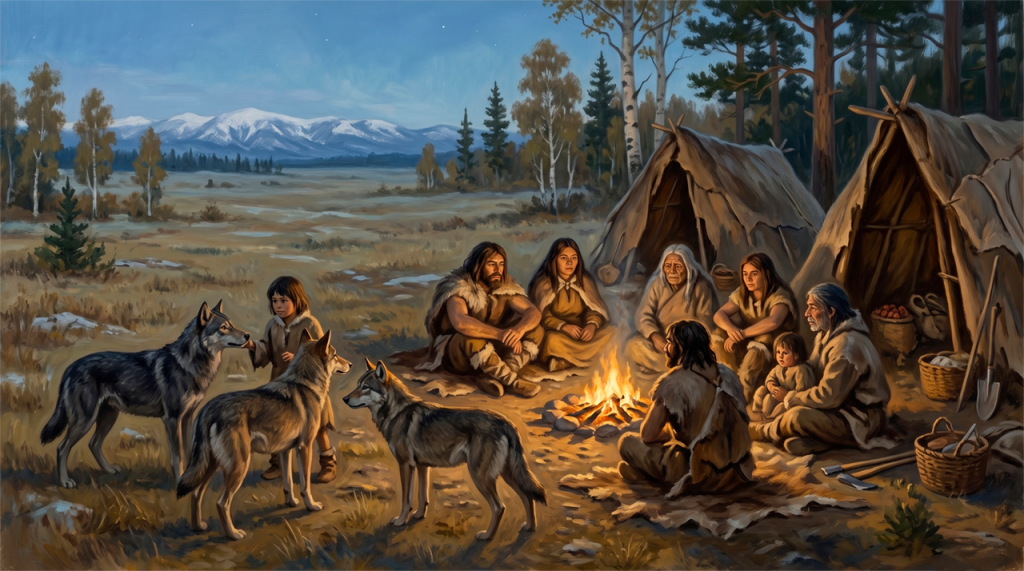
Humans seem to have rewarded the predictable character and habits, which can be shaped into loyalty after a few generations, since prehistory. Early remains show genetic evidence that the descendants of wolves (in other words, early dogs) lived with hunter-gatherer groups millennia before the dawn of Neolithic societies, and that small human groups acquired dogs from one another.
So far, the earliest physical evidence of the bond between humans and early dogs comes from remains in Bonn-Oberkassel, in the Rhineland, where, roughly 14,000 years ago, a man, a woman, and a dog were buried together. The remains show that the dog suffered a long illness and humans had nursed him through weeks of fevers and seizures, before the couple and the animal were buried together, showing a symbolic bond beyond life, as well as a commitment to care and protection.
Dogs’ evolutionary willingness to adapt to us, as shown by their different shapes and niche specialization, almost by breed, shows one single strategy from this canid species as a whole, which holds for Chihuahuas as well as Great Danes: their willingness to live with us and assist us. Only, this assistance leaned toward alertness and help with exploring, hunting, and protecting us and ours, whereas nowadays most dogs are evolving to show affection towards their owners. This may suggest that, amid rampant alienation, contemporary society’s greatest need is unconditional love and respect for one another. And when people can’t find affection or aren’t willing to put the effort required to foster and maintain healthy human bonds, they resort to pets.
First dogs, then civilization
Dogs’ willingness to live with us and meet our needs could have been present from the beginning. In late March of this year, a team led by Anders Bergström pushed back the earliest confirmed genetic evidence of domestic dogs by about 5,000 years. Bones found in Turkey and in a cave in Southern England, dated to around 15,800 years ago, turned out not to be wolf bones: in both cases, the remains were already those of dogs.
What’s most fascinating is that both groups of hunter-gatherers had not yet settled or planted a seed; they were not farmers. But they already had dogs. And, as reported by the New York Times, genetic patterns suggest those dogs were already moving between hunter-gatherer groups, passed along like an advantageous strategy, an early “piece of technology.” Or, in human terms, like a loved relative.
Back to Jack London, he bracketed our relationship from both ends: Buck from The Call of the Wild finds his instinct and will to prevail as an alpha animal, transitioning from a manicured life in suburban Palo Alto to self-sufficiency in the wilderness. But if Buck slowly recovers the wolf inside him, White Fang, the wolf-cub that names London’s other novel on the topic, gradually consents to become a dog. After his Klondike days, Jack London suspected what geneticists are now confirming: the line between the two animals, despite their radically different looks and habits, is thinner and more porous than our taxonomy shows.
When the bond runs the other way
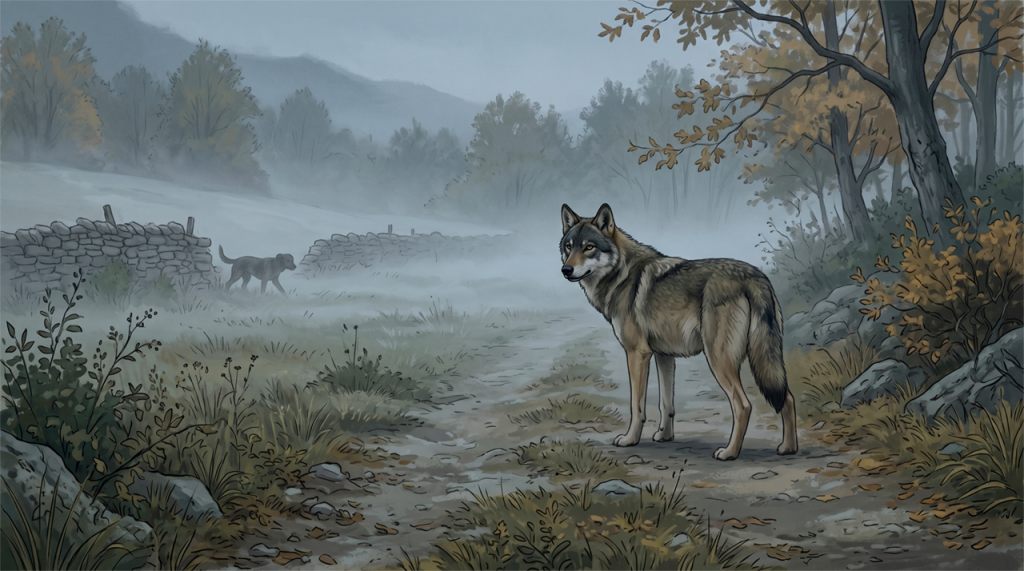
The bond looks like it runs the other way, from domesticated to wild, and this phenomenon is coming into focus with dogs and wolves: a study published this past January in the journal Biological Conservation analyzed DNA from 748 wolves found dead in Italy from 2020 to 2024. The study found that 47% of them were wolf-dog hybrids.
The phenomenon is concentrated in packs from the central and southern Italian Peninsula, where wolf populations recovered first after a near-extinction event in the early twentieth century, and where the countryside is full of free-ranging domestic dogs.
As we learned from stories like those by Jack London, a wolf in a healthy pack will treat a loose dog as a competitor or as prey, whereas a lone female wolf in a thinned-out, weak pack will sometimes treat a healthy dog roaming in the wilderness as a mate. Then, nature follows its course.
We the Neanderthals
But at what point can hybridization transform a species beyond recognition? Geneticists call this threshold genetic swamping: a point at which the wolf as a distinct genetic entity simply disappears, absorbed back into the descendants of the very species it had once given rise to.
Perhaps (this is my speculation as a non-expert, mind you), Neanderthals and Denisovans didn’t vanish from the Earth through extermination or illness, but rather through genetic swamping: unable to maintain their own healthy populations, some female Neanderthals decided to attract adventurous modern human males, and the rest is prehistory.
Regarding wolves who want to be dogs, and dogs who want to be wolves, there’s something quietly fitting in the symmetry. As I speculated a few years back in a self-published book, the covenant began somewhere on the cold Eurasian steppe, when a wolf made an apparently awkward, private call: to come closer to a person.
And it may yet end in the hills of Lazio and Calabria with a dog walking back the other way.