A fundraiser at UC Berkeley’s MVZ, a bird curator’s case against lead bullets, and five tons of lead azide blown up in Iowa the day before Thanksgiving.
For all the usual complaining about the San Francisco Bay Area, I don’t have much negative stuff to say; either I’m being extremely lucky, or this place treats you well and will give back anything you have to bring to the table, amplified.
That is, of course, if you can afford to live in the area to begin with. It’s easy to forget that any coveted East Bay school district (where, say, going to public schools suffices, even to demanding parents) like Berkeley, Albany, etc., will look like a gentle and relatively densified suburb with nice weather and lush vegetation, but then you look at the median price of any two-bedroom bungalow and realize that it will be more expensive than almost anywhere else in the United States, including Manhattan at this point.
Once you buy in and live in a prosperous, dynamic, culturally enriching, and bookish area, life isn’t bad for a family with growing kids. I thought about this as the week evolved into a stock market meltdown and the weather forecast was about to bring rain and the so-called king tides to the region in a year with an especially virulent El Niño weather pattern that points to another rainy winter in California.
A banana farm and a house full of orangutans
Yet our everyday experience was, as always, busy and interesting. And perhaps because Kirsten was editing a video piece on our visit to the pioneering greenhouse house in the Colorado mountains with energy policy and environment expert Amory Lovins, founder of the Rocky Mountain Institute, the week was already revolving around biology, zoology, energy efficiency, and adjacent topics.
If you have the chance to watch the piece, you’ll see what I’m talking about. You change your mindset when you visit someone who grows bananas in the snow (as Amory and Judy Lovins have done at their Earthship-like home since 1984) and creates a living environment so interesting, comfortable, and connected to nature.
It didn’t surprise us when, during our interview, Amory brought up the concept of biophilia, popularized by Edward O. Wilson, which the Lovins try to apply at home with an indoor garden productive year-round, and all kinds of references to life: Gaudí furniture, pictures of animals and landforms, and many, many reproductions of playful orangutans around the house; among them, a painting by an orangutan (that is, painted by the orangutan itself, not a ‘painting of’) with which Amory had interacted. Orangutans are Amory’s beloved species.
The week was already tilting toward the fields of biology, zoology, and our connection with other life, on which our well-being depends.
The university you already knew from the movies
If, on top of that, your eldest kid ends up joining UC Berkeley, the area becomes even more interesting from the moment you visit this public institution, which you have already met in pop culture, from its links to the counterculture you read about when you were studying years ago and wanted to be a rebel, whatever that was (it was posing, or larping, kids say these days), to Joan Didion, to Forrest Gump and Oppenheimer, to mention two movies with connections to it.
Case in point: due to our connection to our daughter and not the other way around, we were invited last week to a fundraising event at Berkeley’s Museum of Vertebrate Zoology (MVZ), an impressive specimen collection that’s linked to some of the most important zoological research in the last hundred years or so. We’re talking about rows and rows of storage cabinets with over 700,000 vertebrate specimens, plus over 100,000 frozen tissue samples, some of which are rare or unique.
Before going to the gala, I knew little about the place, and what I knew came from casual conversations with our daughter, who helps there. When we walked to the Valley Life Sciences Building, a modern edifice from 1930 with Art Deco and Neo-Babylonian ornaments, it was already dark.
As I read a bit of trivia on our way there, I learned that Berkeley’s is the largest vertebrate collection of any university museum in the world. It was founded in 1908 by Annie Montague Alexander, born to a Hawaii plantation family, who is considered one of the “builders of Berkeley.”
Falcons on the Campanile, a T. rex in the stairwell
Kirsten and I kept reading as we walked to the place not far from the Campanile, a tower I now see differently after learning about its nesting peregrine falcons, watched by the Cal Falcons team of scientists and volunteers. Annie, who nested on the tower for nearly a decade with a succession of mates, and Archie, her last one, vanished in early 2025, likely victims of avian influenza (the female was named after the MVZ founder; Archie referenced UC Berkeley alumnus and Olympian Archie Williams, 400m gold at the 1936 Berlin Olympics).
New falcons are visiting the tower; however, no new breeding pair has settled in permanently yet. But the area holds more than symbols of nature conservation: apparently, a good deal of research and innovation in fields like evolutionary biology has happened at MVZ, and biodiversity research keeps evolving thanks, in part, to places like the one we were about to visit.
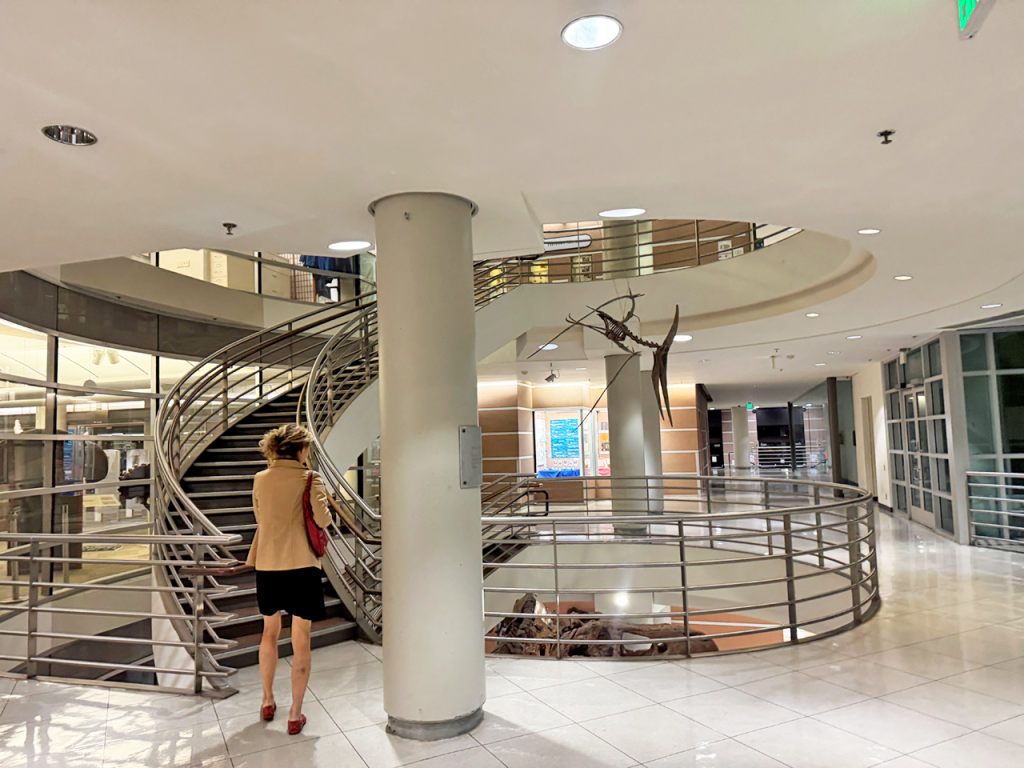
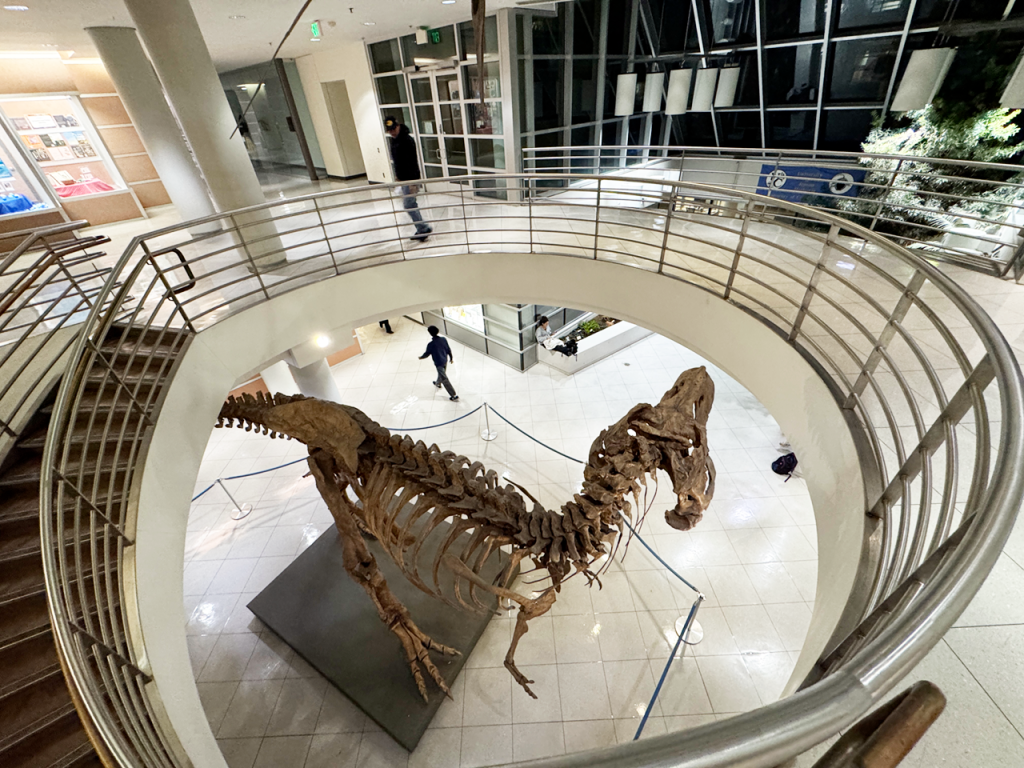
In the hall, I was already carried away by the Tyrannosaurus rex skeleton cast rising inside the circular stairs at the center of a skylit atrium erected during a 1990s renovation. I guess I might be a normie, because the boy in me will always be interested and content if there’s a dinosaur around.
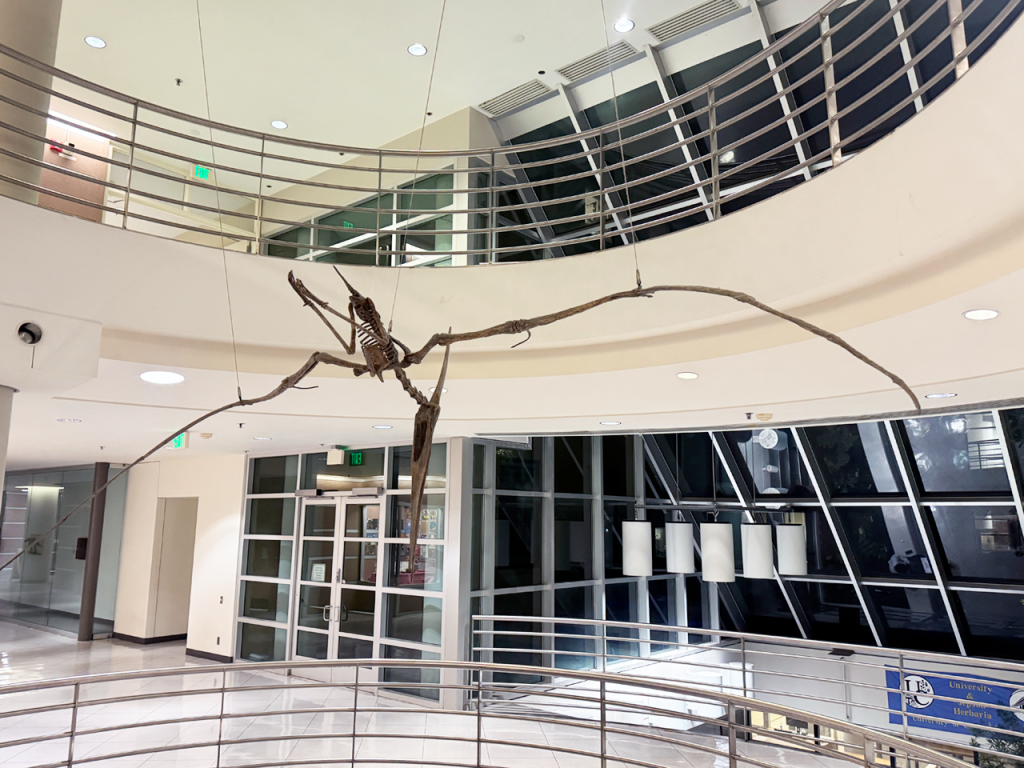
So we took the circular stairs to the third floor, where the hanging cast of a Pteranodon ingens (a Cretaceous flying reptile, and hence a pterosaur rather than a conventional dino) was flapping its wings.
Sometimes you don’t decide how to associate surprise inputs, so a previous image of one of these smart corvids that hang around campus came to me by association. Imagine, I thought, if this guy, with its size, was the one flying down on the garbage to grab the Chipotle leftovers lingering outside a garbage can not far from the building.
Chelsea boots and name badges
At the reception, we even had badges with our names printed on them that you pin with a magnet to your formal clothes, just like the rest of the participants in the charity gala. Everyone expected was there: a few philanthropists (some from families who have quietly donated to the museum for years and, in some cases, more than one generation), a few invitees like us, and the whole team from the MVZ.
The dress code was California formal, which isn’t that formal, but prompted Kirsten to try a dress, whereas I put on Chelsea boots, dark trousers, and a formal-casual raincoat I got in France, given the changing weather, even if it wasn’t raining.
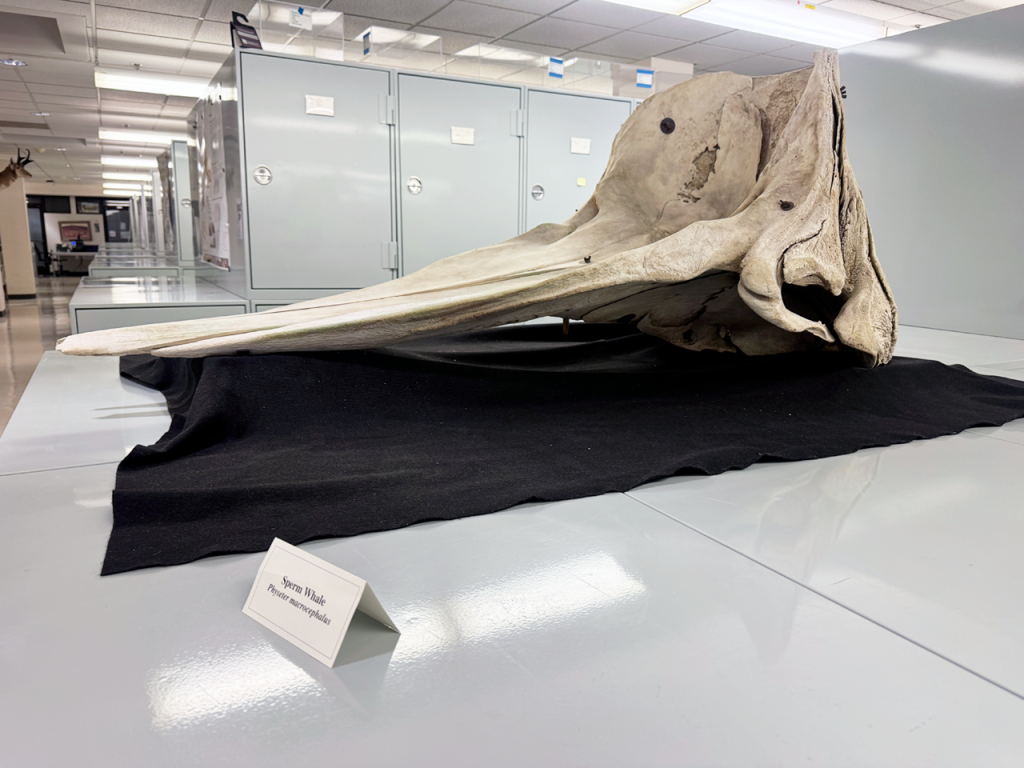
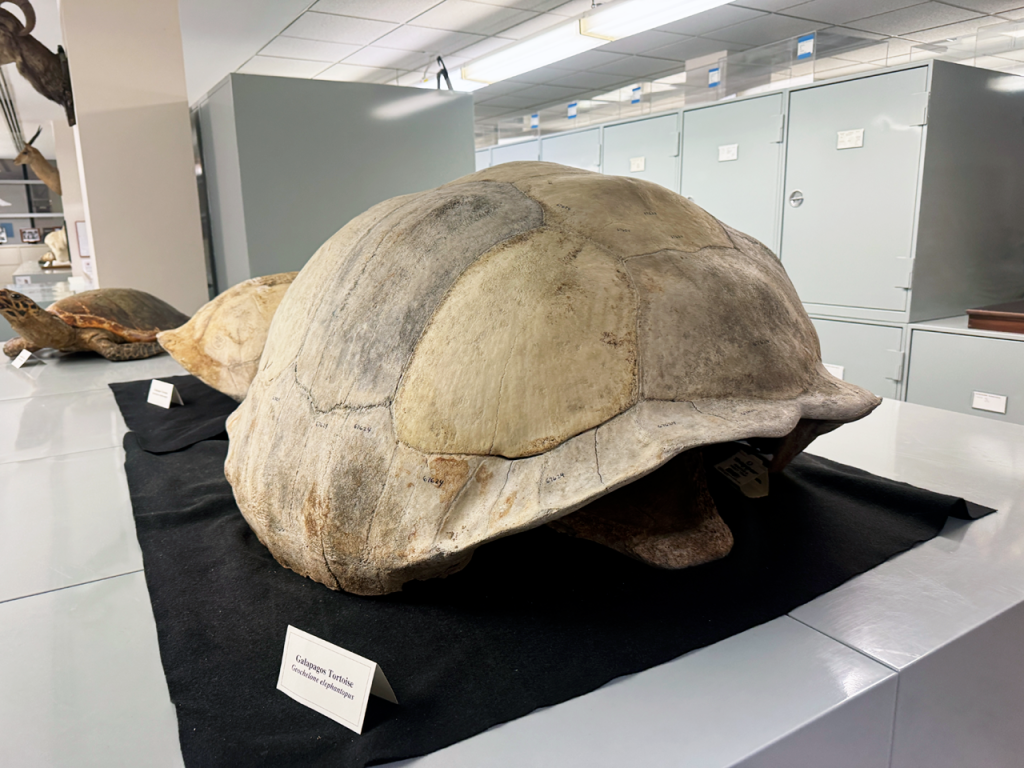
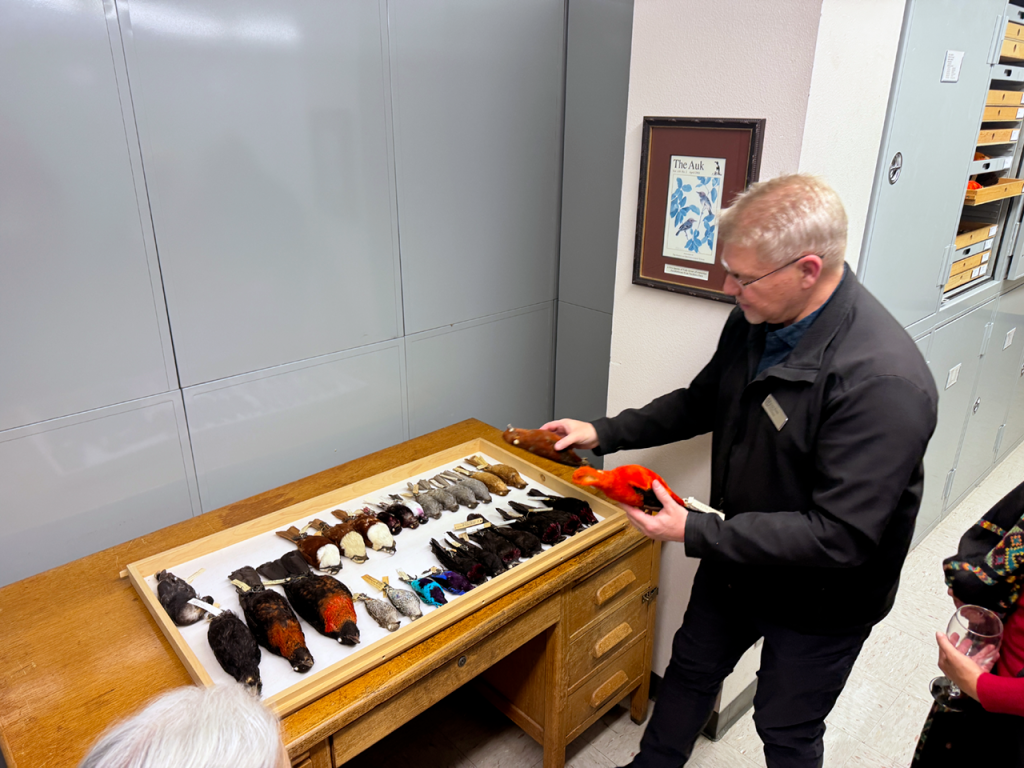
To get to the central area of the collection where everyone gathered, we went through a few displayed pieces: a blue whale skull, two giant turtle shells, and framed references to scientific articles and papers where the institution has played a crucial role, of which there are many.
The environment brought me back to the early days after college, when, as a junior journalist, I had to attend many such events in Barcelona, which were late and messed up other plans; most times, I’d look for colleagues to endure the tedium and strategize for drinks and food, and many of them liked that life to the point of craving it, but not me. This evening was different from the start.
A director who spent a sabbatical by the Barcelona seafront
We arrived when the MVZ director and curator of mammals, Michael Nachman, was already welcoming everyone and introducing the whole team, as drinks and appetizers were passed along. Later, on our way out of the event, we talked with him and realized there’s often common ground one way or another.
Michael was polite, and perhaps sincere, when he told us he’d spent one of his best years on a recent sabbatical in Barcelona with his wife and children. Nachman worked with Josefa González’s group at the Institute of Evolutionary Biology (IBE), run jointly by Pompeu Fabra University and Spain’s CSIC. At home, I looked his work up and realized he’d also given the closing lecture at the biosciences conference at my alma mater, the UAB, which is across the hills from Barcelona, a bit like Berkeley to San Francisco.
When Michael said he worked by the water in Barceloneta, we pictured the spot: the CMIMA, a light-filled marine research center near the sculptural ‘fish’ at the edge of Barceloneta and the city’s Olympic Village, or the neighboring PRBB. Our youngest son had been born next to it at Hospital del Mar.
I walked past that place almost every day between 2007 and 2014 before we moved to another area of the city closer to the hills, where it’s calmer, and kids could walk to the school they attended (our children’s last school in the city before moving to France, Escola Projecte, was on Avinguda Tibidabo, the same street as the school Michael’s kids attended).
A gala that refused to be stuffy
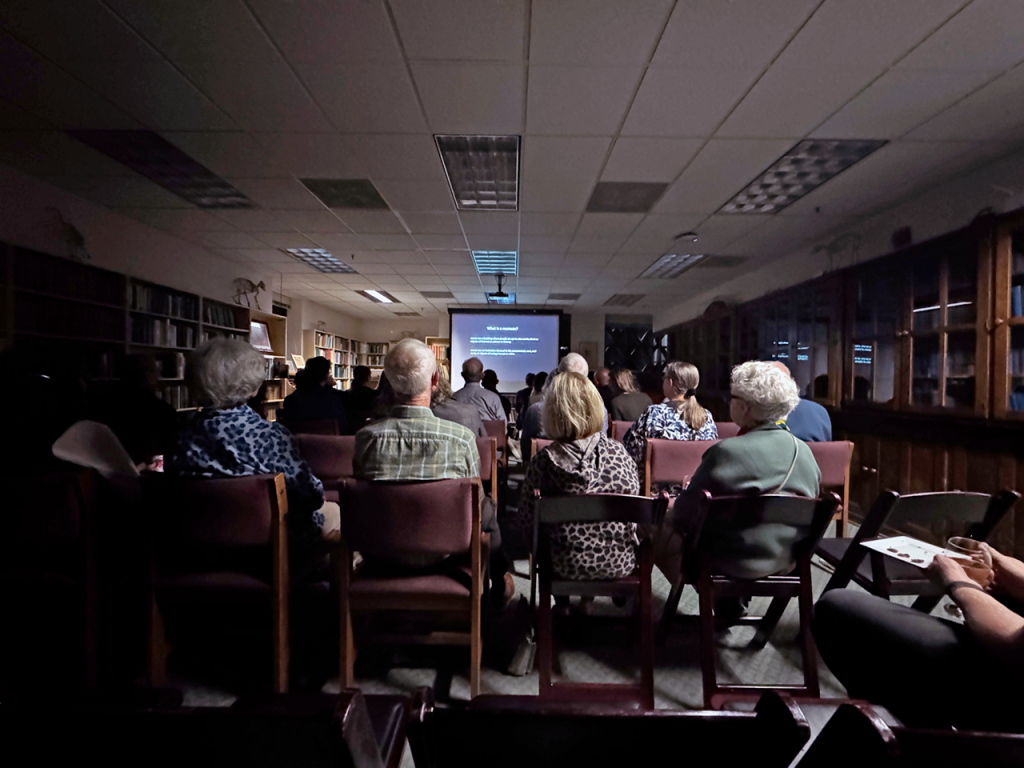
Back to the reason why it didn’t get boring at the MVZ gala: Michael and team were warm and enthusiastic, California-style and very hands-on, as if they were precisely trying to avoid one of those events that feel as dead inside and stuffy as the specimens the building holds. So Michael invited everyone to go into the museum’s auditorium to attend a few entertaining speeches, one per main branch of the collection.
Thanks to the slideshows and short videos, we learned that MVZ funds field trips across the world, and met interesting creatures, like very beautiful, tiny, and colorful amphibians, while trying to guess which colors and patterns were biological markers of toxicity to potential predators.
It wasn’t going badly at all for my biology and zoology nerd self: I subscribed for years to the Spanish edition of National Geographic from its launch in the mid-nineties until our children were born a little over one decade later (not that stopping the subscription dampened my mammal perpetuation zest).
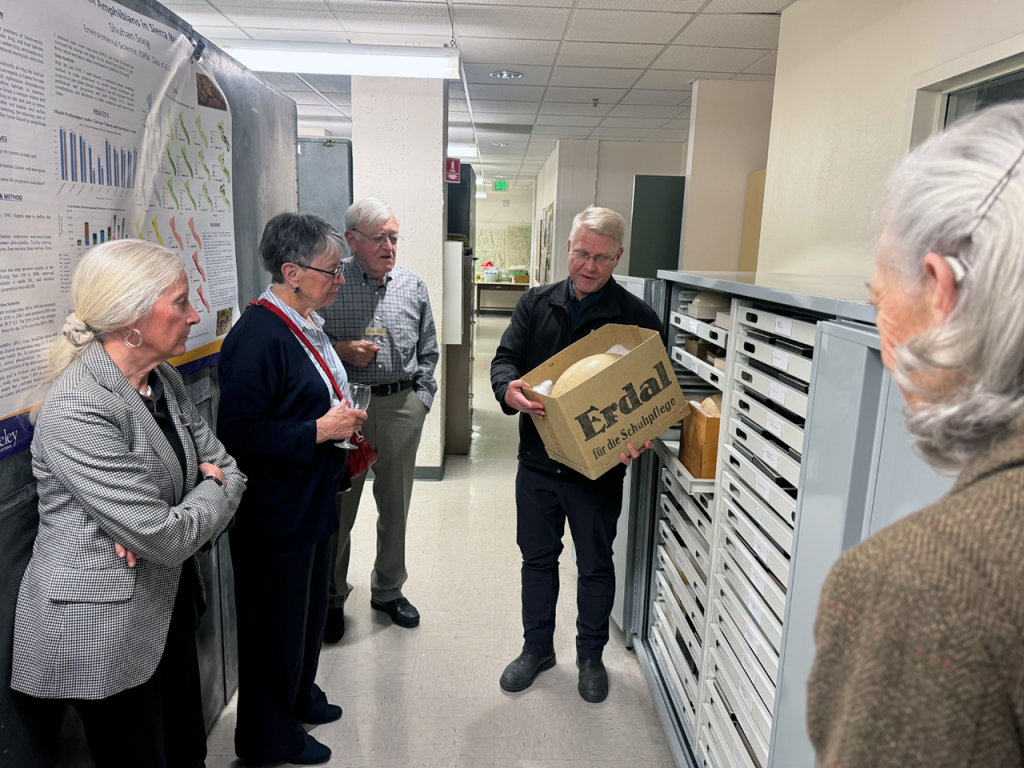
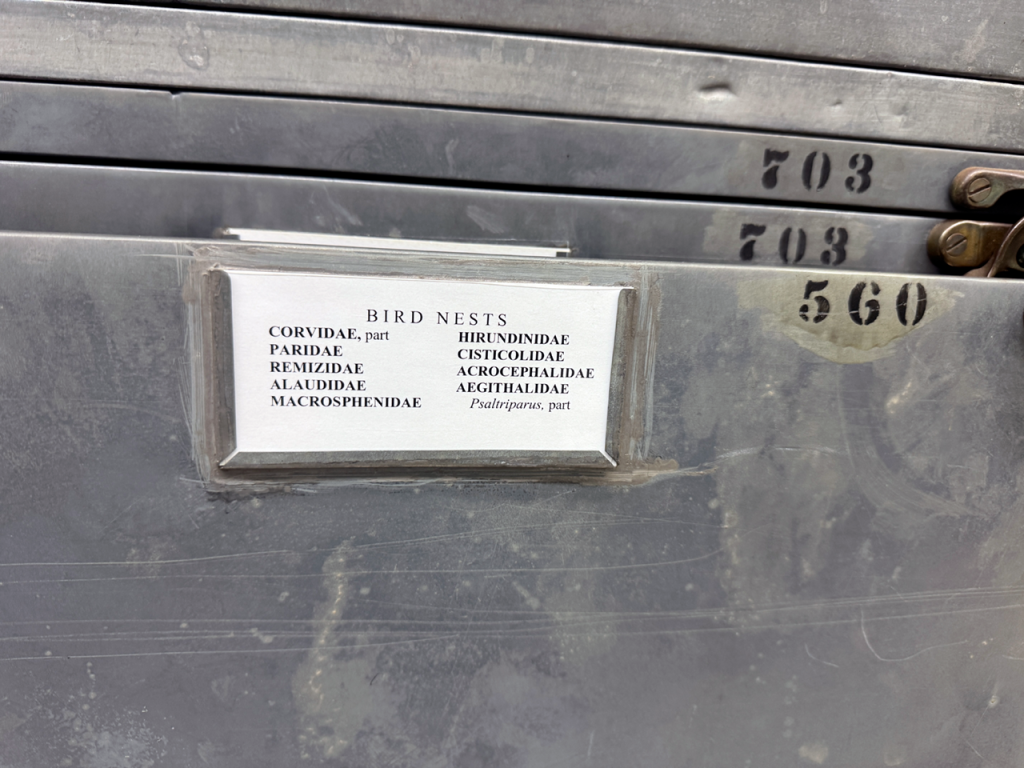
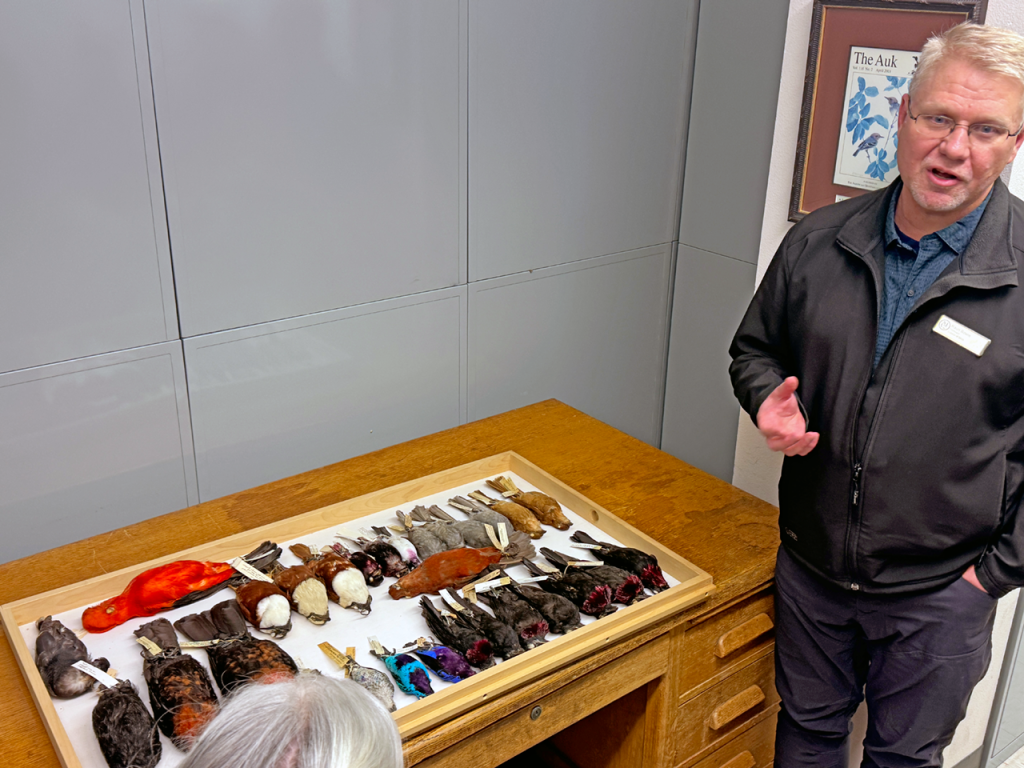
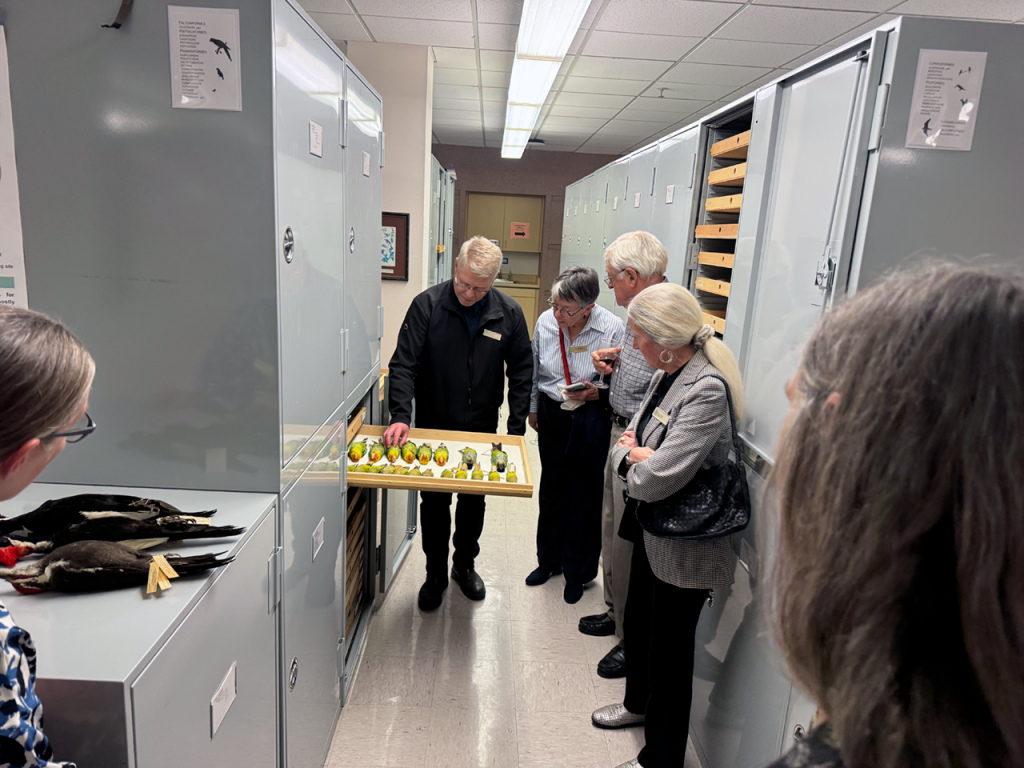
Yet it got better when we left the auditorium and got back to the central area of the collection. There, we formed small groups and joined a personalized tour by one of the experts. From the outside, the cabinets that store the specimens look like the archive of an insurance company; open any of those cabinets, however, and you’ll find a vast collection that could help future efforts in conservation and even de-extinction through DNA sequencing of stored specimens and genome editing (CRISPR) of living relatives.
An elephant bird egg in a shoebox
Facing the dilemma of having to pick, Kirsten left with a group, and I decided to join Rauri Bowie, professor and curator of the collection’s birds, eggs, and nests specimens, if only because any grown child who once loved and read about dinosaurs obsessed over Archaeopteryx, the first of several discoveries connecting the extinct group of likely warm-blooded reptiles that dominated our planet to modern-day birds. And, of course, in Thanksgiving week, you hear a group of turkeys go by near your street, and picture the sound that (you imagine) these creatures made.
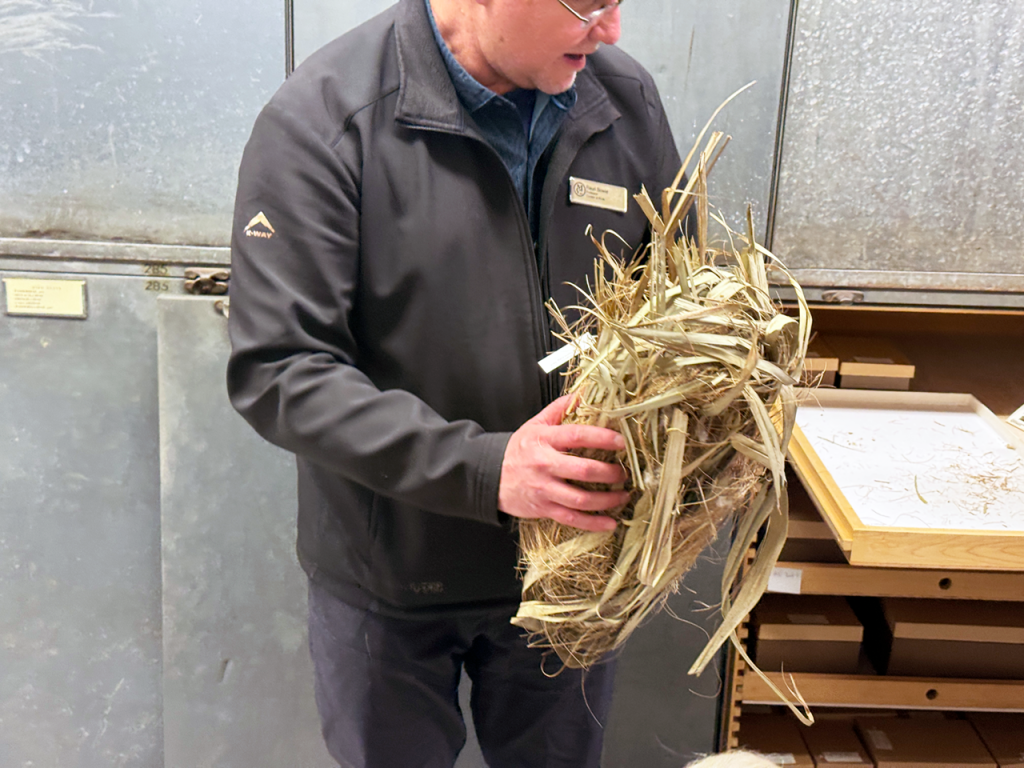
In any case, Rauri’s accent was difficult to locate; at first, I thought Australian, but he confessed he grew up in South Africa, did his doctorate at the University of Cape Town, and came to Berkeley in 2006.
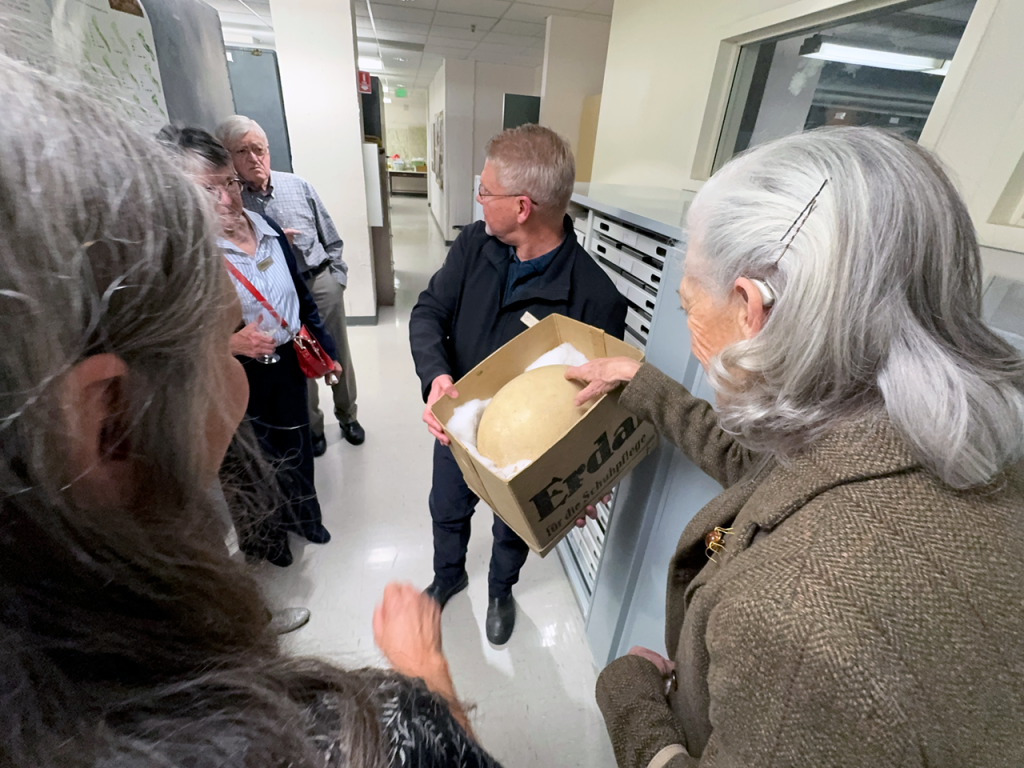
We started with the egg cabinets, visiting the biggest egg in the collection and also the smallest; the biggest egg in the building was the size of a football and barely fit inside a shoebox; it belonged to an elephant bird, an extinct species of giant flightless bird from Madagascar that vanished around 1000 AD.
Interestingly, someone asked whether dinosaur eggs were bigger, and Rauri explained that, on the contrary, the fossil record shows that even the eggs of the biggest dinosaurs were much smaller than those hatched by this extinct flightless bird.
Hungry moths and a nest lined with horse hair
The box also contained the smallest egg in the collection, which belongs to a hummingbird species, those ethereal creatures that fascinate us Europeans when we live in North America or visit the place, in awe and unable to compare the rapid fellas with anything from the Old World. According to Rauri, the hummingbird egg ended up in that box because someone tried to make the same comparison and forgot to put it back.
According to the team, the collection is very much in continuous use, and it faces conservation and maintenance challenges. The team is currently tackling a moth problem: the building’s HVAC system malfunctioned, temperatures rose, and dormant larvae may have revived. Moths can damage specimens. Lepidoptera, an order such museums also guard, was sending its smallest, hungriest members to test the collection’s defenses.
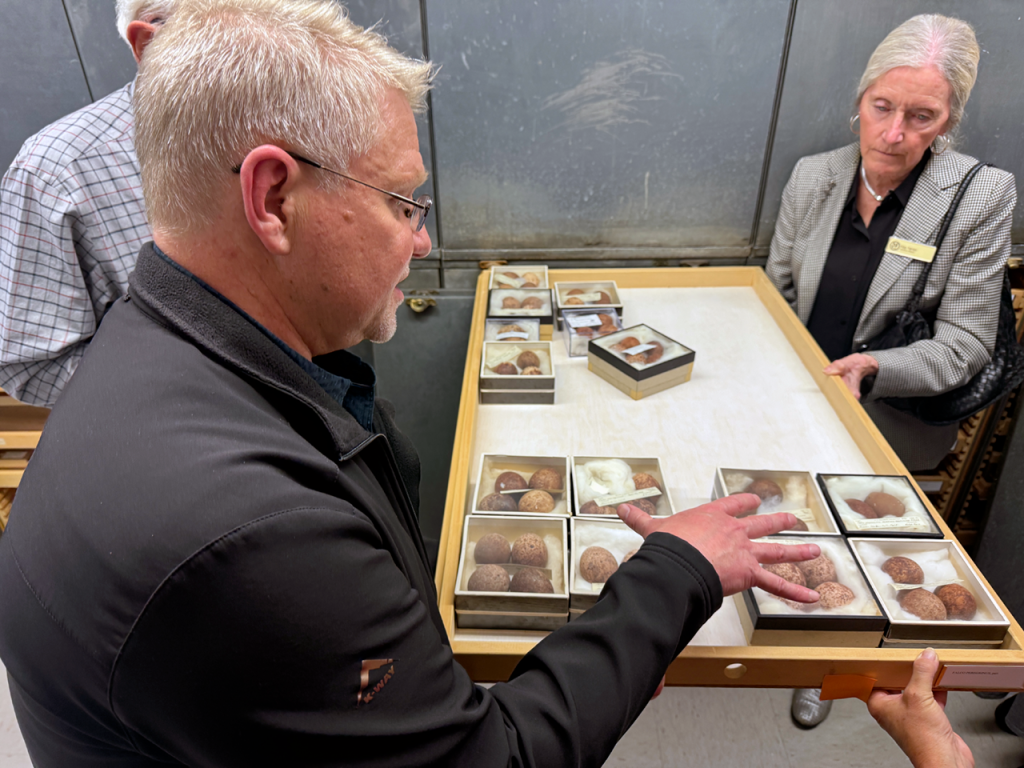
We learned about evolutionary strategies that led to eggs with different shapes, textures, strengths, and many other details. There was also room for the beauty and engineering behind nests: each one seemed to hold secrets worth mentioning, and I began seriously thinking about a video on the channel that could link bird construction to dwelling strategies followed by humans, because we could learn a thing or two.
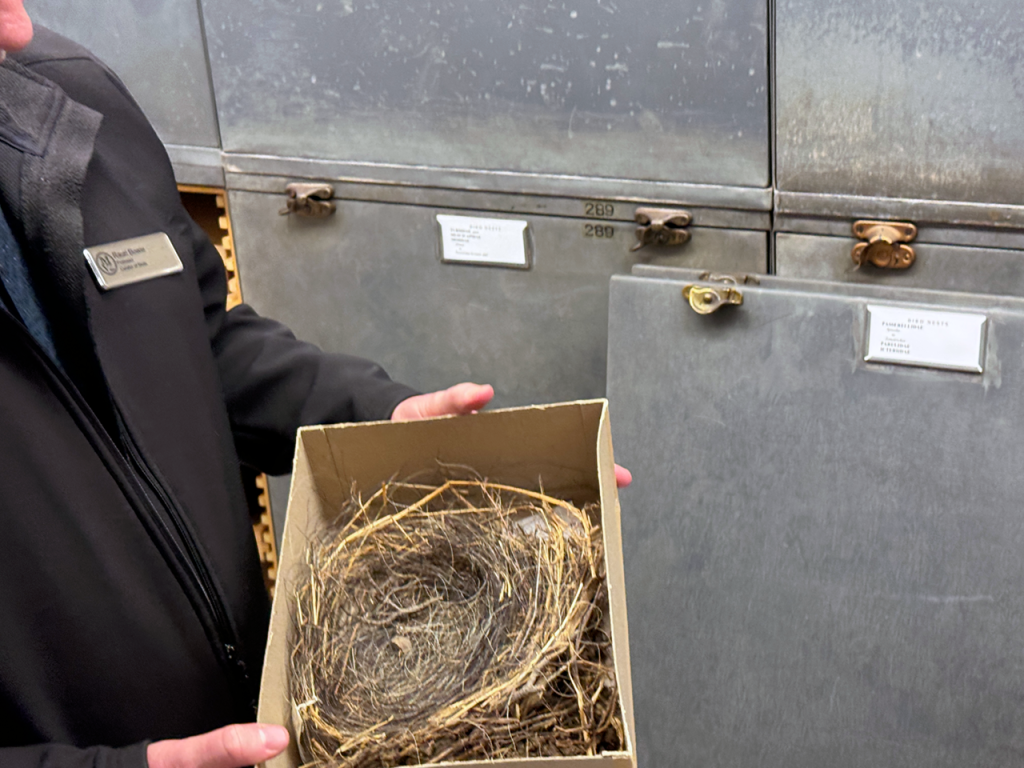
Nests are also a resourceful record of the handy materials their builders find when they get in the frantic task of building a dwelling for their brood before it’s time: one of the local nests we saw, which had been recovered in Morgan Hill on the southern tip of the Bay Area during the 1920s or so, held at its soft concentric center a web of dark filaments many of us didn’t associate with their origin: horse hair.
Back then, the Model T and its competitors were breaking ground in prosperous rural communities, but horses were still numerous enough to constitute a source of material for local birds to build the softer parts of their nests.
A woodpecker with a paper tag on its leg
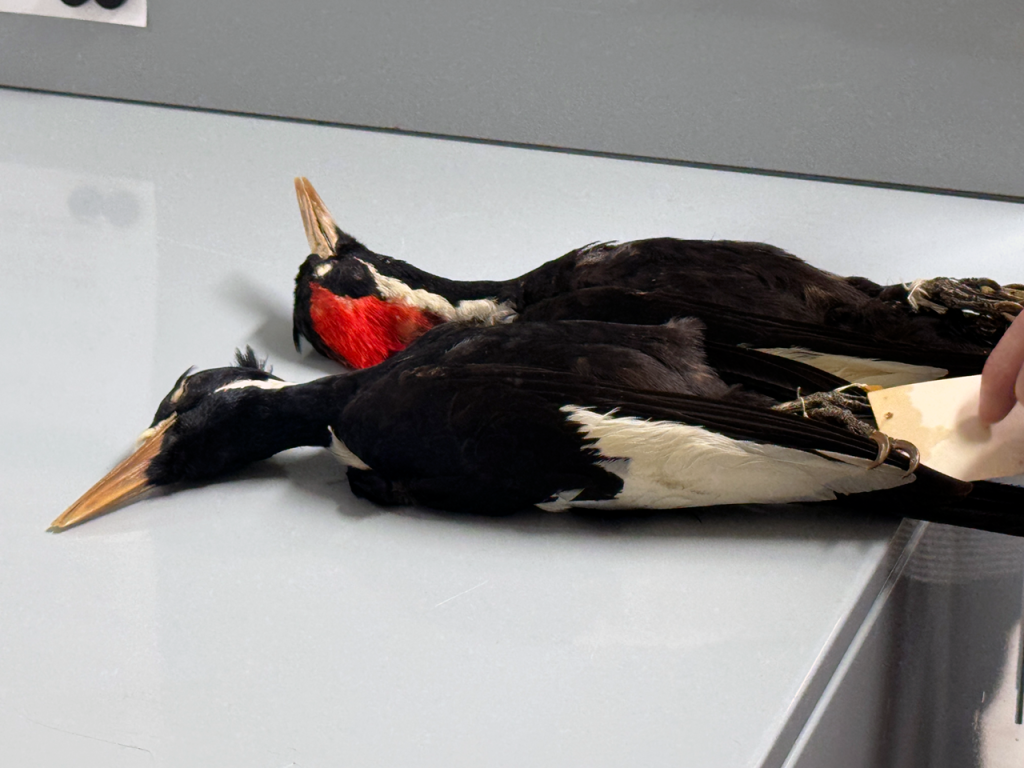
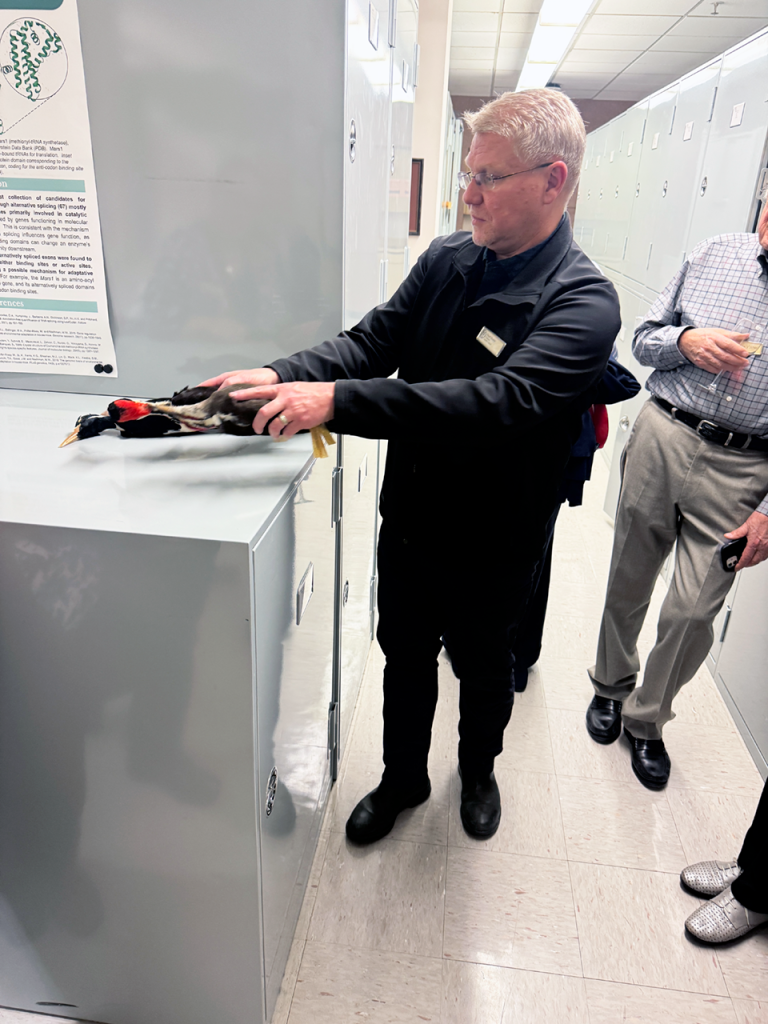
Then we looked at many birds. We all paid attention when the researcher and curator came with a drawer containing specimens of ivory-billed woodpeckers, the largest woodpecker in the United States, a black and white bird with a pale bill that lived in the old-growth swamp forests of the Southeast and Cuba, and is suspected extinct. The last undisputed sighting in the U.S. was in Louisiana in 1944. The forests were logged, and collectors shot the survivors as they became rare.
Is there any room for hope? someone asked. A few researchers argued that blurry sightings and recordings in Louisiana and Arkansas still deserved a hearing. It’s a strange feeling to look at a bird that most experts consider gone, lying with a paper tag tied to its leg. The specimens are what remain of the species as evidence, and the reminder of what we are losing. Perhaps, in the future, new de-extinction strategies will make the return of these species possible.
We did not stay in the past. Talking about the viability of species at risk and how experts from places like the MVZ have helped the California condor and other birds, we learned about the threat that the use of lead by hunters poses. Condors are scavengers. They eat carcasses, and any carcass of deer or other animal that hunters leave behind poses a risk for birds feeding off it. The gut pile left after field dressing often contains fragments of lead bullets.
The shards a condor swallows
It’s no joke. A lead-core rifle bullet mushrooms and sheds tiny shards when it hits an animal, and it’s legal to use lead ammunition, even when we know that threatened species like the condor swallow them with the meat. The lead paralyzes the bird’s digestive tract, and most poisoned condors die of starvation and dehydration.
Rauri’s point was simple. As long as lead ammunition is legal for hunting anywhere condors fly, the species will depend on humans to survive. But lead also affects eagles, ravens, and every other animal that cleans up after hunters.
Of course, the issue could improve if copper and other non-lead bullets that exist were used. It’s a matter of will and policy, and if policy doesn’t help, hunters should stop using lead altogether. To any hunter reading this: you can help stop the problem.
The numbers support Bowie’s frustration. In 1987, only 27 California condors remained, and the last wild birds were captured for a breeding program. It worked: today there are about 600, two-thirds of whom are flying free in California, Arizona, Utah, and Baja California.
Wilder condors, more lead
But there’s a setback that could have been prevented: between 1992 and 2025, lead poisoning caused 161 confirmed deaths in the wild flocks, or half of all deaths with a known cause. California banned lead ammunition for most hunting within the condor’s southern range in 2008, and statewide in 2019.
These measures have limits, as shown by a study published this year in Nature Communications, led by Victoria Bakker of Montana State University with the UC Santa Cruz toxicologist Myra Finkelstein. What changed is that, as condor populations got healthier in the wild, condors fed far less from the carcasses provided by biologists, ranging farther and finding their own food.
The new food likely includes carcasses of wild pigs, which are being shot in large numbers for population control, though the researchers couldn’t yet prove the link. A state ban is not enough if the birds fly into places where enforcement is thin and lead bullets are still widely used.
Five tons of an old poison in Iowa
As we talked about the impact of lead on such a symbolic animal, I thought about the news coming from Iowa that same week. The U.S. Army was getting ready to blow up a stockpile of bomb-making chemicals at the Iowa Army Ammunition Plant, near the small town of Middletown.
Inside two concrete bunkers sat 68 barrels of lead azide, about five tons of it, the nation’s entire stockpile of a compound used to set off grenades and artillery shells since the First World War. The barrels had been stored there since 2009. In March, inspectors found the material was crystallizing, which made it sensitive to cold and friction and could make it explode on its own at any time.
No solution was ideal, and nobody near the plant wanted to pick between two poisons: a spontaneous blast or a controlled one. The Army postponed the date three times, environmental groups sued, and residents within five miles were asked to leave their homes.
On November 25, the day before Thanksgiving, the Army went ahead. It surrounded the bunkers with two-story walls of concrete and sand, filled them with gels and foams to trap the dust, and sprayed water over the plume.
When the tour ran late
Forecasters expected the wind to carry it southwest, toward Missouri and away from Burlington, a city of just under 25,000 on the Mississippi River. Half an hour after the explosions, EPA monitors weren’t detecting lead in the air. But no study of wind trajectories could guarantee that nothing settled on the farms and homes downwind.
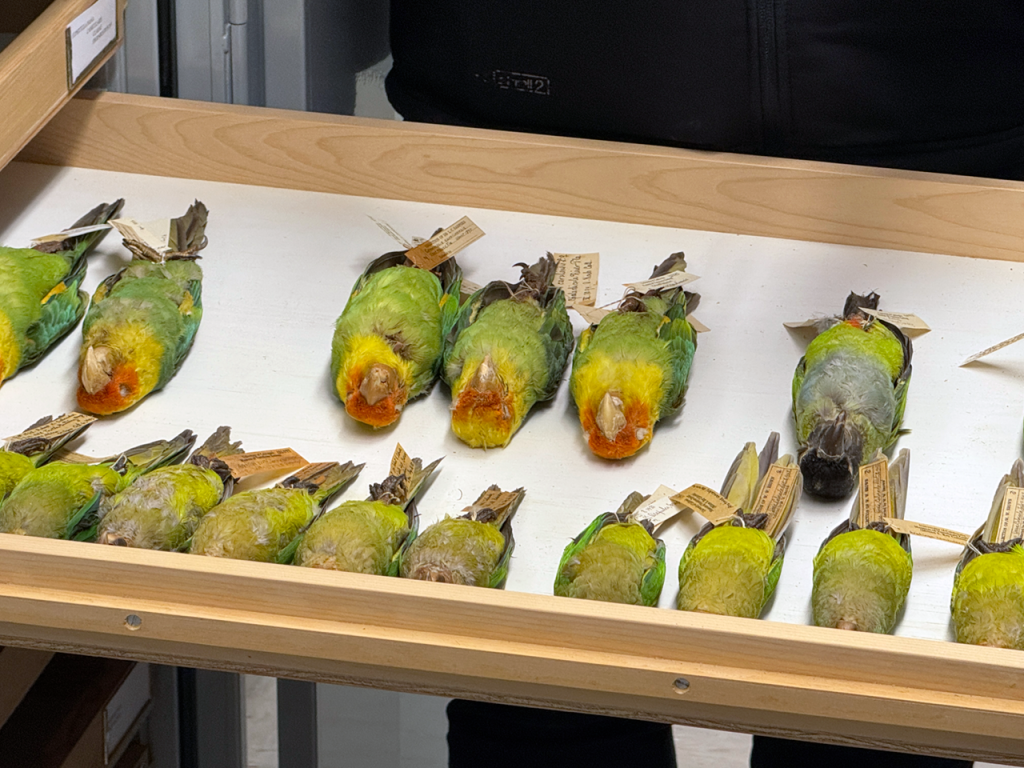
No wonder we were the group that enjoyed the longest walkthrough visit of the collection: we were all so engaged, Rauri included, that when we got back it was really late and people had to leave to go to work the next day.
We had just realized that, with some things like DDT in the past or lead now, one can’t look the other way, and the only way to avoid poisoning animals or people is to replace toxic substances with safe ones.