One hour south of Barcelona, the grapes come in before the proverbs say to pick, and the ruins along the old road have stopped counting.
It’s harvest time, by the old calendar, in the wine country region one hour south of Barcelona, where we decided to restore a country home a few years back.
Nowadays, the harvest happens much earlier, though locals have these dates imprinted in their minds, keeping the ancient almanac present.

It’s a wide, elongated valley that’s sheltered by low, pine-forested mountain ranges parallel to the coast, following its southwestward bend. Its weather is pleasant. There, harvest has advanced a few weeks on average in recent decades.
Proverbs and festivities, some tracing their roots to pagan times, set the peak of harvest in late September, while grapes now have to be picked much earlier. This year, Gramona in Sant Sadurní (where the local sparkling wine, cava, is made) started picking on July 22, four days ahead of the previous record of July 26, 2023.
Good morning, in the wrong language
So, when I came briefly to visit my parents, I noticed on my morning outings that hardly anyone remained in the fields. Now that we live in California, the place is as far as it gets, but people from Sonoma would find the weather and landscape familiar, and it wouldn’t feel culturally foreign for them either.
This isn’t due to the familiar trend of modernity, the advance and homogeneity of industrial and commercial areas, logistics centers, and the landscape that convenience brings, and that we can call “non-places,” because they feel like they don’t really belong to a place in particular, yet they are present everywhere. Rather, it’s a dry place with gentle hills covered in the familiar pattern of vine rows.
This time of the year, the weather and landscape feel so similar that there’s nothing to get acclimated to; in my case, hearing Catalan and Castilian Spanish doesn’t even register, to the point that some mornings, when I pass by someone running or on a mountain bike, I forget I switched continents and say “hi” or “good morning,” feeling embarrassed right away and switching to Catalan.
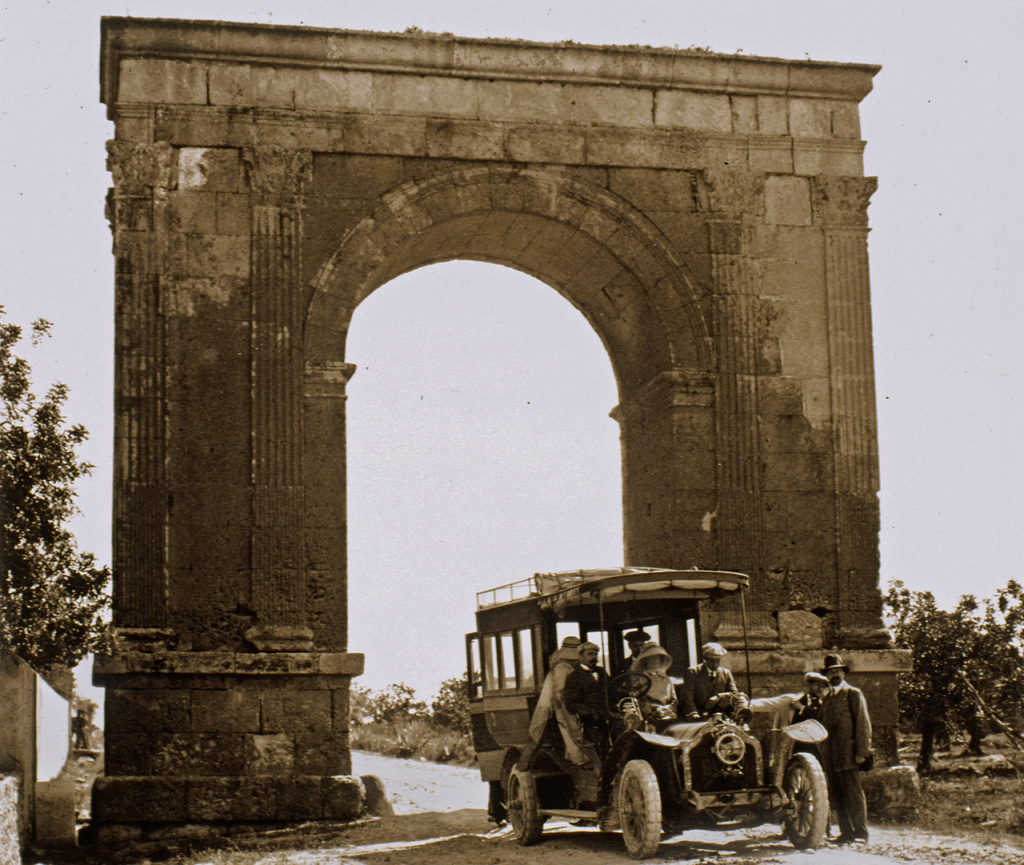
Perhaps this is because it feels at times just as if I were to drive north from the San Francisco East Bay and hit the rural corners of wine country in Napa and Sonoma, only there are no pickup trucks on the road, and, seen from the train I take to get there, the houses look different, switching from the universe of Edward Hopper’s lines to that of Cézanne-esque brown clusters of Mediterranean houses.
Our own Camino Real, older than California’s
There’s quite a bit to like about these landscapes arranged by men, though locals have forgotten it exists when they drive down the N-340, our very own, and much older Camino Real. In the past, it was locally called Camí Ral, and it crossed the valley diagonally to go southwest (to Valencia and eventually Cádiz). Nothing commemorates the fact that it’s an old artery that has shaped the landscape since Roman times, when the route its modern version follows was first laid out.
Taking the Camí Ral from north to south, one can imagine what it was like to cross this same landscape (though without the fast train connecting Barcelona to Madrid, which also crosses the valley to avoid the surrounding mountains) at a much slower pace, when only that road existed. The first cars shared the pavement with animal-powered wagons using big wooden wheels, carrying the harvest as entire families rushed to pick the grapes.
Now, from the commuter train or the road, let alone the highway AP-7, which separates the driver from any meaning that the landscape might have preserved, the fields look mathematically precise, and no people are seen, only occasional modern machines with a hollow middle to cross the vine rows and pick the grapes; some mornings, if one decides to take a walk or a run and enters dirt roads into the fields, a few crews can be seen, often composed of those willing to take on the job, and no families. Mechanized, reduced to precision and speed, and led by immigrant crews.
Many of them are already about to leave for the day as the morning advances and temperatures rise, and many growers now pick at night to keep the grapes out of the scorching sun.
What a Roman would still recognize
Yet it’s the same place, and a Roman living in the Empire could visit and take a trip down the Via Augusta from Barcino to Tarraco (then the big place: the capital of the province of Tarraconensis), and his experience wouldn’t be much different. Dropped today in the same place, he might get scared as the fast train roars in the dedicated AVE railway, or baffled by the machines, but the landscape, and many of the old houses, wouldn’t feel out of place to him.
Along the road, amid rows of impersonal apartments and beach houses, there’s even a surviving honorific arch, built in Roman times to mark the edge of Tarraco’s territory despite having a popular name that comes from a medieval ruler, the first count of Barcelona, Count Berà, appointed after the Franks took Barcelona in 801 and deposed in 820 for preferring peace with the Muslims across the frontier. It stands on the line of the Via Augusta, now the N-340, about 20 km northeast of Tarragona, in Roda de Berà, and absolutely nobody (not the locals, not the tourists) pays it any attention.
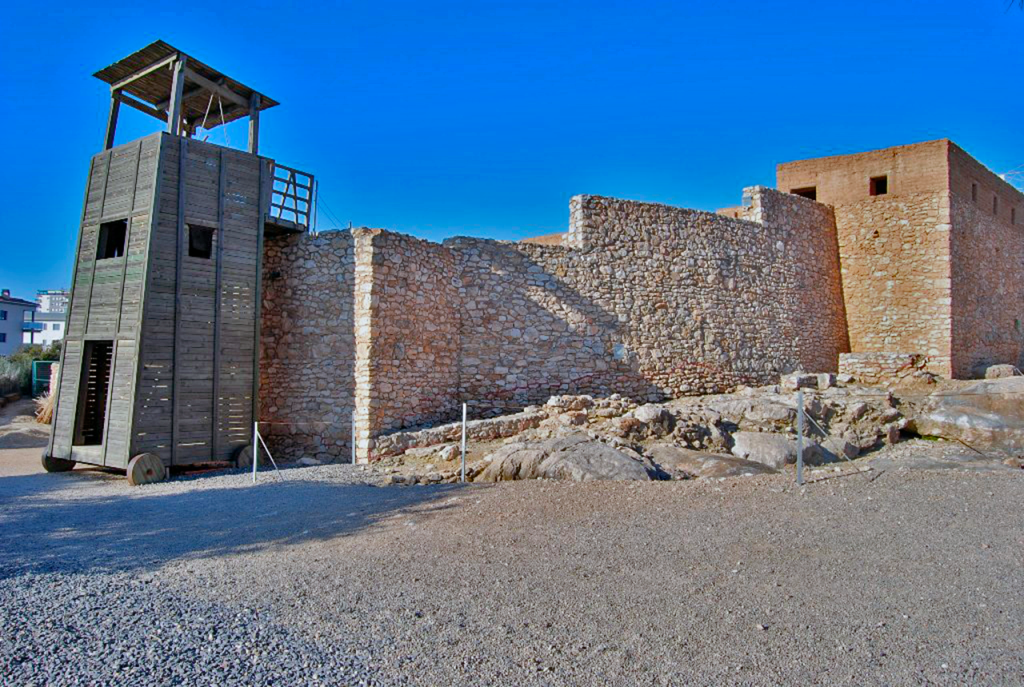
Perhaps the ancestor of that same visitor living in the times of the Roman Republic would have found a slightly different landscape, and a web of smaller, narrower paths connecting Iberian villages along the valley, instead of the wide, paved Via Augusta.
Locals would have collected water in cisterns instead, just as Phoenician and Greek traders had before them, but the Roman works whose vestiges dot the valley went up from the onset of Romanization all the way to the 4th or 5th century, when the surviving aqueduct was built to serve a wealthy villa, not long before the Suevi, the Visigoths and other Germanic tribes took over Roman Iberia. The Suevi settled in the Iberian northwest, with Gallaecia, today’s Galicia and northern Portugal, as their kingdom, whereas Tarraco was taken by the Visigoths in 472.
A driving lesson beside six Roman arches
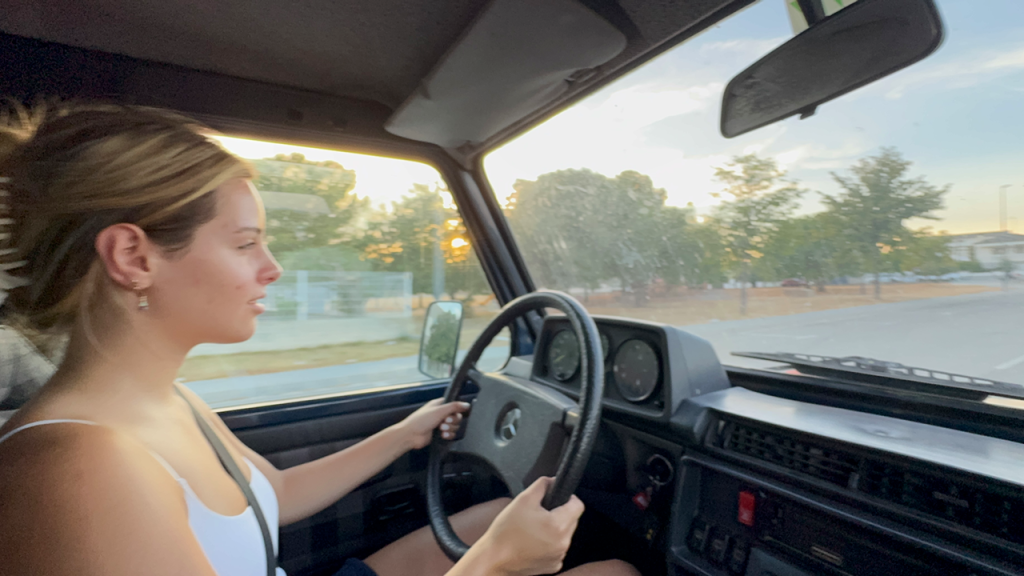
Of course, these are things that have little to do with our experience as a family in the place, even though I hope our kids get a sense of the nuances of this corner of the world where they feel at home, too. Last July, when our middle daughter asked me to go on a driving lesson so she could drive our old G Wagon, I sensed an opportunity to explore our surroundings. We headed to a commercial and industrial area between two nearby villages, small and calm, with a perfect grid layout and no cars on summer evenings.
To get there, you take a small county road, cross the commuter and high-speed train tracks, and cross the highway from Barcelona to Valencia and Madrid, which bifurcates to go west and south not far from that point. Then one reaches a roundabout that feels a bit like one of those non-places that could be anywhere, with commercial, square warehouse buildings bearing industrial and commercial names, including a big Chinese-run bazaar. Even its name, L’Empalme, is impersonal.
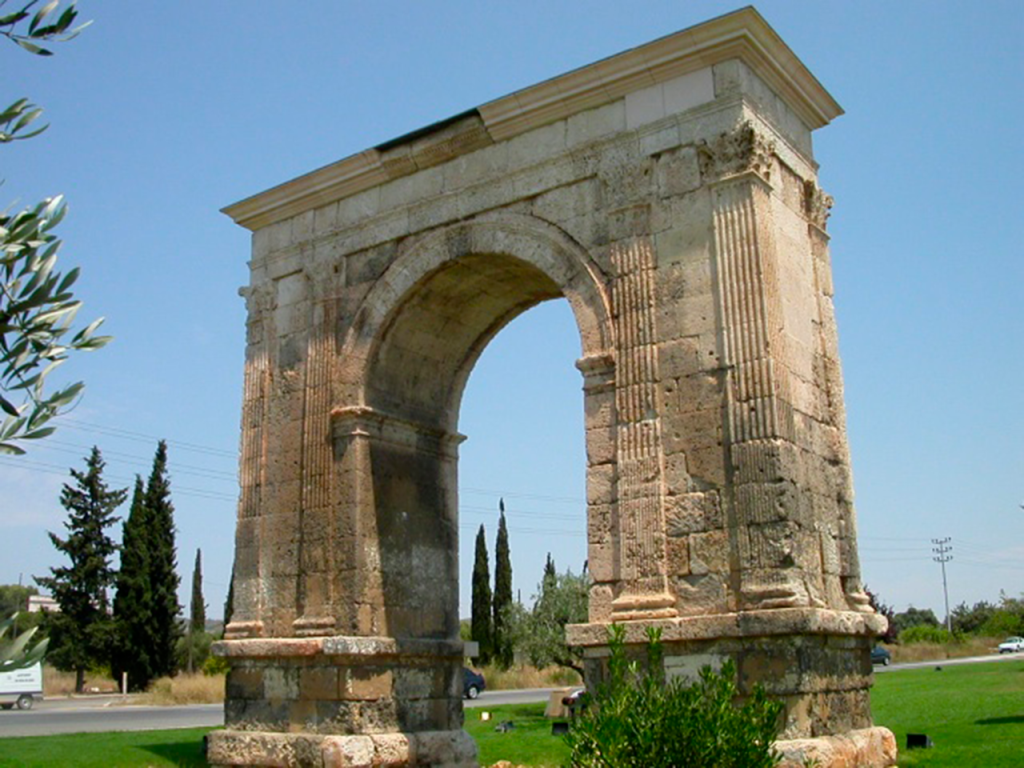
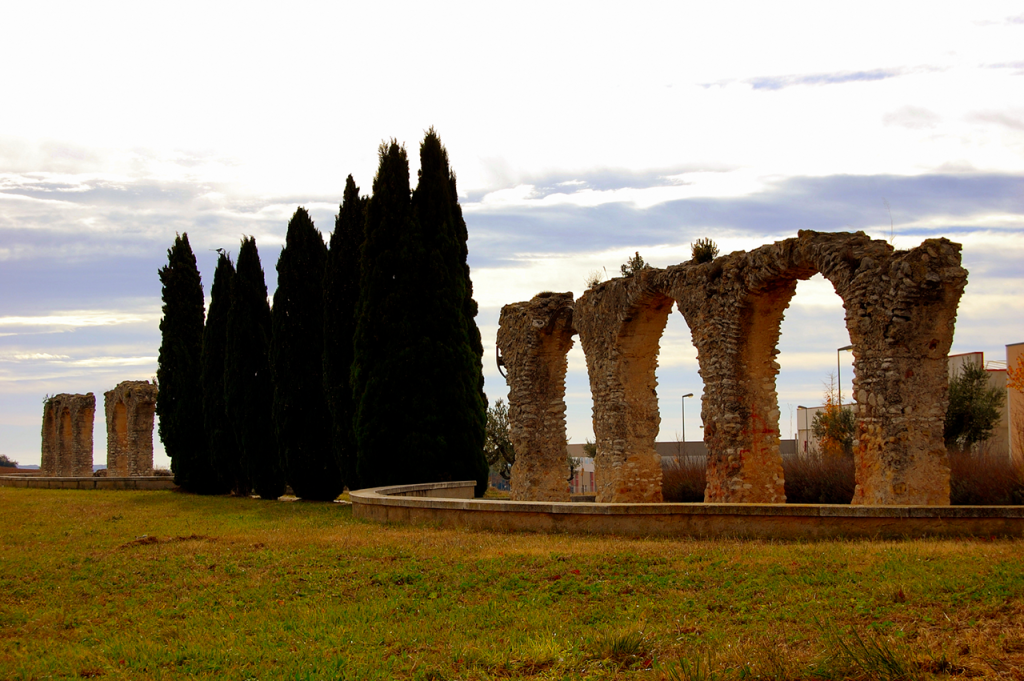
Along this unremarkable non-place, one cannot miss a set of arches running along the side road. One can tell they are old, but not how old; they could pass for a recent embellishment. This shows how unimportant ruins are assumed to be in the fabric of the landscape across the Mediterranean, for the arches are part of the Roman aqueduct of Sant Jaume dels Domenys, or locally the aqueduct “of the Arches,” Aqüeducte dels Arcs in Catalan.
After a few laps, we stopped for a moment, and I explained to her that the arches she could see weren’t someone’s recent folly. They are the remains of an aqueduct in the middle of a plain that looked like it does now, minus the industrial warehouses. The arches, aligned in a slightly curved line and preserved across 70 meters (over 200 feet), are divided into three sections.
What’s perhaps more interesting is how Roman engineers adapted to local conditions: they built it with crumbling local stones of various sizes, secured with plenty of Roman mortar, and used edge-set stone slabs only for the arches. They chose well, and the six surviving arches are still in good shape, and the mortar is indistinguishable from the one we used at our home a few years back. I’m sure our daughter saw some continuity in something she could see and experience, transcending local history books.
Between the apartment blocks, a citadel and a cellist
What baffles me is that one doesn’t need to imagine how it all would have been and felt, for the area we inhabit when we are in the Penedès is surrounded by sites with Iberian ruins, many of them only partially marked and excavated, as well as many Roman vestiges that no one gives a second thought to and many have forgotten about.
Ten kilometers from our house, there’s a beach town called Calafell whose beach, half a century ago, was still the fishing quarter of the old village up on the hill, near El Vendrell. The traditional fishing village of Calafell, where dandy intellectual and book publisher Carlos Barral made his refuge, fishing and sailing with locals, preserves only a few old houses by the water, surrounded by five- and six-floor apartment buildings built to host middle- and working-class Barcelonians from the sixties onwards. Foreign tourists are fewer here than on the affordable stretches of the Costa Brava or down the coast near Tarragona and Salou.
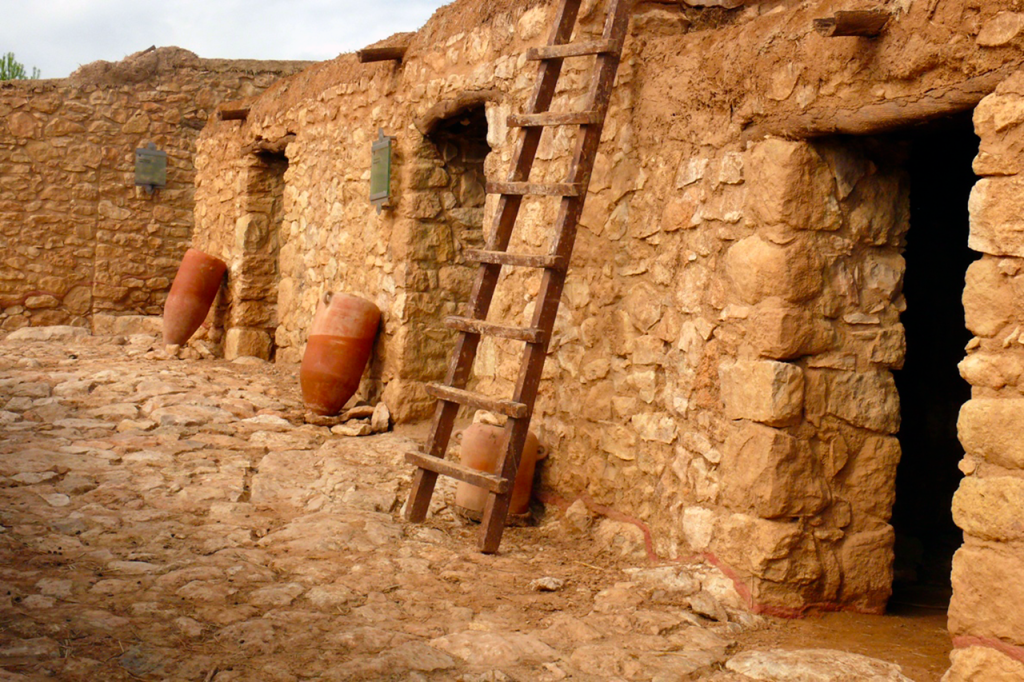
Nobody seems to notice that the town hosts a boulder surrounded by houses, with a reconstructed Iberian citadel on top of ruins excavated from 1983 to 1992 by Santacana and Sanmartí. It’s one of many fortifications along the valley, built to repel incursions from the sea. Yet the Romans prevailed and changed the place forever. The site was reconstructed on its own foundations from 1992 to 1994, the first site in the Iberian Peninsula rebuilt that way, set at its last occupied phase, the 3rd century BC.
Not far away is El Vendrell, the birthplace of Pau Casals, the cellist known worldwide for his heartfelt interpretations of Bach’s cello suites, who went into exile in 1939 in Prades, across the border in French Catalonia under the Canigó, and left for Puerto Rico in 1956. It’s a landscape of vines, olive trees, and a few almond trees, but also one of music. El Vendrell has its own beaches, Sant Salvador and Coma-ruga. On Sant Salvador, Casals built the house that is now his museum.
The grapes came before the Romans
Casals saw music as a series of vestiges that also connected to a deeper meaning. His birthplace area seems ideal: Iberian ruins show how deep the valley’s continuity runs. Vines turn up in every Iberian site in the Penedès studied for seeds.
Centuries before the Romans, local groups living at the archaeological sites of Font de la Canya, Sant Miquel d’Olèrdola, les Guàrdies, Darró, and even in the well-known beach town of Sitges planted grapes. As for traces of winemaking, El Vendrell (Mas d’en Gual: stems and hundreds of charred seeds) and the Iberian citadel nobody visits in Calafell yielded charred, crushed grapes from the 3rd century BC.
How did the vineyard landscape, already present in pre-Roman times, appear in this corner of the Western Mediterranean? The answer is about 20 km from our country house, which is clustered in a hilly hamlet with an early medieval castle on top, a vestige of the Frankish frontier in the valley.
The site of Font de la Canya, in the village of Avinyonet del Penedès, is unknown to locals despite being the cradle of vine growing in the whole region. Its oldest phase goes back to the 7th century BC, holding the largest set of Vitis vinifera seeds found in the northeast of the peninsula, the oldest evidence of vine growing in Catalonia.
Imported pottery from the same period gave archaeologists a clue to the origins. Phoenicians established colonies along the coast of the Iberian Peninsula, and they imported more than goods to barter. The local people, the Iberian Cossetani, brought grapes to the area and imported the technique through Phoenician trade; wine in amphorae and the taste for it shaped the territory from the 7th to the 3rd centuries BC. Many of these settlements were abandoned after the first Roman armies arrived in the Second Punic War; the larger ones, Darró and Olèrdola, continued into Roman times.
Wine good enough for Rome
As for the grape fields, they remained and grew, and the local wine reached the metropolis soon after. In his Natural History, Pliny credits Laietanian wine (or the one grown in the present-day metropolitan area of Barcelona) for volume and sets Tarraconensian wine, for elegance, beside Italy’s first. The poet Martial wasn’t only familiar with the wine from Tarraco but thought that it rivaled Italian varieties.
Drivers who go past the Arc de Berà may not be aware, but that area, ten minutes from El Vendrell, was one of the markers that wagons loaded with amphorae from the kilns of the Laietanian export trade had to cross, getting the local wine out of the valley and into the harbor and on to Ostia Antica.
Some of that wine reached Rome itself: amphorae of the Tarraconensian types turn up in the city, though the great amphora dump of Monte Testaccio, by the old river port on the Tiber, is Andalusian olive oil, not Catalan wine.
September 21 on the almanac, July in the fields
This year the picking was in its final stretch by the first week of September, weeks ahead of the old date. The yield was good after the drought years, but many growers ended the season with grapes they could not sell: the late varieties and the grapes meant for cava above all, according to the farmers’ union Unió de Pagesos.
Those same weeks, the wineries along the Ruta del Vi, which turns 25 this year, sold the harvest as an experience: a breakfast among the vines and a vat to tread barefoot, 39 euros a head.
The proverb still says Per Sant Mateu, verema arreu: by Saint Matthew’s Day, September 21, pick everywhere. The rows were bare long before that.
The date survives in conversation, at the village festes and on the wineries’ posters, the way the arches survive by the roundabout, in place and unused.