From the cul-de-sac to the canal path, our built environments shape how we move, think, and belong. Psychogeography isn’t dead—it might just have moved to the suburbs—to reinvent them.
Our landscapes—urban, suburban, rural—are not neutral backdrops. They shape who we are and what we can become, and sometimes not in a predictable way: A tightly zoned suburb can breed isolation hidden behind carefully trimmed lawns, whereas a walkable city can spark curiosity or critique (but the press and social media will only highlight crime events, distorting the reality experienced by a majority of people).
“Living on the wrong side of the tracks” isn’t just a topic to feed mini-novellas about living in forgotten towns or on the edge of opportunity. Sometimes, being aware of the existence of the wrong side of the tracks is the vantage point for seeing society as a whole and life in its unfiltered fullness. Life on the edges can breed alienation, and also spark the art we consume and hope, propelling the stories we want to watch and read.
It takes me an errand to drive any of my kids to different parts of the East Bay outside San Francisco to observe inequalities in safety, income, and life expectancy with the naked eye. The places we move through condition us—rewarding conformity in some corners, punishing difference in others. They carry the residue of past intentions: segregation, speculation, industry, resistance, counterculture, gentrification… And sometimes, these places speak back in unexpected ways.
Difficulties of professional flânerie
That’s perhaps why I’ve long been drawn to the act of wandering—what French underworld poet (and Edgar Allan Poe’s admirer and somewhat loose translator) Baudelaire once called flânerie—as a quiet rebellion. Long before I knew the term psychogeography (the influence of the geographical environment on our behavior), I sensed that drifting through forgotten alleys or overlooked corners wasn’t just escapism. It was a form of resistance, a way to loosen the grip of a world increasingly shaped by utility, surveillance, and order.
Perhaps that’s why, many years ago, I tried to define myself on our site’s bios section with two simple sentences:
“I like reading, writing, and photography. I also enjoy being with my family, running, philosophy, arts, and exploring interesting places (urban, natural, spiritual).”
The instinct to explore interesting places has stayed with me over time, but I’ve grown to appreciate strolls through less celebrated, less crowded corners. Wandering in dense urban areas can certainly offer a packed day of discoveries, yet drifting off the beaten path isn’t limited to cities. Suburbs and countrysides hold their own kind of quiet mystery—if you walk slowly enough to notice.
When we travel, we can perceive many of the ways environments shape people: which streets have the nicest, oldest trees and front yard gardens, which places seem well-tended and relaxed, or which areas don’t offer a welcoming feeling to them.
Even in our supposedly free societies, being out of place—or simply out of step—can get you in trouble. The line between loiterer and poet, misfit and menace, is thin. That tension—between celebration and brutality, freedom and constraint—is the same one humming beneath Childish Gambino’s This Is America, shifting from gospel joy to trap menace like a temperature gauge for the American psyche.
When the environment turns bland, affecting you
The rebels and antiheros of the 19th century are as prescient today as they were when they came along, perhaps because being caught off-guard nowadays can get you instantly in trouble if you’re off the norm.
That’s why I believed, and still do, that places shape people’s potential more than people shape places. Places do affect who we are and can enrich us—or get us in trouble.
That instinct deepened over time, and I found companions in literature showing me so, like the many celebrated young protagonists fleeing the provinces to make their mark in Paris, London, or New York. Through them, I realized that urban discovery—particularly in cities that carry sedimented time—is a universal calling. Baudelaire captured this beautifully in his idea of flânerie, the pleasure of aimless urban wandering in a city slowly shedding its artisans, alleys, and shadows in favor of progress and predictability. The flâneur was not just an observer, but a subtle resistor of modern order.
Nearly a century later, in 1955, that romantic longing found its radical twin in the work of Guy Debord. The poster child of the Situationist International reframed wandering as a political act, vindicating urban enchantment and organic, irregular, and residual charm when top-down urbanism favored the alienating functional planning of the likes of Le Corbusier.
In Introduction to a Critique of Urban Geography (journal Les Lèvres Nues, No. 6, 1955), Debord gave it a new name—psychogeography—and a mission: to expose how urban environments condition us, and how drifting through them might short-circuit the logic of spectacle, utility, and consumerism. And it’s indeed a pleasure to wander around and stumble upon charming buildings and lively streets.
The imprint of Bertram Goodhue, an architect of Romanticism
But this pleasure in drifting—so rich in poetry and potential—has been historically threatened for quite a while now. As cities modernized, they systematically erased the spaces that once sheltered unpredictability: the tenement, the back alley, the squat. Walking itself was sanitized; wandering became suspect, linked to vagrancy and moral failure.
The psychogeographer, like the punk or poet, became a ghost in the machine of the modern city. Consider the way many people talk about housing affordability: many only want to build “housing stock,” with no other consideration than cost and convenience, a recipe for building uninteresting non-places rather than rooted, interesting neighborhoods people enjoy living in and visiting.
Erasing the urban past isn’t healthy or advisable for similar reasons. Not all ghosts go quietly. In spaces meant to be forgotten—cracked sidewalks, abandoned lots, underpasses—new forms of rebellion were born for a reason: gentrification always begins at the affordable, semi-industrial periphery of dynamic places that got too expensive. Just as the poètes maudits and early Romantics rebelled against the rationalized city of the Enlightenment, punks and other urban tribes reclaimed derelict space as sites of identity and resistance. Their very presence carved out pockets of freedom in cities built for productivity and order.
This process has been going on for a long time. Like the punks and other urban tribes in deindustrialized cities during the late 70s and 80s, the early poètes maudits and Romantics (from Chateaubriand and Byron to Goethe’s fictional antihero Werther), reacted against the planned, functional, predictable, commercial city, seeing it as alienating.
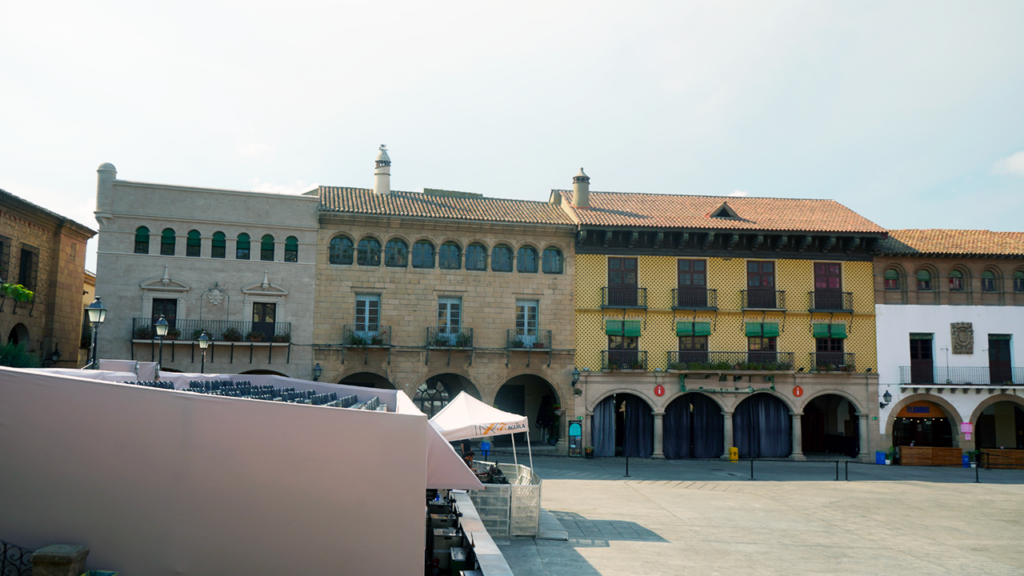
As cities grew more hygienized, old cities began to restore their medieval centers in Europe, whereas in the United States, architects and planners like Bertram Goodhue thought of building little Mediterranean paradises from scratch just outside the places that had pioneered functionality and car reliance, like Los Angeles. Born in Connecticut, Goodhue did not have formal architectural training in college but learned the trade as an apprentice, largely self-taught and observant of the European vernaculars he encountered during extensive travels to France, Spain, and Italy.
When Goodhue invented a “style” for California
Later in life, he spent significant time working in California, where he set out to reinvent the way Americans lived and prospered (right when the Panama Canal was going to connect the West Coast to the world’s commercial hubs). To do so, he took elements from Baroque and Moorish Andalusia, reimagining them in entire neighborhoods in Southern California, and people mostly cherished the results —his work in Gothic Revival and Spanish Colonial Revival transformed the way many Americans see their neighborhoods.
During the 1915 Panama–California Exposition celebrated in San Diego one year after the opening of the canal dramatically boosted maritime trade by connecting the Atlantic and Pacific Oceans, and the exposition celebrated California’s new strategic role from backwater to new central point between the West and Asia (the dream of the Spanish when they set the “galeón de Manila” connecting the Philippines and Acapulco). To Goodhue, California wasn’t meant to remain a wild frontier, but as part of a Mediterranean ideal made of the convenient parts of old-world urbanism, blended with local pragmatism.
What Goodhue built for the San Diego exposition was remarkable. In retrospect, entire neighborhoods of Southern California and the urban coherence of Santa Barbara wouldn’t exist without his work’s influence. Departing from Beaux-Arts norms (you have to know the rules to break them for good), Goodhue embraced asymmetry, ornament, vernacular influence, and the ability of architecture to enchant a place’s inhabitants and visitors.
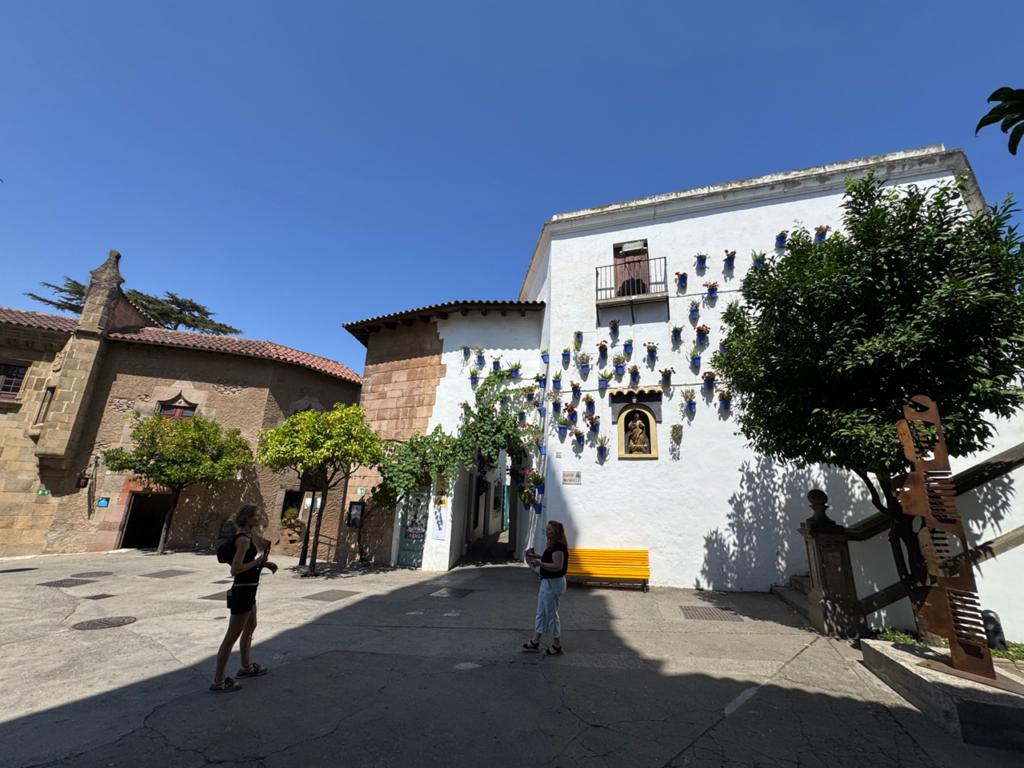
His inventive revival didn’t exist in Spain or anywhere else in the Mediterranean the way he envisioned it, let alone California, but it blended and worked in the climate and character of a place that still carried living memories of the Mission era. Synthesizing the best of Spanish vernaculars (small-town, Baroque, Moorish influences, Mission elements already in place), he approached the potential of Romanticism to the pragmatic Californians. And they liked the new blend, because it felt good to walk by, and to live and work in.
Soon, the exposition’s buildings, especially the California Building and its ornate tower, became icons. Architects across the Southwest mimicked this style in homes, civic buildings, and churches.
A Spanish ideal village encased in Barcelona’s Montjuïc
Fast forward a few years to 1929 and cross the Atlantic. In that year, Barcelona celebrated its second International Exposition, and this time the city’s authorities wanted to enchant visitors at a whole new level. Right when the city had finished its celebrated grid expansion from the Old City near the sea towards the hills, Ildefons Cerdà’s Eixample, maybe the exposition could host another type of urban experience, one more in sync with flânerie and psychogeography.
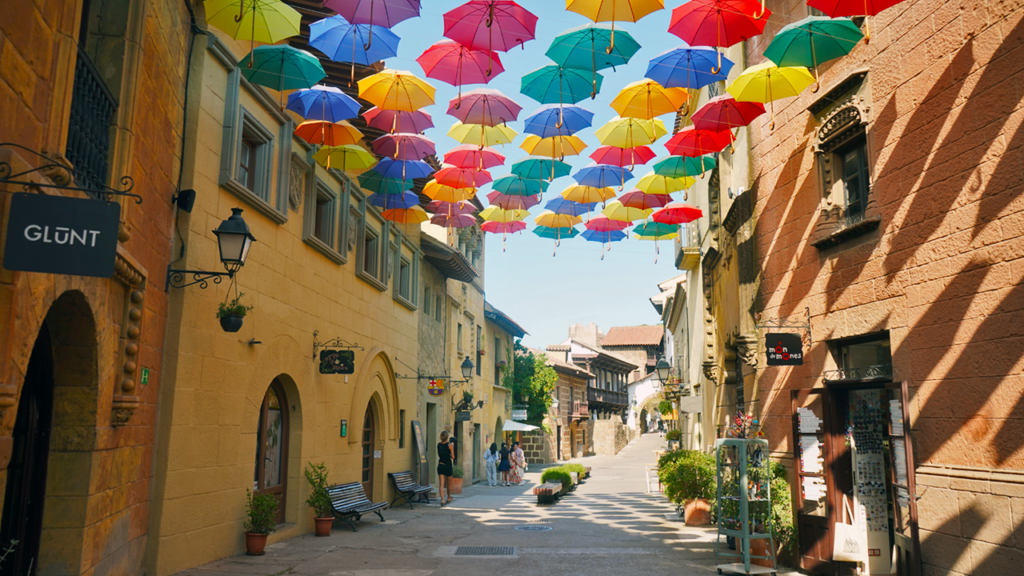
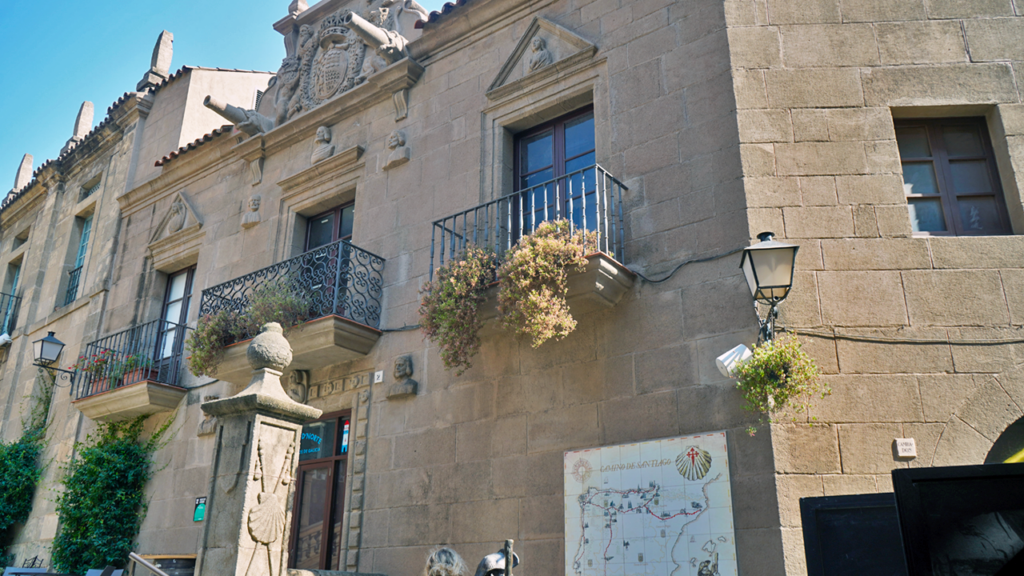
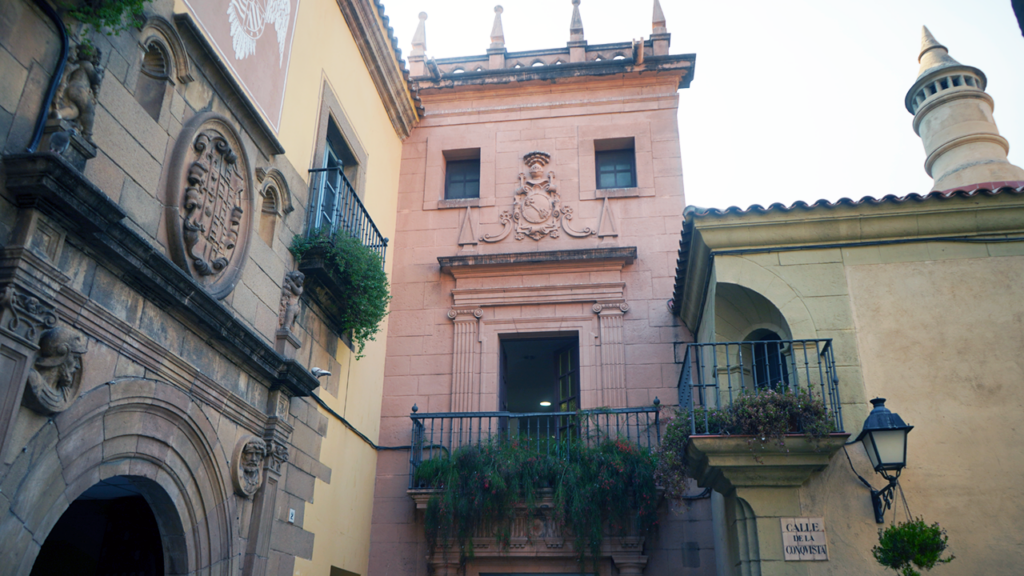
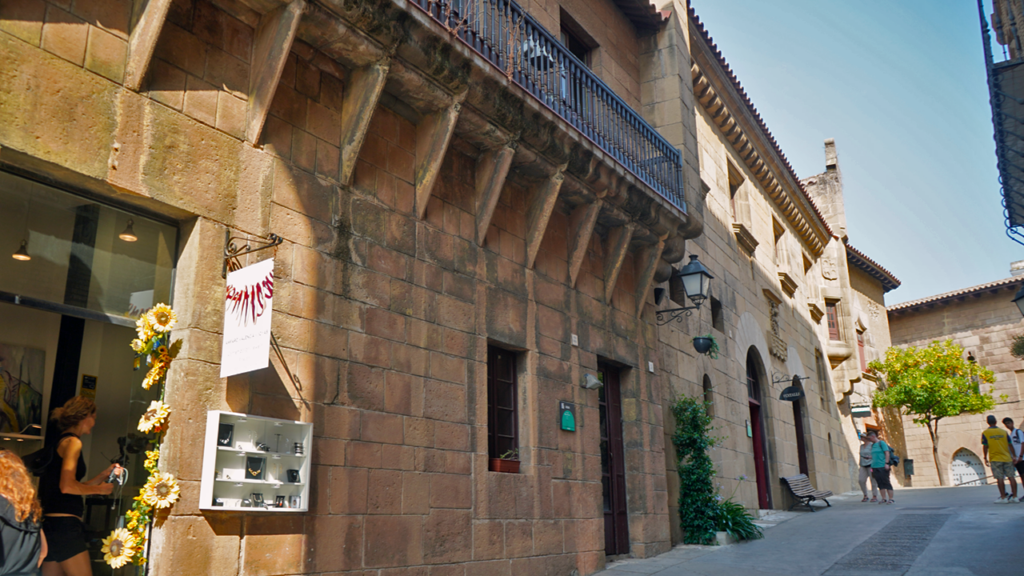
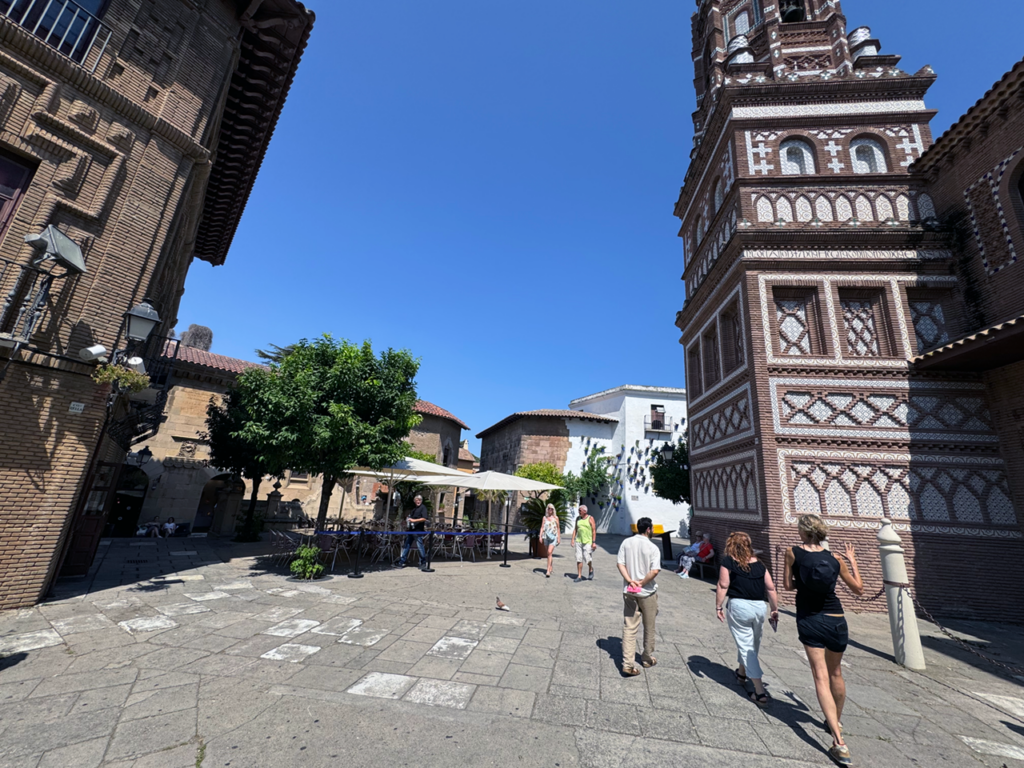
A mere 400 meters away from the Fountains of Montjuïc, Barcelona allocated an oversized parcel to bring to life a rather Quixotic enterprise: to create a Medieval-looking village from scratch (with walls, churches, stores, homes, main square, and all) representing the main vernaculars across the country.
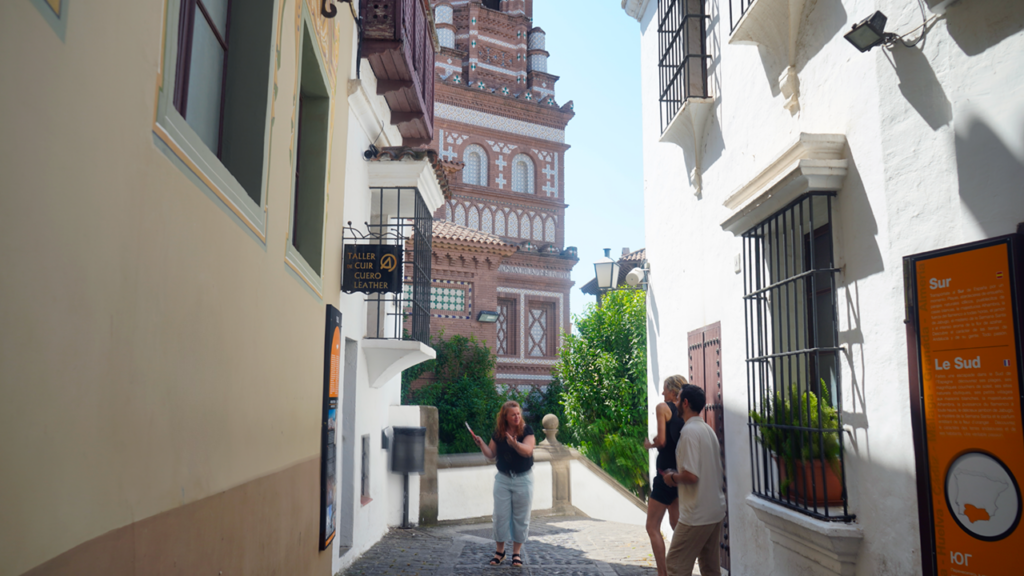
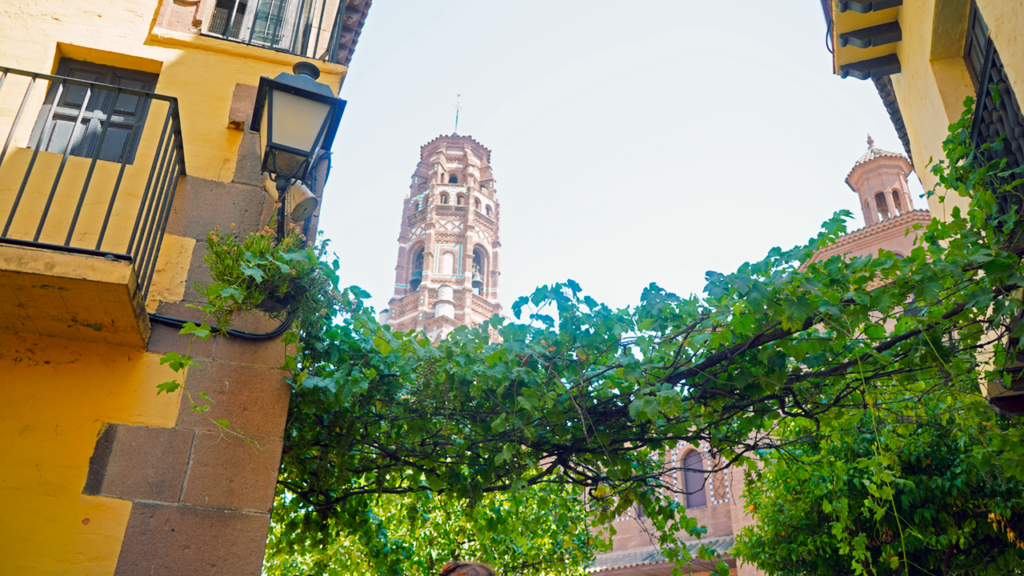
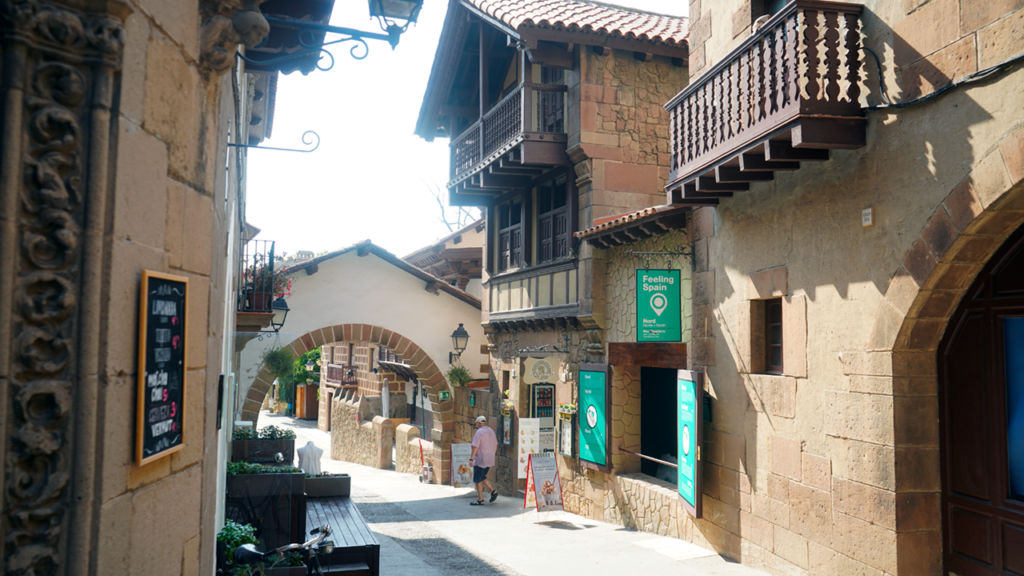
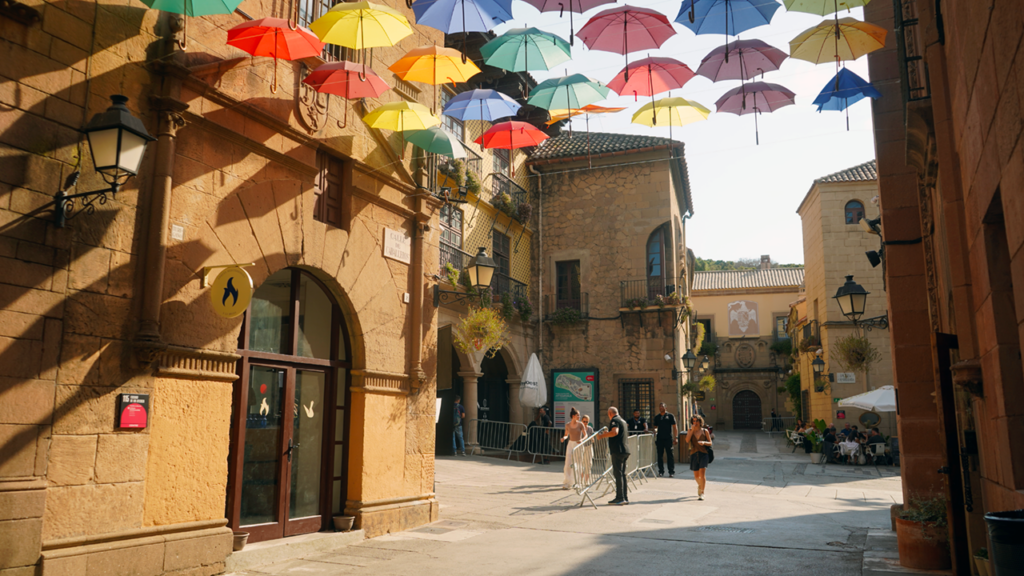
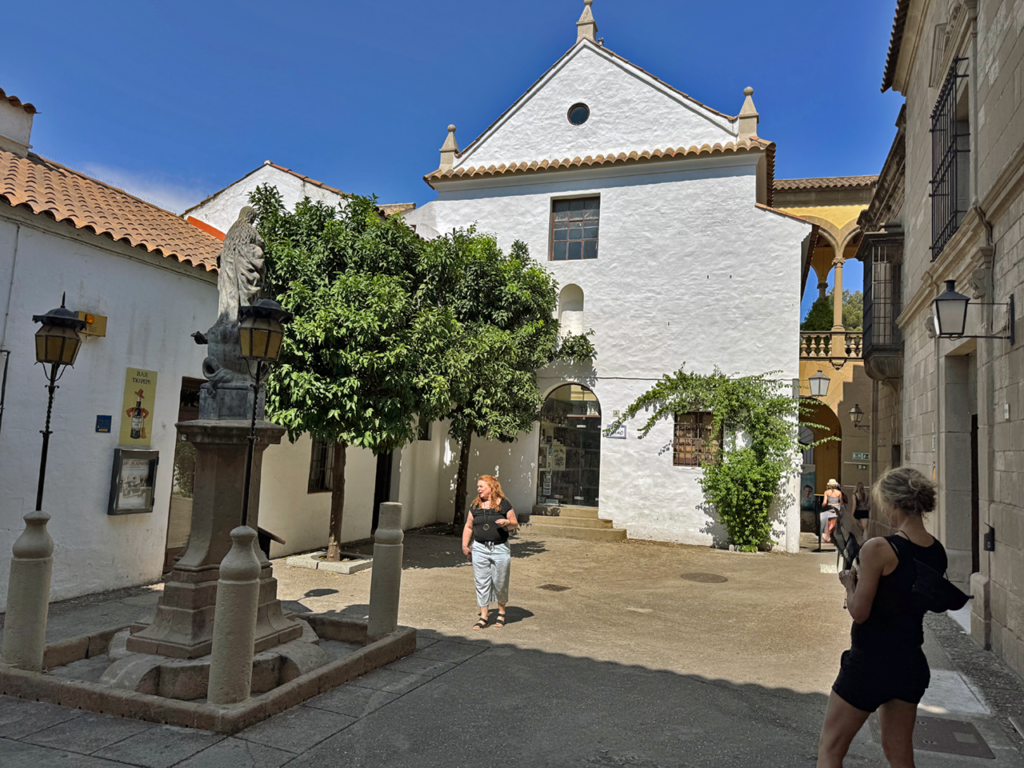
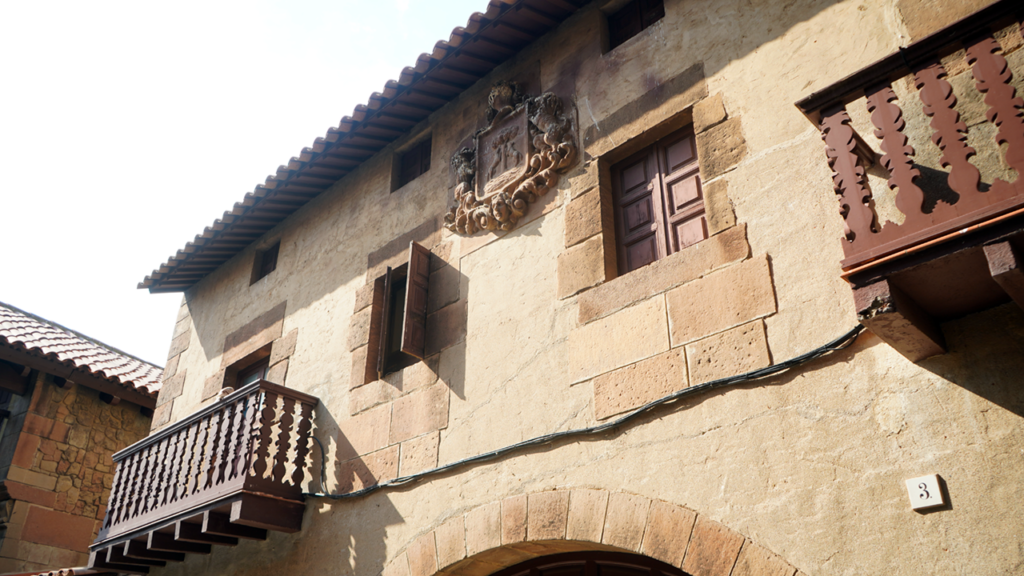
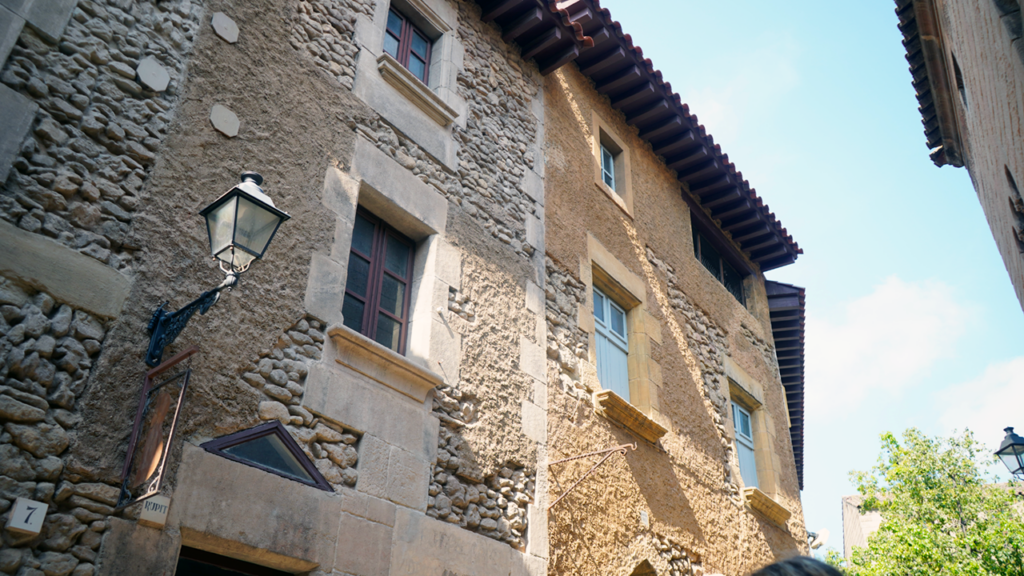
That’s how Poble Espanyol (Catalan for Spanish Village, Pueblo Español) came to life, hosting 117 full-scale buildings replicated from different parts of the Iberian Peninsula, recreating entire village atmospheres and even microclimates thanks to narrow, irregular streets where the breeze kept temperatures down in summertime.
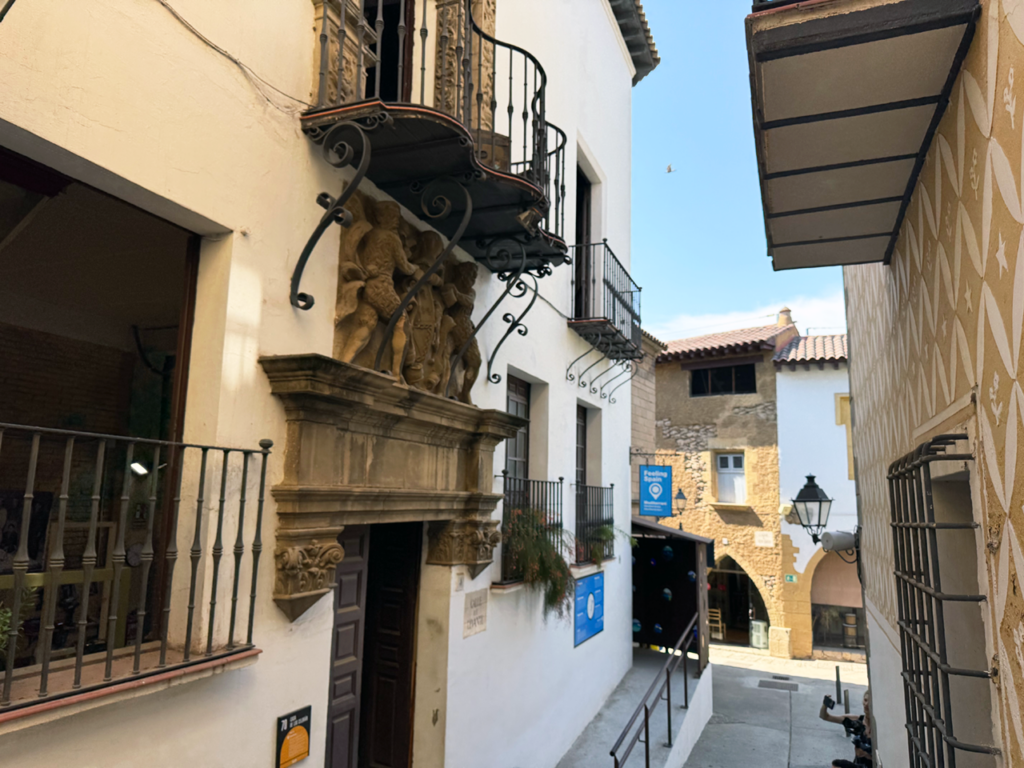
This “Spanish town” made of archetypal buildings and narrow streets was meant to be destroyed after the exposition, but public outcry saved it; today, it can be considered a tourist trap… or an opportunity to experiment by oneself how Romantic spaces transform our mood, potentially affecting our perception and well-being.
As always, there’s a personal story: like any Barcelonian who has lived in the Old City for years, I never visited Poble Espanyol (not even to see a concert or a theatre play, common events there), nor was I really interested in doing so. And I’m pretty glad that, when it was time for me to pay a visit to the place, I didn’t go with a preconceived idea. I just walked around, back and forth, and marveled, amid a heat wave that was pummeling Europe, to experience how much nicer its small streets are when it’s hot and humid in the city, thanks to its “backwards” medieval design. It didn’t feel real at all, but it felt prescient, and it reminded me of the many places I still have to visit in my own country.
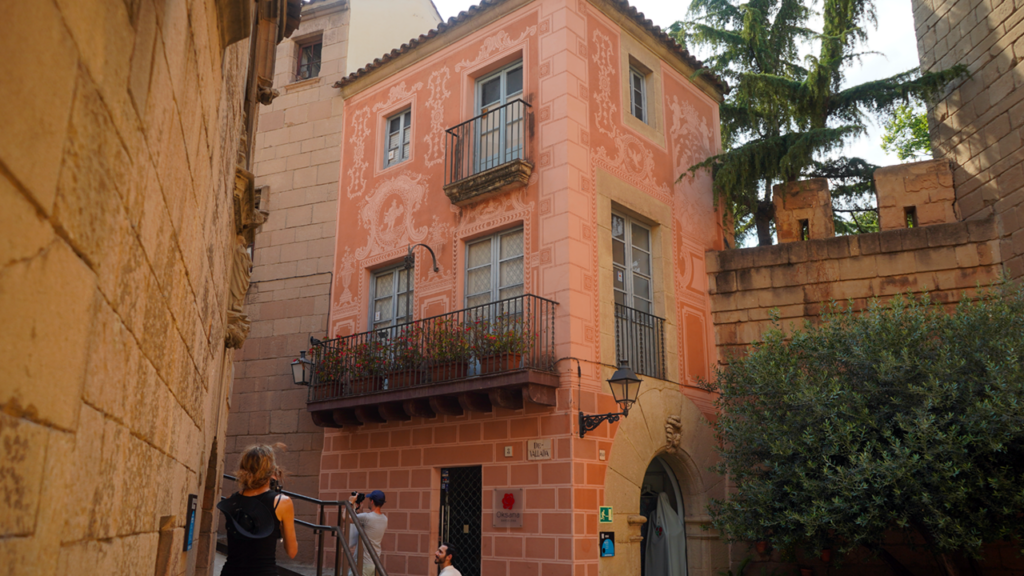
Poble Espanyol in Barcelona and Goodhue’s buildings in San Diego’s Balboa Park for the Panama-California Exposition (the California Building; El Prado Complex with its ornate buildings connected by arcades, courtyards, and gardens; the Cabrillo Bridge, etc.) were both invented places—romantic, ideologically loaded constructs that used architecture to shape memory, identity, and desire. But they laid out the groundwork for how regions imagine themselves in the modern world.
The literature of arrivistes
It’s no coincidence that artistic vanguards and subcultural misfits have long been drawn to society’s spatial margins. From the tortured Romantics to the members of the 27 Club, these cultural outliers turned their backs on cities designed to suppress spontaneity. They didn’t just live in the city—they rewrote it, redrew its emotional cartography.
It’s interesting to notice all these novels of “arrivistes” (social climbers) trying to break through in the city and make sense of the modern world, which was a big genre in 19th-century French literature, particularly (to portray all these patois, imagine Midnight Cowboy as an equivalent for New York one century after).
The list of celebrated arriviste characters in 19th-century French literature is quite spectacular: Eugène de Rastignac in Balzac’s Père Goriot (“It’s between you and me now, Paris!”); Lucien Chardon, later Lucien de Rubempré in Balzac’s Illusions Perdues (a rise-and-fall cautionary tale); George Duroy, in Guy de Maupassant’s Bel-Ami; Julien Sorel in Stendhal’s Le Rouge et le Noir; Frédéric Moreau in Flaubert’s L’Éducation sentimentale…
If you think these characters have nothing to do with you, they inspired many other stories. Without them, many celebrated classics wouldn’t have found a proper footing and “inspiration”: Nick Carraway in The Great Gatsby, Jake Barnes in The Sun Also Rises, Joyce’s alter ego Stephen Dedalus in A Portrait of the Artist as a Young Man, Salinger’s Holden Caulfield from The Catcher in the Rye… Many of these writers were soaked in the mentioned French novels before writing their own.
All these arriviste characters respond to a social trend in their time: as youngsters leaving the countryside to try to make it in the city, they found creative ways to thrive despite the odds stacked against them, even if they chose to rise through the cracks and back doors of the respectable, mainstream society. Would they have the same luck nowadays?
In these books, the city is a character that gives and takes, an environment that emerges as a character with a soul. By contrast, many of the popular novels around love intrigues in the narrow-minded, emerging burgeois world which back then dominated in the Anglo-speaking world, from Henry James’ A Portrait of a Lady (cautionary tale for air-headed American girls idealizing the charms of Old Europe) to the perennial Pride and Prejudice, seem to play out in the static, idealistic countryside environments of the gentry.
I’ve always preferred the former (the portrays of characters striving to rise socially and materially) over the still-life depictions of the new-wealth-imitating-old-wealth portrayed by the latter, and I’m assuming either young men have a giant chip on their shoulder, or they prefer roleplaying adventurous rollercoasters instead of dreaming of playing real tennis with some respectable ladies in their English lawns.
Learning from outcasts
Same with American literature: give me the Frontier and the misfits, and forget the rigidities imported from the Old World. Over in the US, hobos and bums fought alienation and the process of normativization of the modern world with the same unstructured medicine: hop on a train or walk the road like Thoreau or Whitman or Jack London or Thomas Wolfe, and you’ll pierce through the bland conformity of convenience and relative prosperity, finding America in the raw.
It’s as if the urge to wander, resist, and re-signify space—core to psychogeography—is not limited to European cities, but finds its grandest, most expansive expression in the American tradition of territorial drift. America has long extended psychogeography beyond the city, transforming it into a national mythos: the open-ended journey as a form of existential and spatial resistance.
I cannot help but sympathize with the individuals who struggle to adapt to society’s conventional paths that populate American literature, from the serialized popular reads of westerns, adventure fiction, pulp-noir, sci-fi, etc., to the books also sanctioned by critics then and now.
Unlike most of their counterparts in Europe, the outcasts from American popular novels (back when they were the popular serialized entertainment, akin to TV/Netflix series or YouTube videos today) extended their wandering beyond cities and into the untamed landscape, which (unlike in the Old World) held a promise of a new beginning, even when it was as out of reach as anywhere else.
East of Eden
Consider, for example, the early struggles of good-hearted Adam in East of Eden, who at the beginning of Steinbeck’s novel is clearly favored by his father over his brother Charles, the tormented and bullied second, but struggles to be the ideal son envisioned by his father. When Steinbeck writes about how young Adam ends up not wanting to go back to the still world of the family’s Salinas valley farm, ending up a hobo, he was tapping into the spine of early mass-society alienation, and the adventurous way to fight it: if you’re resourceless, built a resourceful existence out of having nothing at all. Here’s how Steinbeck describes that part of Adam’s life. Instead of entering home, where he’s expected, he gets close and then leaves, repelled like the negative poles of a magnet:
“Adam waited out the winter, wandering up the river to Sacramento, ranging in the valley of the San Joaquin, and when the spring came Adam had no money. He rolled a blanket and started slowly eastward, sometimes walking and sometimes with groups of men on the rods under slow-moving freight cars. At night he jungled up with wandering men in the camping places on the fringes of towns. He learned to beg, not for money but for food. And before he knew it he was blindlestiff himself.
“Such men are rare now, but in the 1890s there were many of them, wandering men, lovely men, who wanted it that way. Some of them ran from responsibilities and some felt driven out of society by injustice. They worked a little, but not for long. They stole a little, but only food and occasionally needed garments from a wash line. They were all kinds of men—literate men and ignorant men, clean men and dirty men—but all of them had restlessness in common. They followed warmth and avoided great heat and great cold. As the spring advanced they tracked it eastward, and the first frost drove them west and south. They were brothers to the coyote which, being wild, lives close to man and his chickenyards: they were near towns but not in them. Associations with other men were for a week or for a day and then they drifted apart.
“Around the little fires where communal stew was bubbled there was all manner of talk and only the personal was unmentionable. Adam heard of the development of the I.W.W. with its angry angels. He listened to philosophic discussions, to metaphysics, to esthetics, to impersonal experience. His companions for the night might be a murderer, an unfrocked priest or one who had unfrocked himself, a professor forced from his warm berth by a dull faculty, a lone driven man running from memory, a fallen arcangel and a devil in training, and each contributed bits of thought to the fire as each contributed carrots and potatoes and onions and meat to the stew. He learned the technique of shaving with broken glass, of judging a house before knocking to ask for a handout. He learned to avoid or get along with hostile police and to evaluate a woman for the warmth of heart.”
“Adam took pleasure in the new life. When autumn touched the trees he had got as far as Omaha, and without question or reason or thought he hurried west and south, fled through the mountains and arrived with relief in Southern California. He wandered by the sea from the border north as far as San Luis Obispo, and he learned to pilfer the tide pools for abalones and eels and mussels and perch, to dig the sandbars for clams, and to trap a rabbit in the dunes with a nose of fishline. And he lay in the sun-warmed sand, counting the waves.
“Spring urged him east again, but more slowly than before. Summer was cool in the mountains, nd the mountain people were kind as lonesome people are kind. Adam took a job on a widow’s outfit near Denver and shared her table and her bed humbly until the frost drove him south again. He followed the Rio Grande past Albuquerque and El Paso through the Big Bend, through Laredo to Brownsville. He learned Spanish words for food and pleasure, and he learned that when people are very poor they still have something to give and the impulse to give it. He developed a love for poor people he could not have conceived if he had not been poor himself. And by now he was an expert tramp, using humility as a working principle. He was lean and sun-darkened, and he could withdraw his own personality until he made no stir of anger or jealousy. His voice had grown soft, and he had merged many accents and dialects into his own speech, so that his speech did not seem foreign anywhere. This was the great safety of the tramp, a protective veil. He rode the trains very infrequently, for there was a growing anger against tramps, based on the angry violence of the I.W.W. and aggravated by the fierce reprisals against them. Adam was picked up for vagrancy. The quick brutality of police and prisoners frightened him and drove him away from the gatherings of tramps, He traveled alone after that and made sure that he was shaven and clean.”
Beginning of Chapter 7 of East of Eden (John Steinbeck, 1952)
Survival of a hobo spirit in a hygienized world
But the process of enforced socialization by punishment (see policies like hygienism, eugenics, etc.) established by modern, sanitized societies caught up with young Adam, who learned to adapt before he was too tired to stay a hobo and finally entered home after his father’s death:
“Adam waited until three days before his second release. Right after noon that day he filled the water buckets and went back to the little river for more. He filled his buckets with stones and sank them, and then he eased himself into the water and swam a long way downstream, rested and swam farther down. He kept moving in the water until at dusk he found a place under a bank with bushes for cover. He did not get out of the water.
“Late in the night he heard the hounds go by, covering both sides of the river. He had rubbed his hair with green leaves to cover human odor. He sat in the water with his nose and eyes clear. In the morning the hounds came back, disinterested, and the men were too tired to beat the banks properly. When they were gone Adam dug a piece of water-logged fried sawbelly out of his pocket and ate it.
“He had schooled himself against hurry. Most men were caught bolting. It took Adam five days to cross the short distance into Georgia. He took no chances, held back his impatience with an iron control. He was astonished at his ability.”
Chapter 7, East of Eden (John Steinbeck, 1952)
Today, this urge to abandon the rigidity of convention and narrow perception of success within prosperous societies still holds true with a growing number of misfits, from the merely disenfranchised to those who can play in the margins while keeping the door back to the world of convention and quantified productivity ajar.
Right to dream and wander
Interestingly enough, many cities in the Old and New worlds experienced a similar phenomenon as the middle classes and wealthy left their overcrowded historical centers and chose to live in more spacious, rational sections “uptown.” This holds in places like Barcelona, but also in New York and many other cities.
Romanticism didn’t beat a sense of function, efficiency, convenience, and safety. With time, the newer, more rational avenues attracted their own rich psychogeography, and nobody in Paris would nowadays criticize the Haussmannian renovation of the city for the sake of authenticity and experience.
Yet, we need to be exposed to the layers upon layers of beauty and randomness that make places special. Goodhue understood this and tried to enrich the American sense of utility with “new” ways of experiencing urban environments that consisted of exposing people to mainly pastiches of “old” styles. It worked and made people dream and envision new lives.
Today, the places he envisioned belong to the places they were built in, and nobody would dare to say that his San Diego legacy, or Santa Barbara, or Stanford University, are foreign to California.
It’s more difficult, though not impossible, to reclaim the leftovers of the post-industrial, exurban landscapes, the so-called “non-places” of today. But many people reclaim them as their own and build worthy memories around them.
A kid from Santa Barbara
This morning, as I drove through one of such unimportant landscapes, I recalled my days as a teenager, when every edge, every so-called “wrong side,” had its own quiet rituals, its own ways of marking territory, of shaping time.
Maybe psychogeography today isn’t about reclaiming Parisian boulevards from rational planning. Maybe it’s about reimagining the geography of sprawl—finding meaning in drainage ditches, strip malls, abandoned big-box parking lots. About how the spatial codes of class, race, and aspiration live on in these in-between zones, but also how they can be cracked open, rewritten, walked through differently.
Wade Graham’s book Dream Cities, a compendium of “seven urban ideas that shape the world,” opens with a first chapter (called Castles: Bertram Goodhue and the Romantic city) in which he explains his relationship with the world he interacted with growing up in Southern California:
“I grew up in sixteenth-century Andalusia. Or so it might have seemed. Most of the small city where I was born is made of white stucco buildings with deep-set windows guarded by wrought iron grates and topped with red roofs. The courthouse is resplendent with brightly colored Tunisian tiles and crowned by a baroque clock tower; even its jail resembles a Moorish palace. The scent of orange blossoms fills the air in winter, and bougainvillea and roses drape over homes and businesses alike. The town’s sea of red roofs is presided over by the twin bell towers of an old Spanish church. The street grid is laid out on the 45-degree tilt specified by the Laws of the Indies, the street names drawn from the surnames of the town’s first Spanish settlers. A handful of the original adobe structures have been restored and stand as reminders of historical continuity. But 99 percent of the city is fake. This is Santa Barbara, California, 90 miles north of Los Angeles, mostly constructed in the twentieth century and still being built in the twenty-first by Americans flush with industrial fortunes intent on living inside a full-scale stage set of someone else’s vanished past.
“As a kid, I traversed this faux-Mediterranean idyll on my skateboard. It all seemed perfectly natural. As I got older, I absorbed the mostly unspoken narrative that this ambience and attention to detail were what made us in Santa Barbara different, and, it was implied, better than those condemned to live in L.A., the smog- and traffic-chocked Babylon to the south. This story was reassuring: the town’s antiquated style conferred both a measure of virtue and some degree of protection, because of its separation in time and space from the degraded and degrading Big City.
“The separation in space was easy enough to understand: to leave the traffic and smog to others not fortunate enough to live here was evidently a good thing. The other part—the vague sense of virtue that the town’s architecture promised—was harder to nail down. Gradually, I came to understand that what was at play was psychological, the achievement of a sense of time travel to a better world. For it to work, the place needed to be more than simply many miles away from the city. It had to be apart from it, as if it occupied a time in the past, a separation more important than physical distance and much harder to bridge. At the simplest level, the veneer of antiquity promises those who invest in it a good return, not just in property value but in worth—in the social-worth and possibly the self-worth sense. A patina of antiquity in real estate can vest a person or family with the aura of old money—which is why the nouveaux riches of all eras have chosen to buy castles to launder their money, washing that bad, arriviste smell out of their wealth. In Santa Barbara the money has mostly always been “new,” as each generation of new arrivals brings its loot from some distant capitalist battlefield, retiring from the fray in genteel fashion in this paradise.
“The illusion of standing apart in space and time also satisfied another longing: to not live in a modern city at all, to have nothing to do with what the city stands for—work, toil, struggle, urgency, and other people, especially undesirable ones. Santa Barbara is a modern city made successful by pretending that it is neither thing. Its new ‘old’ architecture is an illusion that sustains the collective delusion of difference, which is what makes it so desirable. It forms the basis for a limited-access Utopia.”
Excerpt from Chapter 1 of “Dream Cities: Seven Urban Ideas That Shape the World” (2016) by Wade Graham
We tend to think of space as fixed, but how we inhabit it—how we walk it, see it, story it—changes everything. Psychogeography might just be a practice of paying attention to how we’re shaped by the places we ignore.
Maybe the “wrong side of the tracks” isn’t wrong at all—just the side less mapped by capital, more textured by experience, and the open-road potential that made hobos like Walt Whitman thrive.