How social changes, housing policy, and neglect worsen mental health and homelessness in America. Lessons from history and abroad show the cost of ignoring systemic solutions.
For all the backlash regarding ChatGPT 5 and the debate around whether there’s an AI bubble and how significant the real impact of the field in society is, recent studies show that the use of the technology is affecting the work prospects of young graduates between 25 and 30 years old, while older professionals are enduring the impact much better.
However, AI, like deindustrialization in the 1970s, 1980s, and 1990s, may affect people’s lives more profoundly, causing them to shift their perception of self-worth and purpose in life. And this time, this new wave of alienation may affect white-collar jobs instead.
Why are adults faring better when competing against AI tools? For one, adults have had more time to develop the experience and contextual skills that make their work much more difficult to substitute with chatbots. The data should provide some insights for people about how teens should approach college and their careers.
What’s left to do and create
Paradoxes and strange lessons mark our times. After being bombarded for years with the message that they need to focus on STEM degrees, such as computer engineering and computer science, the reality is that many STEM graduates face higher unemployment rates than those in fields like Art History, Philosophy, or Nutrition sciences, among others.
Several factors influence the trend, among them a notorious tech sector hiring slowdown after the Covid hiring frenzy, but the elephant in the room is automation and AI: many tech companies are already excelling in using AI in some entry-level tech tasks: software development, customer support, clerical roles, content creation, and data analysis are deeply evolving, fast, mainly affecting workers ages 22-25.
I just read a quote by author and videogame enthusiast Joanna Maciejewska that captures the moment:
“I want AI to do my laundry and dishes so that I can do art and writing, not for AI to do my art and writing so that I can do my laundry and dishes.”
Who the Charles Dickens of our times should be, I have no idea, but I have the intuition that a public figure with such an impact in the intellectual discourse and pop culture at the same time isn’t a writer today, if we take recent articles regarding the decline of reading among both adults and the young at face value: I don’t know if the novel-reading men are gone for good, as Joseph Bernstein argues, or whether fewer people are reading books at college or in general, period, especially for fun.
What I know is that many of the ones who do, including me, would benefit from a contemporary story with an equivalent structure to A Tale of Two Cities:
“It was the best of times, it was the worst of times, it was the age of wisdom, it was the age of foolishness, it was the epoch of belief, it was the epoch of incredulity, it was the season of Light, it was the season of Darkness, it was the spring of hope, it was the winter of despair, we had everything before us, we had nothing before us, we were all going direct to Heaven, we were all going direct the other way—in short, the period was so far like the present period, that some of its noisiest authorities insisted on its being received, for good or for evil, in the superlative degree of comparison only.”
A new Dickensian saga
The new story could be called A Tale of Two Industrialisations. Here’s the thesis: When America’s factories fell silent in the late 20th century, it wasn’t just machines that were turned off—it was people’s sense of purpose. The deindustrialization that swept through cities from Detroit to Youngstown didn’t only eliminate paychecks; it dismantled identities and a very working-class sense of pride and meaning.
Work had been a source of belonging, dignity, and rhythm to life, and when assembly lines vanished, so too did the communities built around them. The fallout trickled down into every corner of society: rising unemployment, crumbling neighborhoods, a spike in addiction, and untreated mental health struggles. Homelessness became not only a problem of shelter but also a crisis of meaning.
Today, we stand on the edge of a transformation of similar magnitude, but the machines being switched out are cognitive ones. Artificial intelligence is beginning to take over tasks once thought safe from automation—coding, design, customer service—even creative writing. For entry-level workers, especially, the disruption threatens not just their income but also the fragile bridge between education and stable adulthood. If losing manufacturing jobs fractured the industrial worker’s self-esteem, the displacement of knowledge workers could fracture society’s broader faith in upward mobility.
Left unchecked, this could lead to cascading social effects: heightened stress, alienation, untreated mental illness, and, ultimately, an increase in addiction, difficult-to-treat “diseases of civilization,” and yes: ultimately, it could trickle down to people having a hard time finding a place in society, which could increase the percentage of adults living with their parents, isolating themselves like the Japanese “hikikomori,” and also homelessness. Just as steel towns became cautionary tales, we may find AI-shuttered offices echoing with similar human costs.
Blaming the last buzzword for the Seven Plagues
We should not fall into the temptation of blaming AI for all our current and future problems. Social media became the big evil for years, but now chatbots are the main culprit. Chatbots may not be causing people to date less or leading to psychosis. Chatbots may be affecting these phenomena, but it is not yet clear how much, and sometimes they could be positively impacting social issues.
So, after discarding the characterization of AI as the main or sole evil of our times, I can’t help but observe how the new gold rush engulfs the Bay Area with exciting new energy, very big investments, exciting prospects for many people, but also an exacerbation of the region’s challenges with housing and the people at the margins of society.
Just as shuttered steel mills left not only economic voids but social ones, today’s AI wave may unsettle far more than job markets. When livelihoods collapse, the consequences rarely stay confined to paychecks; they cascade into mental health, addiction, and ultimately homelessness. Of course, there will be no way to prove how yet another technological transformation and the riches it creates in the Bay Area will exacerbate the region’s problems, ultimately making it more expensive to live there and increasing exclusion at the margins.
And this won’t be a Bay Area-only or a California-only issue. When we recently traveled to the Pacific Northwest and adjacent areas in and around the Great Basin, I became really interested in our visit to one very American poster child of social issues affecting the working class: we had visited the college town of Eugene many times—a quirky college town with a hippie legacy and TrackTown, USA (birthplace of Nike and epicenter of the running phenomenon thanks to the coach Bill Bowerman and runner Steve Prefontaine), but I had never been in its sister city right next to it, Springfield.
A mural in an industrial town
As we drove to it, Kirsten mentioned Springfield as “the place of The Simpsons,” and I honestly thought she was joking (not very successfully). Then we crossed a bridge into town, and I started to see murals of the series, which required a quick dive into Wikipedia. A quick glimpse at the city, surrounded by factories, lumber yards, and visibly depressed neighborhoods, made me realize that Springfield resembles places in the Midwest more than wealthy coastal areas.
Approximately one-third of Springfield residents pay over 30% of their income toward housing, which is considered a cost burden, according to HUD figures. To add complexity to the issue, city policies—including large minimum development area requirements and complex permitting processes—are hindering the creation of new, diverse housing types.

It’s not surprising that this blend and the long-term effects of its industrial decline have had an impact on poverty rates, mental illness, and homelessness. Once heavily dependent on timber, Springfield’s economy has diversified over decades—but injecting new energy into downtown and retaining businesses remain ongoing challenges.
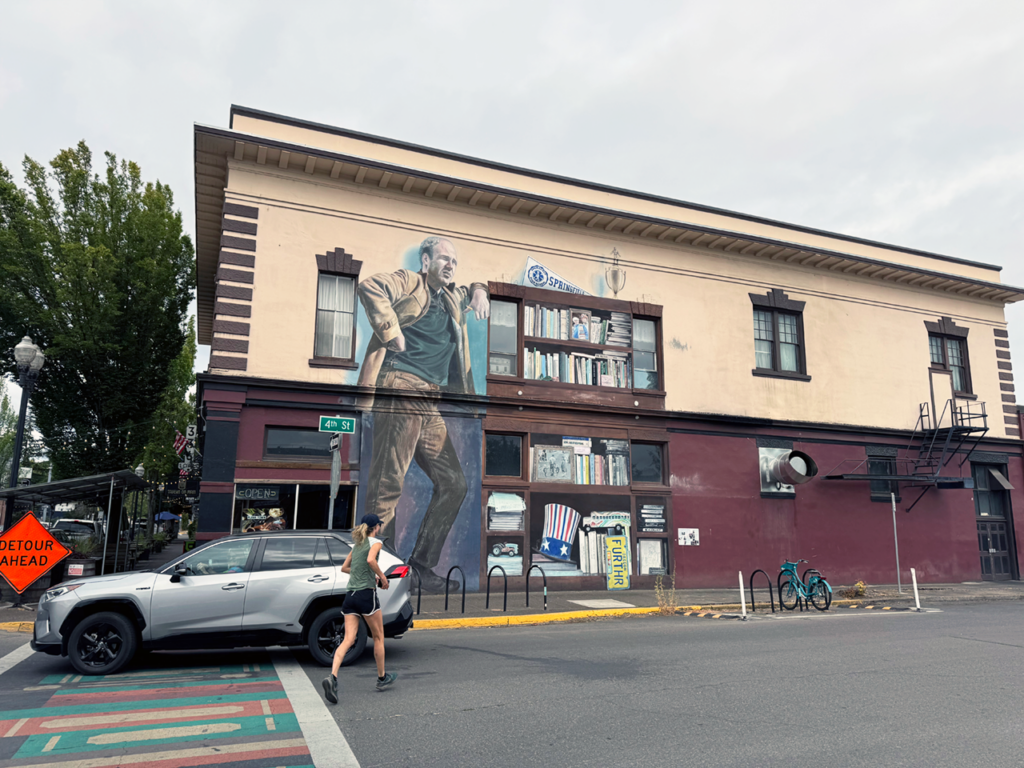
The morning after we arrived in town, I wandered around Springfield’s Main Street and found another remarkable mural, this time unrelated to The Simpsons. As I was cruising around, I saw a young man in beatnik attire depicted in an entire wall façade; it looked familiar, perhaps because I had recently read a book by John Markoff on Stewart Brand where the depicted figure is mentioned: it was indeed a mural of Ken Kesey leaning against a bookshelf filled with visual references to his novels and adventures with the Merry Pranksters.
“Wow, it’s Ken Kesey,” I thought, and an instant after, I saw the plate of the Merry Pranksters’ skoolie, “FURTHR,” somewhere at the bottom of the two-story depiction. Kesey (1935–2001) spent much of his youth in Springfield and attended the University of Oregon in nearby Eugene, where his experiences in the area significantly influenced his early life and writing.
How a novel and a movie shifted the way we perceive mental illness
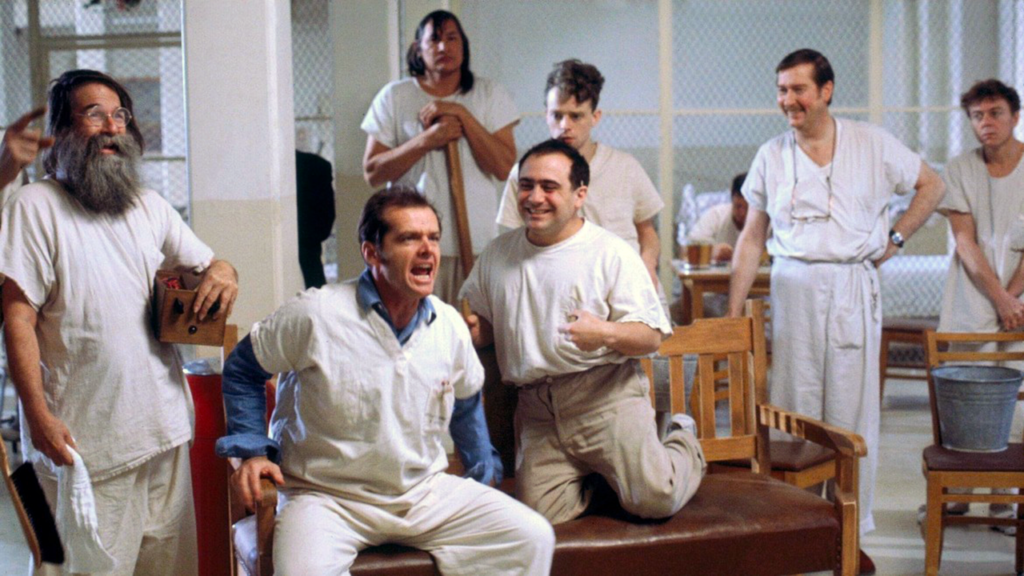
Kesey’s novel One Flew Over the Cuckoo’s Nest, and later its successful movie adaptation, had a significant impact on influencing public opinion across America and the rest of the world regarding the many shortcomings of old-school institutionalization of mental illness. But it’s also ironic that what came after was a void that virtually turned an outdated type of care into no care at all, and today’s epidemic of homelessness can’t be understood without acknowledging the decades-long shortcomings when treating mental illness.
After the 1960s, mental health care in the US underwent a massive shift. In the mid-20th century, hundreds of thousands of Americans experiencing serious mental illness were housed in large state psychiatric hospitals. These institutions were often overcrowded and abusive, as we read in Kesey’s work. So, starting in the 1960s, reformers and policymakers (inspired by new psychiatric drugs, civil rights concerns, and cost pressures) pushed for “deinstitutionalization”: closing asylums and replacing them with community mental health centers.
The hospitals closed, but community-based services were never funded at the promised scale and were soon defunded. Consequently, many people with schizophrenia, bipolar disorder, or severe depression ended up without sustained treatment or housing support. If this weren’t enough, this gap coincided with the rise of mass incarceration (from the 1970s onward) and later with the war on drugs, meaning prisons and jails became de facto mental health institutions. It didn’t go well.
What we’ve learned the hard way over the decades, and we see exacerbated by housing costs, is that, without stable treatment or housing options, people with mental illness are disproportionately pushed into homelessness. And it takes field observation (which can be done by anyone) to connect the dots and observe that drug use and addiction compounded the problem: many self-medicated with illicit substances, creating a cycle of criminalization, poverty, and untreated illness.
Mental health institutionalization wasn’t working
That said, the institutionalization of people with mental illness has a long and sordid history in the US. In 1979, there were nearly 370,000 people in state and county psychiatric hospitals, and conditions were from bad to atrocious. Bryce Hospital (Tuscaloosa, Alabama) dealt with 5,000 patients residing in the facility and had only three psychiatrists on staff.
According to Fredrick E. Vars, professor of law at the University of Alabama School of Law, Bryce at that time resembled more a warehouse than a hospital, described as a “hellhole” by visitors: human feces on the walls, urine soaking the floors, patients strapped to rocking chairs… Things have evolved, and involuntary hospitalization would look very different now, but is it the best solution to get people in treatment and off the streets long term?

As the treatment of alcoholism and other addictions by the health system has shown, explains Fredrick E. Vars, hospitalization helps people “get clean” while they are hospitalized, often getting them out of an acute crisis, but with no behavioral follow-up after they leave, many return right away to use in the street:
“The key is connecting patients at discharge to resources in the community. Until that regularly happens, involuntary hospitalization amounts to just kicking the can down the road.”
Travel across Europe and you’ll realize that the issue of mental health and its perverse association with homelessness isn’t as acute and pervasive as one sees in American cities and certain suburbs. Many factors could explain the disparity, but having a weaker safety net, less housing support, and a fragmented health system doesn’t seem to be helping.
And yet, the “new approach” that is now taking root sounds like an old one: instead of learning from success stories abroad, the current Administration takes a good-ol’ punitive approach, with emphasis on policing, dehumanization, and retention (since it’s cheaper to incarcerate than to treat, we can see where things could go) over public health solutions.
What other societies do
Many European countries have applied mitigation methods to help people escape the downward spiral of mental illness, drug abuse, and homelessness; countries as different as Portugal, the Netherlands, and Finland offer different levels of housing support, harm reduction for drug users, and a health follow-up through universal health care systems and a behavioral approach that prioritizes housing first and a minimal safety net for people, then try to help them break the cycle of addiction.
Like any other dynamic phenomenon, what we call social “problems” are open, complex systems that are influenced by both internal and external factors over time, making them challenging to identify, analyze, predict, or resolve.
And, despite our efforts in ditching the word humanities to use a more scientific-sounding term, “social sciences,” there’s so much interpretation and theorizing in any modeling that two experts could be driving opposite conclusions to any given momentum in some phenomenon they try to isolate from society as a whole, while using legitimate analyses.
Neither of them may be right or wrong, and even the materialization of the wildest predictions from any social scientist will be dismissed by others if they torture their data long enough to make their interpretation plausible enough to the narrative of their liking.
Which is to say: even if our goal as responsible-ish citizens is to elect representatives who should lead us to the frameworks that should solve structural issues, making things better as a whole, it’s very easy to grow cynical as we age and see how some important things affecting many people will get postponed sine die or treated as unsolvable at the scale needed.
Examples are illuminating but non-transferable
Yet, many times it will only take a vacation somewhere else to realize that other societies, if far from perfect and usually less prosperous than the United States, may have solved—often efficiently—many of the issues that seem to fester around the periphery of some of the most prosperous places on Earth.
All of this to say, like the song by Taylor Swift that my middle daughter has played on the car while driving, that societies can and should do better in dealing with their issues deemed unsolvable, especially because there are usually many creative examples of societies dealing with the same complex issues with bigger success rates, even when they invest less on such matters than the US states do.
However, if comparisons can be useful and illuminating, they are not transferable to a different society. For example, knowing what Finland (population 5.6 million people) is doing as a society to tackle homelessness in a country that differs from the US in many things (it’s a small, homogeneous population that relates to the role of the state and rule of law in a very different way than the United States does) is very valuable to US officials and social workers, but won’t behave in the same way if directly imported to the American society, because most certainly many things will get lost in translation.
When successful, the complex, dynamic solutions that successfully tackle complex dynamic problems prove that countries can do better in fields deemed hopeless: Finland applied simple workarounds to many issues faced by chronically homeless people in a very inhospitable country during winter, the same way Portugal (population 10.7 million), another much smaller and homogeneous country than the US, applied equally simple workarounds to tackle a drug abuse spike in the country and mainly succeeded.
Mirrors, not templates
But when a US State (Oregon: population 4.2 million) tried to import the Portuguese system of depenalizing hard drugs and encouraging a responsible, monitored use and a follow-up to encourage users to get help and (successfully so) get clean, it horrendously backfired. Oregon is not Portugal, and the US society can’t be extrapolated to that of other wealthy countries.
This is why there’s a specific type of simplistic social media content that irks me: it consists of cherry-picking idealized workarounds to complex problems applied by much smaller, homogeneous, mostly high-trust societies, and then stating why the US doesn’t “import” such things right away, assuming it will work right away as advertised.
They take bike culture from the Netherlands and Denmark, the lifestyle from Southern Europe, the architecture from Haussmannian Paris and the poshest London neighborhoods, the high-speed rail networks from Europe, Japan, and China, the (almost sci-fi-level dystopic) enforced social “harmony” of Singapore, the healthy outdoor culture of Norway and Switzerland, the successful drug decriminalization that eradicated overdoses and HIV infections in Portugal, the performance of the best universal health care systems in the world, etc. Then they say, ‘Bring these things to the US!’
It’s not that easy, although there’s a great deal to learn from successful case studies around the world. Even if there were a political and social mandate across the board to try to improve the most dysfunctional parts of American society, with a strong bipartisan support at the federal and state levels, as well as the funding and absolute determination to start right away and work at it at the scale and intensity of, say, a war effort, people would understand sooner than later that comparisons are illuminating but never transferable. Comparison is a mirror, not a template.
Comparisons show us what is possible, but they cannot be transplanted. They are mirrors, not templates.
Addressing what people see, skipping root causes
As both policymakers and the public question many of the social problems that either need massive improvement or make the United States an outlier across developed countries, many voices are focusing on the nuisances that they see in their everyday life, related to many other everyday dysfunctions; in the places like the Bay Area, people will walk or drive to attend errands and activities, and they will see how many of the big homeless encampments are being thoroughly dismantled across the region.
However, many of the people affected aren’t offered shelter or, in some cases, refuse to enter any of the temporary housing programs available, which are theoretically based on a first-come, first-served basis and depend on the availability of shelter provided by counties, towns, the state, and private organizations appointed by either. In practice, any encampment closure ends up dispersing some of the people living there, and it’s no surprise that the majority endure mental illness, drug addiction, or both.

As the Trump Administration tries to advance in its promises to tackle the perceived insecurity surge in many cities across the country (despite data contradicting many of the talking points, as crime rates have decreased dramatically since the post-pandemic era), picking symbolic cities ruled by democrats and eluding red-led cities with similar or bigger issues per percentage of population, Washington D.C., New York City, and of course the big California metros will be in the spotlight.
The new executive order directs agencies to end support for “housing first” programs, focusing on a classical public order approach, with the main focus on reducing visibility through law enforcement so that public order is restored and encampments disappear from their current locations. However, where will the displaced people go?
Our trip to Finland
Finland, a country we recently visited, is the only member of the European Union where homelessness has steadily declined for a decade. The country is expanding its already well-funded “housing first” approach, which is combined with behavioral health services, to ensure continuity of care and monitor the progress of every individual over time. The non-punitive, “housing first,” behavioral health approach of Finland has paid off, with long-term homelessness dropping by 68% between 2008 and 2022.
What has worked in Finland regarding homelessness may be more challenging to implement in the US, as the scale and demographic composition of the two countries differ dramatically. Around 8,000 homeless individuals were recorded in Finland by 2008, a steady drop from 20,000 in the late 1980s, of a population of 5.5 million people back then, or 0.15% of the total population. The US had about 770,000 people experiencing the issue at the beginning of 2024, of a total population of 333 million, or 0.23% of the population.
When in Finland, we were curious to find out more about the Finnish model to deal with the cycle of mental illness, drug addiction and homelessness, so we visited the Y-Säätiö buildings in Helsinki, an old social housing institution in Finland. We had the chance to talk to Juha Kahila, head of International Affairs at Y-Säätiö and M2-Kodit, and we toured with them what looked like a conventional apartment building for the most part, only its residents were formerly homeless, many of them dealing with addiction and mental issues.
That said, many people living in the building we visited were still using drugs, which didn’t disqualify them from living there; however, Juha Kahila explained that, even when not everybody is sober in the building, the doctors and social workers are aware of the challenges that all the tenants face so that they can provide personalized help. It didn’t look perfect, but people living there seemed to be recovering their personal autonomy and agency; many were clean, had a job, or were looking for one.
Kahila explained that there’s no secret sauce or silver bullet to break the cycle of addiction and homelessness, only constant field work and the determination to get as many people housed as possible, for when they enter the country’s “housing first” program, they are much more likely to make the extra steps to get proper treatment regarding substance abuse and mental challenges.
“This didn’t happen during Franco”
If Juha Kahila showed us a non-punitive approach to homelessness that was working, Americans should also ask themselves what they know about more punitive policies relying on public order, after the current Administration issued on July 4th the executive order Ending Crime and Disorder on America’s Streets, which basically shuts the door to strategies like the one applied by Finland (and to some extent emulated by the last measures approved in California to tackle the issue) and tries to apply stricter policies to get people off the streets and into enforcement-based treatment programs for addiction and mental illness. Also, new funding cuts to Medicaid (the federal and state health coverage program for low-income individuals and families) could reverse the recent downward trend in opioid addiction across the US.
Donald Trump’s executive order reminds me of a line that a specific type of older person used to drop at a family party when I was growing up in Spain; it usually happened when the conversation shifted toward social issues or civil unrest. That person would sometimes resort to expressions such as: “I never was a Francoist, but I remember that, during Franco [a.k.a. Francisco Franco ‘ s-led dictatorship in Spain from 1939 until his death in 1975], there were no rioters and vagrants in the streets.”
Spain’s Ley de Vagos y Maleantes (“Law of Vagrants and Criminals”) was not, in fact, a creation of Franco’s; it was approved in 1933 by the Cortes Republicanas (the parliament of the Spanish Second Republic) and maintained by Franco. Based on the outdated idea of social hygiene, this “vagrancy act” tried to suppress “moral deviance” because it was seen as a degeneracy of society, and it also included homosexuality.
Messy dilemmas
Both frameworks, the current executive order and this outdated law that came to integrate the Spanish psyche during decades, emphasize detainment or institutionalization under the guise of treatment or public safety, rather than punitive or support-based interventions. The US order pushes for stronger civil commitment policies and incentivizes states to roll back due process and disability rights protections. Similarly, the Ley de Vagos y Maleantes authorized “measures of control”—like internment or isolation—not as formal punishment, but as preventive security measures against “antisocial” behavior.
This old, national-Catholic law that prevented Spaniards, devoid of democracy and civil liberties during Franco, from “enjoying” vagrant-free streets, isn’t just a buried memory. Today, there are cases where cities, countries, or city-states claim short-term “success” in visibility reduction of homelessness, not necessarily solving the root issue.
Singapore is the poster child of applying public order instead of behavioral health. And, at least on the surface, it seems to work in this 6-million-people city-state led by what is described as a “soft authoritarian” system: it has very low visible homelessness (under 1,000 in a city of almost 6 million people), combining strong family obligations, state-built public housing, and strict laws against sleeping rough. The policy has a punitive enforcement, with fines and arrests. However, Singapore’s success with the approach has more to do with universal housing access and family responsibility than with being “tough on vagrants,” according to experts.

If America could not simply import Finland’s housing policy or Portugal’s drug policy, it will not be able to sidestep the social aftershocks of the AI era with quick fixes either. Complex problems require not only policies, but persistence, a case-by-case follow-up and the recognition that what works elsewhere must be adapted, not copied.