Humanoid robots aren’t just a sideshow — they’re the new front line of global competition. As China pushes mass production, the US bets on AI and Tesla’s Optimus, while Europe lags behind.
People cheered athletes at the Beijing Olympic Stadium, an event that brought together over 500 participants from 280 teams representing the most competitive countries on Earth.

Following the Olympic spirit revived in modern times by French educator Baron Pierre de Coubertin, athletes competed in physical and practical challenges, including major athletics disciplines, as well as soccer, kung fu, and specialty sports and activities. But the event wasn’t a déjà vu replay of the Beijing August 2008 Olympics, nor the Paralympic or Special Olympics editions of the biggest event in the world’s sports (with permission of the men’s FIFA World Cup).
This time, the athletes gathered in Beijing were humanoid robots no less, and the event wouldn’t have had much impact across the world had it been celebrated behind closed doors, but as soon as clips of the main competitions made it to social media, the frenzy got to everyone’s small screens.
Race to the top, or to the bottom?
Consider, for example, the 100-meter race, an event in which humanoid robots had to showcase balance and skill as they sped towards the end line, their spine tilting ahead. The winner, called Embodied Tiangong Ultra, a name that has little resemblance to the ones picked by humans (let’s run Elon Musk’s exception naming children here), covered the 100-meter distance autonomously in 21.50 seconds.
Now, it took Usain Bolt of Jamaica, so far the fastest, most-explosive short-distance runner that our species has given so far, only 9.58 seconds to cover the same distance when he established a new record at the 2009 World Athletics Championships in Berlin, Germany. Now, if we have to trace a parallelism between the advancement of humanoid robots and Moore’s Law (in which chips doubled their density approximately every 2 years as the cost decreased), as robotics improves (becoming more compact, affordable, and powerful), the difference with Usain Bolt will close rapidly.
Soon enough, humanoid robots (that is, bipedal robots that emulate our psychomotor skills) will surpass the fastest humans in speed. Will the same happen within this new Moore Law paradigm with other soft skills, leading individuals and companies to invest in robotic helpers to do menial tasks first, and ultimately taking over complex tasks as well?
Several questions arise as we see humanoid robots speeding up their development, getting more agile and capable of dealing with tasks that require a remarkable amount of spatial intelligence and skill. Events like the World Humanoid Robot Games in Beijing, or Tesla’s promise (yet to be delivered fully) of stocking their recently opened diner experience, L.A.-style, with humanoid waiters (who knows, some may end up delivering food and drinks on roller skates, so people get the thoroughly dystopian Jetsons-meet-Grease vibe), are designed to raise our empathy towards humanoid robots, so we perceive them as allies instead of non-human competitors.
The sheer size of China’s exports
While people cheer in Beijing as humanoids try penalty kicks, and in LA, a chrome diner serves milkshakes that people can’t wait to get from mechanical (but humanoid) arms, analysts can’t help but think about the impact of this imminent revolution in which scifi-level services could change the way we live and work, in tandem with AI.
But there are other, less innocuous perspectives. As officials at the European Commission try to determine if the EU chief Ursula von der Leyer’s plane got its GPS jammed by suspected Russian operators and Xi, Putin, and Modri (the leaders of China, Russia, and India, respectively) met last weekend before the second day of the Shanghai Cooperation Organisation, China tries to agglutinate the BRICS bloc in opposition to NATO and the West.
Energy-rich but manufacturing and technology-dependent Russia is doubling down on its cooperation with China as China’s northern border with Russia’s Far East becomes a boomtown region that interchanges energy and rare earth minerals in exchange for goods and manufacturing prowess, from EVs to pharmaceuticals. Outside Western reach, commercial technologies such as drone manufacturing from Iran and (though not openly) China are already used in Russia’s war effort after invading Eastern Ukraine.
But China’s rapid advancement in commercial humanoid robot development could also have geopolitical ramifications. Russia’s human toll in the war weakens Putin’s image within the country, and agreements like the one that led North Korea to send an estimate of 10,000 to 12,000 soldiers to the Ukrainian front in exchange for salaries (around $2,000 per soldier per month according to South Korea’s intelligence service and multiple outlets), could speed the interest in deploying humanoid soldiers in open conflicts around the world.
So, on one side, it seems that people could watch videos of humanoid robots running and serving ice cream all day long. On the other side, analysts and platforms like DataTrack predict that China’s trade surplus in 2025 (total exports minus imports) will exceed $1 trillion for the first time in history. No other country has ever come closer, and estimates believe the number will be closer to $1.2 trillion.
The era of consumer humanoid robotics is near
And while the United States attempts to counter China’s export hegemony with tariffs and strategic restrictions, such as advanced chips used in AI, the Asian giant is forging ahead in many technological fields, surpassing the European Union and Japan, and also outpacing the United States.

China is also a country of aggressive early adopters, culturally rewarded for spotting and trying trends that could help spark and develop entire industries, and robotics is no exception.
Consumer robotics has come a long way since I was writing articles about tech in the early 2000s, right after the tech boom bubble burst. Back then, Japanese electronics brands led a much smaller market that was barely beginning to take advantage of computer miniaturization and battery technology improvement. During the pre-smartphone era, a series of improvements had already occurred.
Cheap, small CPUs used in game consoles, camcorders, and early mobile phones helped drive down the prices of processors and microcontrollers. Mobile phones had become a mass market phenomenon, especially in Japan and Europe (where markets benefited from an early push on European-wide standards such as GSM for mobile networks and Bluetooth for connectivity between devices). In parallel, Li-ion batteries got smaller, denser, and cheaper.
When we thought the future was already happening in Tokyo
When writing for tech magazines in Barcelona in the early 2000s (fun trivia: I also wrote the tech section for the Spanish version of Playboy magazine, but was never invited to any event), I worked with some real tech nerds, which at that moment and place it gravitated around Japanese “otaku” (mainly, pop culture around manga, video games, and anime) and many of its subcultures.

It was a time when many of us became interested in subcultures, often through friends recommending music, movies, or computer games, and early Internet culture, particularly by obtaining magazines and sharing them. That’s how an article about Japanese robotics from the mid-to-late nineties reached me. The reporter visited a mixture of otaku hobby shops in Akihabara, Tokyo. With the help of university and company labs, such stories nurtured homemaker robots, which evolved into a small, quirky pop tech scene not dissimilar in spirit and enthusiasm to the Homebrew Computer Club in Menlo Park, California, from the mid-1970s to the mid-1980s. The article predated Robo-One, a competition that started in 2002 showcasing combats among bipedal humanoid robots, still ongoing and soon-to-become even more popular as humanoid robots develop fighting skills.
And we all thought, as it happened with the Homebrew Computer Club, that the underground Akihabara robotics scene would spark a revolution in commercial robotics once Japan-based electronics companies took notice. What led us to think so was the fact that the components hobbyists were using for their robots were all already present in consumer equipment. Sensors were already inexpensive and compact: ultrasonic ranging for primary navigation, infrared sensors to detect boundaries and obstacles, bump switches, and CCD camera sensors for vision. Then there were actuators and DC motors from kitchen appliances and remote control (RC) cars, such as the legendary Nikko, improved rechargeable batteries, and embedded storage to “run” programs or tricks on the robots.
Things seemed to align to turn Japan into the world’s center of miniaturized electronics and consumer robots. Even Sony got excited with the prospect when it launched AIBO (Sony ERS-110) in 1999, an autonomous, dog-like robot pioneering consumer-grade pet-like devices. Back in 1999, the consumer market hadn’t seen anything like it: AIBO weighed between 3.3 and 4.4 lbs (1.5 to 2 kg) and was 10.6 inches high at the shoulder, or 27 cm; 11.8 inches long, or 30 cm; and 5.9 inches wide, or 15 cm.
Hinting at possible futures, then backing down
What equally shocked children and adults was seeing the 18-articulated-joint, animal-like robot moving autonomously with gestures that seemed natural enough. It could walk, sit, lie down, wag its tail, and perform some tricks; its navigation was good enough for 1999, thanks to its infrared, touch and CCD sensors. It also “heard” and responded to limited voice commands, reacting as well to touch sensors strategically placed in the head, back, and chin.

And, of course, Sony’s effort to break the empathy barrier made the electronic pet evolve a proto-personality thanks to LED eyes and limited body language. Like real-life pets, AIBO could also learn routines over time, storing personal use data and experiences on a Memory Stick (Sony’s proprietary memory card, which the company was trying to force on the market over standards such as the eventual winner, SD).
In retrospect, AIBO was expensive and limited. Launched in Japan at roughly ¥250,000, which at the time was about $2,500. It became available in US and European retailers not long after for around $2,500–$2,600. Its limited production of around 5,000 units made it scarce enough to generate excitement, high demand, and resale premiums.

AIBO also highlighted one of the biggest paradoxes in the world of consumer technology during the last 4 decades. Despite the pop-culture impact of Japanese otaku and the Asian country’s head start in consumer robotics, video consoles, portable gaming, and miniaturized electronics, Japan’s technological output missed the personal computer revolution and remained skeptical about software development for the consumer market and aloof from the disruptive potential of the Internet. As Silicon Valley monopolized the personal computing and Internet revolutions, China became the manufacturing epicenter of the world (first by copying, and finally by leading innovation).
Add to it Japan’s housing bubble burst and long-lasting deflation, as well as traditional rules around education and enterprise innovation. The country, an outlier in aging population and a low birth rate, didn’t push for its own market of smartphones (despite NTT Docomo’s head start, a telecom conglomerate that created its own crazy mobile telephones) and consumer robotics, despite hobbyists and enthusiasts who had been gathering in the backstores of Tokyo’s Akihabara neighborhood.
From the birth of AIBO to a 2015 Japan family visit
As some sort of veteran-ish tech journalist in Spain, it didn’t take me by surprise when I saw that the rise of functional “robots” for the consumer market, designed to perform menial human tasks that we don’t want to do, wasn’t coming from Japan’s robotics hub, but from companies in Europe and the United States: first shown as a prototype in 1996 and released in 2001, Electrolux developed the first robot vacuum cleaner, Electrolux Trilobite, using at the beginning ultrasonic sensors for navigation and later switching to infrared sensors.
Named after the extinct sea creature, the Trilobite included self-charging capabilities and a large dustbin, although its early-stage navigation and limited autonomy rendered it more of a commercial prototype than an effective product. The first successful robotic vacuum cleaner originated at MIT during a challenge to design a robot that could clean. A company spun off from the effort, and the prototypes improved by adapting technology from military landmine-hunting robots for navigation.
That’s how the first commercial iRobot Roomba, launched in September 2002, made an impact in the collective unconscious: robots weren’t science fiction but a semi-useful reality that one could buy at the store. The Roomba wasn’t just Jetsons-cute but useful, with improved navigation, autonomy, and relative durability. Soon, copycats improved upon the design, which became a generic.
In Japan, AIBO was conceived as a techno-cultural mascot—not about utility but about living with robots that one day could be sentient, following a long tradition of empathy towards man-looking machines, as the success of Astro Boy, Osamu Tezuka’s childlike humanoid robot, showed in the 50s and 60s, which later inspired the classics Mazinger Z, Doraemon. By contrast, consumer robotics began with the autonomous vacuum cleaner, which became a household name.
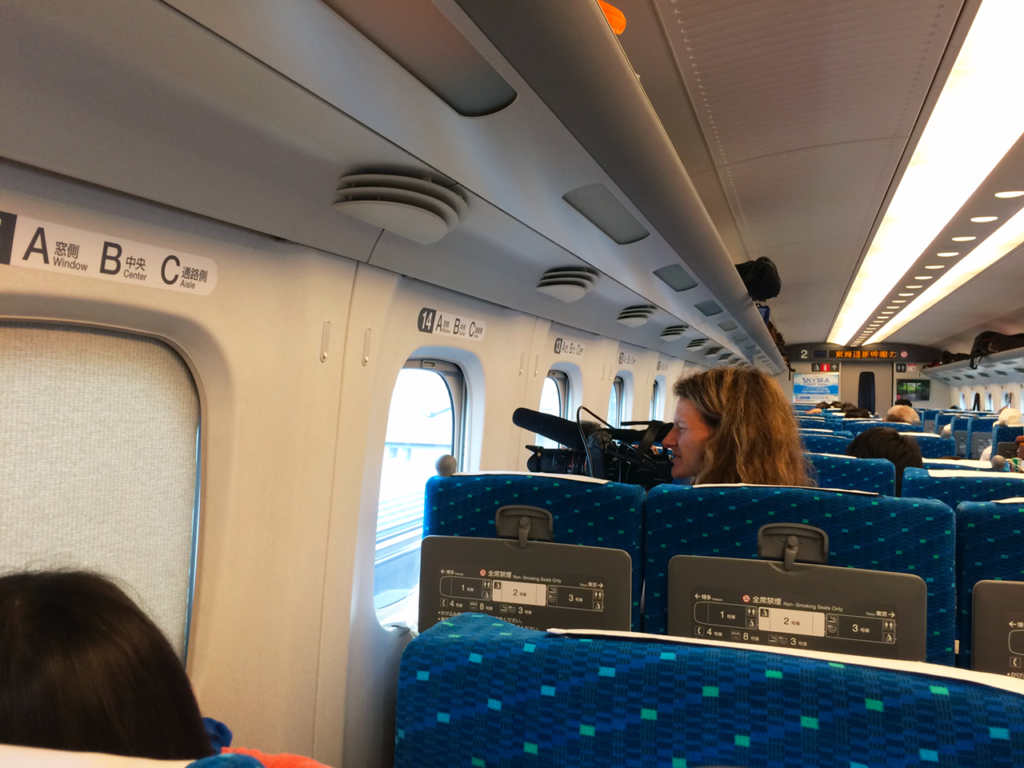
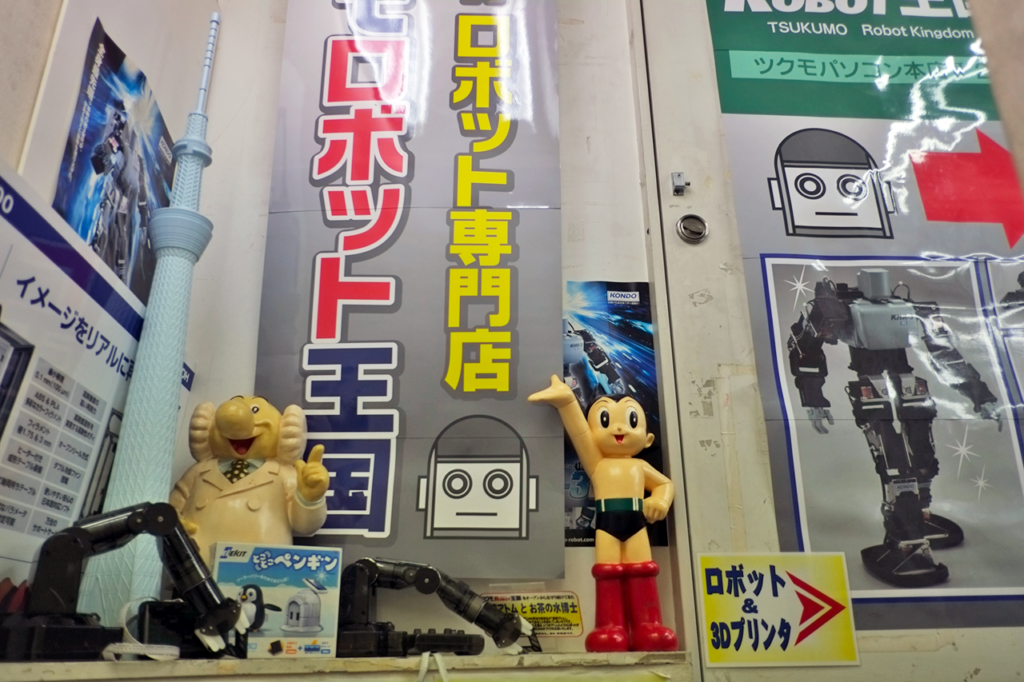
When in June 2015 we visited Japan, landing in Tokyo for a few days and then traveling to Kyoto in Shinkansen, visiting the countryside by rental car right after, I made sure I had time to show the children, much younger back then, the old stores of Akihabara. I was glad to find and visit in person some of the surviving Akihabara stores, and tried to explain many of the things we found.
Stumbling upon Softbank’s Pepper with the kids in Tokyo
Not surprisingly, I found pervasive references to Astro Boy (a metaphor of the postwar optimism that had vanished), Mazinger Z (technically a piloted robot, but still), and the iconic Doraemon, the influential robotic cat that many people hitting middle age across Asia, Europe and many places of the Americas would recognize.
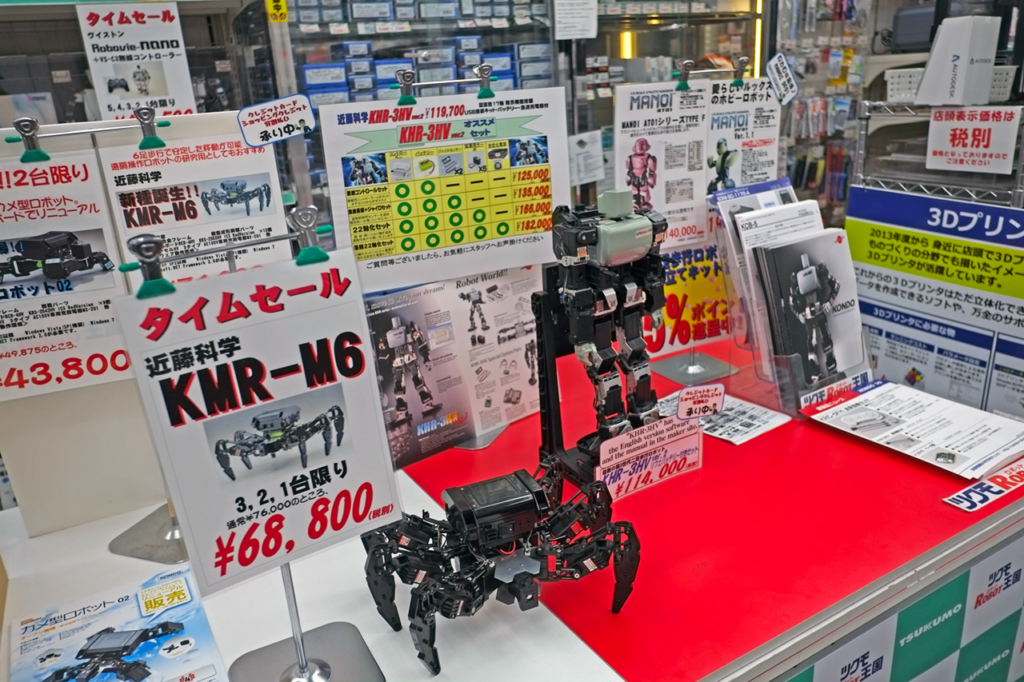
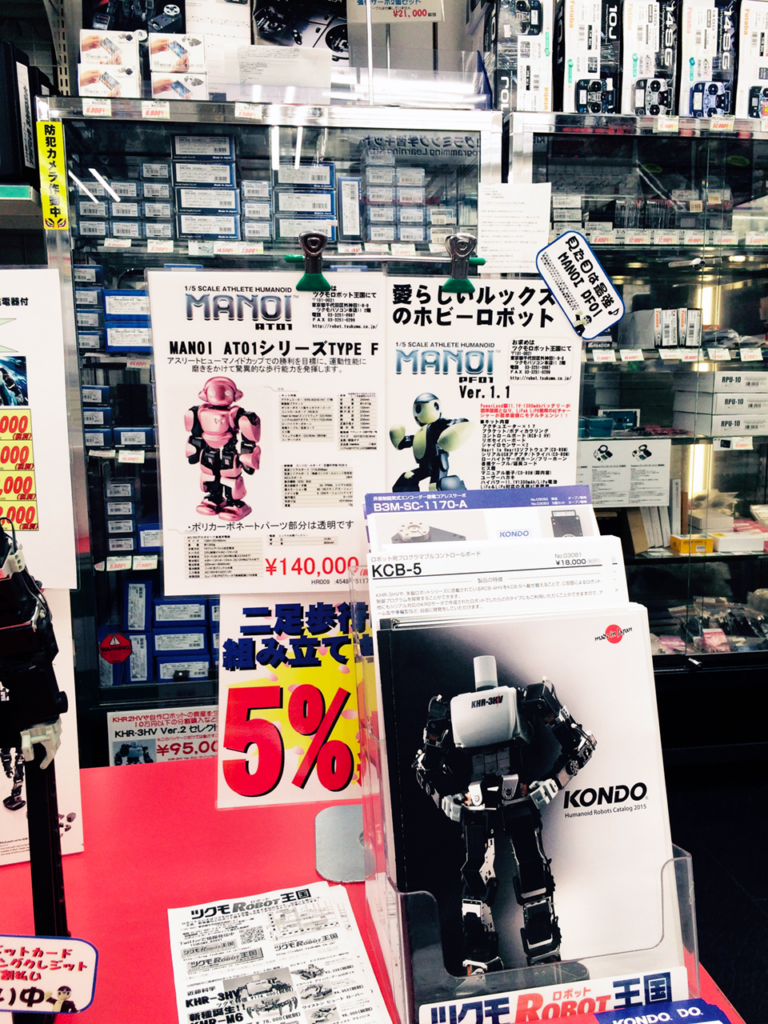
We entered a couple of stores that packed floors of hobby electronics, second-hand gear, and tiny specialist stalls. There were motors, reduction gears, sensors, battery packs, controllers, assembled robots with no visible brand, and every imaginable miniature electronic object. At times, I realized, I was more engaged than the children.
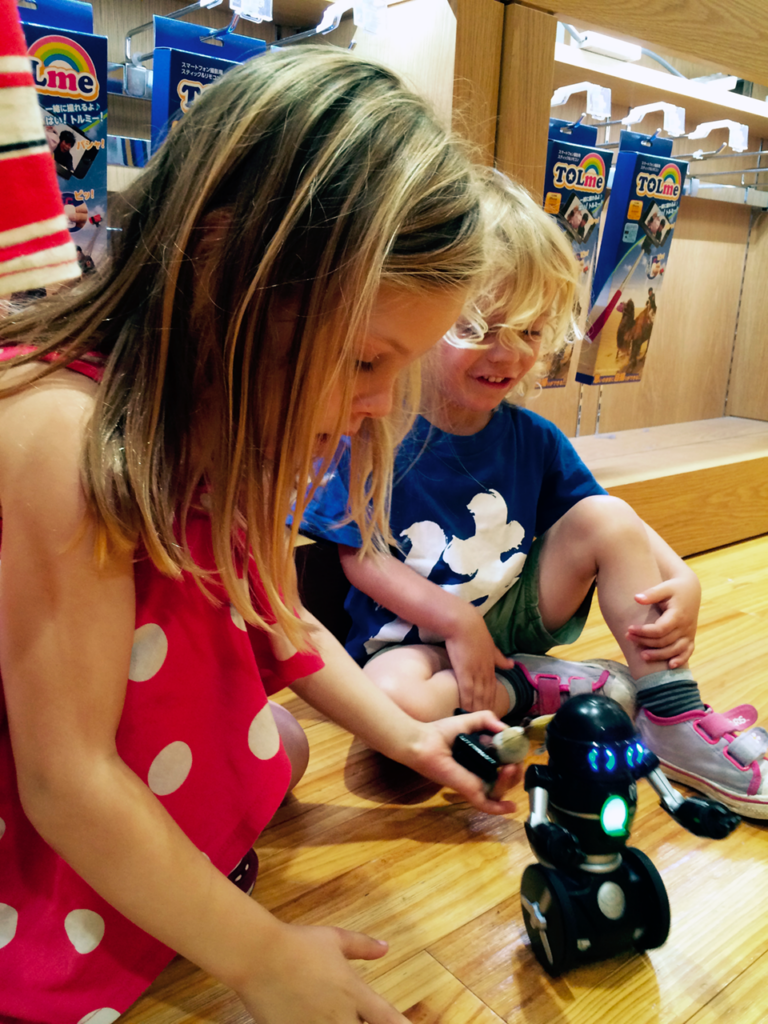
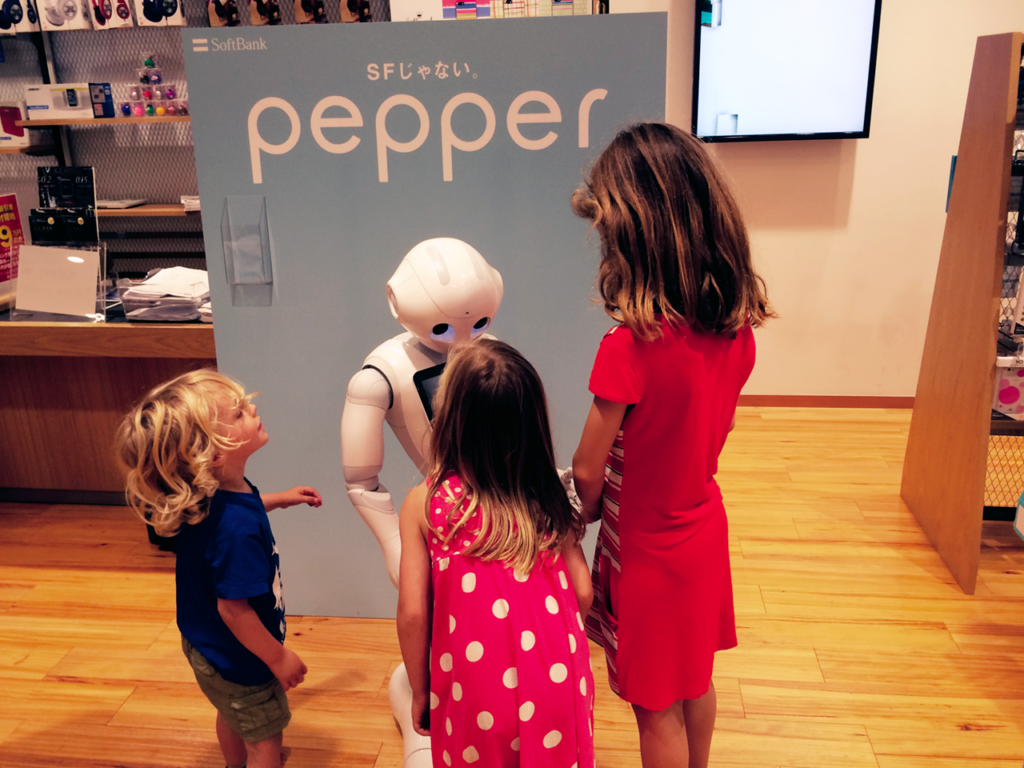
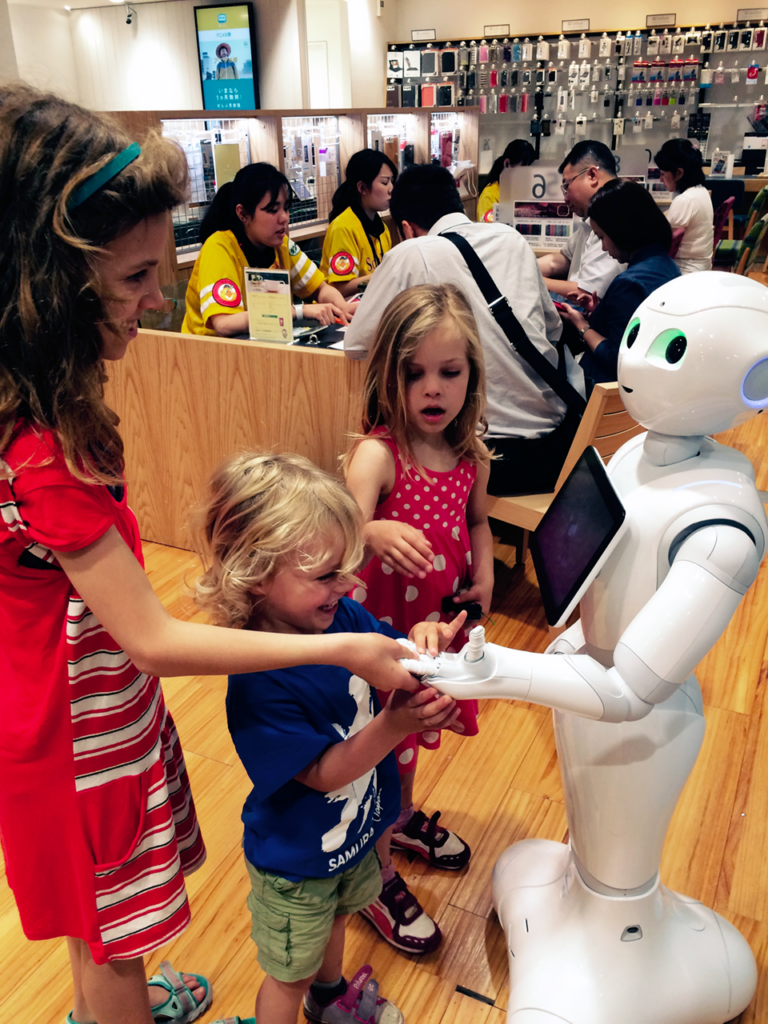
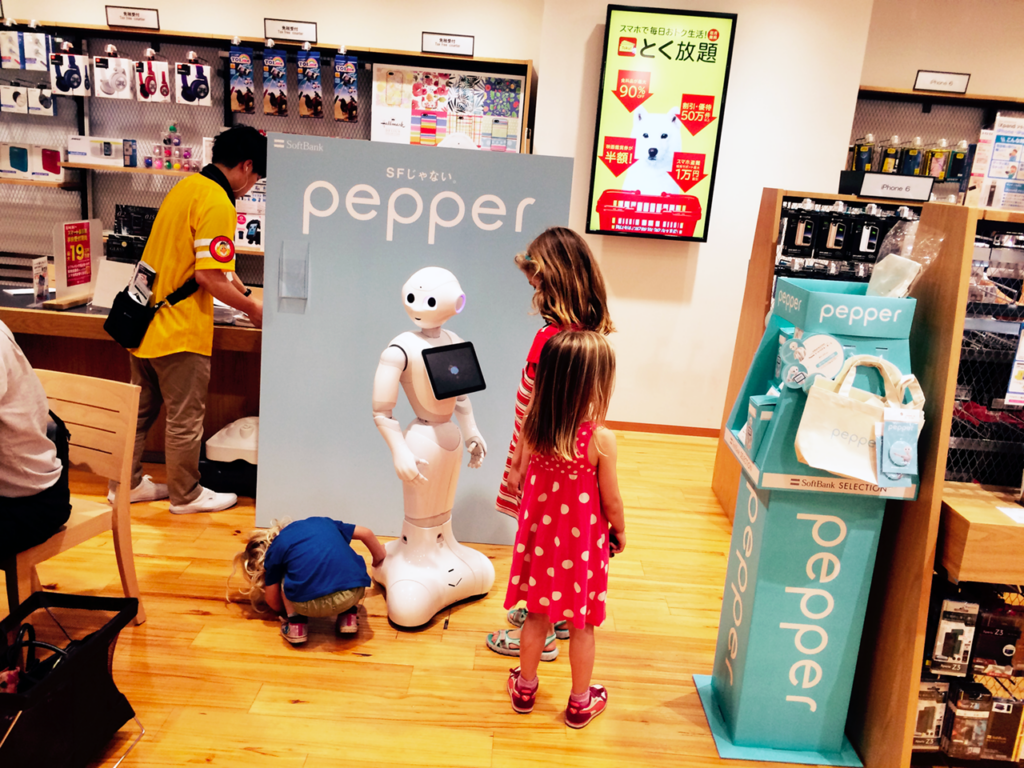
The dynamics changed when, a few days later, we randomly encountered at a store a semi-humanoid robot of their size, called Pepper. I didn’t know anything about it, but I did a quick search on my phone (probably an iPhone 5s that I held for quite a while back then) and found out that Pepper had been developed by Softbank Robotics and was designed to interact empathetically. To our kids, it was intriguing and very relatable: its face had two round eyes and a certain resemblance to Astro Boy, it had two arms that responded to tactile stimuli, and local kids were interacting with it through a touchscreen on the robot’s chest.
Released in June 2014 and discontinued in 2021, Pepper had a relatively complex emotional engine, detecting and responding to basic human emotions. SoftBank Robotics’s idea could be vindicated in the future, in a country well under the fertility replacement threshold that ages quickly and culturally embraces innovation. Our kids’ response to Pepper made me think then that, perhaps, there are contexts in which robots capable of performing menial tasks in retail, education, healthcare, customer service, or companionship could make a difference. It took us a while to leave that store, for our kids wanted to keep playing with the robot.
Pepper wasn’t a success. Pepper initially went on sale in Japan in June 2015, with the first batch of 1,000 robots selling out in just 60 seconds. Each unit was priced at 198,000 yen (about $1,900 at the time). However, the service included an ongoing service monthly plan that added, in some cases, several hundred dollars a month, adding maintenance and insurance. It was even more expensive when sold to businesses and institutions.
China rise, humanoid robots edition
In any case, things were changing quickly in robotics, but the advances didn’t come from Japan. In the US, another company founded in the 1990s as an offshoot of MIT, Boston Dynamics, reached several breakthroughs in agile, legged robotic design. Soon, the ability of Boston Dynamics’s robots to showcase mobility and stability in situations like walking, running, climbing, tool use, balance, backflips, handstands, etc., improved so quickly that the company’s videos became viral sensations, and remain so to this day.
But the real disruptor is coming from a brand new, mammoth robotics hub: China overtook Japan in total operational cost of industrial robots in 2016. Not long after, in 2019, China used 783,000 advanced robots, more than double Japan’s (355,000 units). In 2019 alone, China installed more industrial robots than the next four countries combined, and in 2023, the country accounted for 51% of global industrial robot installations.
Not long ago, China was attempting to emulate Germany’s use of advanced industrial robotics in fields such as car manufacturing. By 2024, the Asian giant had surpassed the German model it had sought to emulate. What’s more concerning to Europe’s strategic position is its negligence in fields such as AI and humanoid robots, falling way behind the US and, especially, China.
China is also a juggernaut in the new field of advanced consumer robotics. With little concern regarding any ethical or practical consideration that could affect work or safety among the population in the years to come, Several Chinese companies have already reached large-scale humanoid robot production. Shanghai-based AgiBot produced 1,000 humanoid robots by December 2024 and plans to scale up so economies of scale can bring the cost (and price) down. In early 2025, its competitor Leju Robotics delivered its 100th full-size humanoid robot and plans to produce at least 200 per year. Other companies like Unitree and UBTech are producing humanoids used by industries like car manufacturing.
Convergence of agility robotics, humanoid bots, and AI
China has set ambitious goals for humanoid robotics, which are seen as strategic for the national industry and national security, similar to those for electric cars and AI. Among the goals, the Chinese government hopes to reach mass production by late 2025, ahead of anyone else, and achieve global leadership by 2027. The country leads in patents related to robotics, further increasing its leadership.
Two American companies are set to build the strongest alternative to the Chinese humanoid model, which could bring echoes of disturbing mass android use like those imagined by the Star Wars sagas: Boston Dynamics leads in robotics motricity, pushing the frontier of artificial legged locomotion, agility, and real-world mobility (that’s why the company is selling robots to companies operating in extreme fields that require hazardous, repetitive, or outright dangerous work). Watching videos of Boston Dynamics’s bots performing all sorts of tricks can be a baffling, if not scary, epiphany. Blend their agility with advanced AI, and the far-fetched depictions of androids in science fiction get more and more plausible—and not that far in the future.
The biggest unknown concerning the American humanoid robotics ecosystem isn’t the lack of vision (besides Boston Dynamics, startups like Apptronik, Figure AI and Agility Robotics are pushing the new field) but the potential impact of one announcement that so far has involved more PR than confirmed technical prowess: Tesla’s Optimus. We know that Tesla’s plans for its humanoid robot extend far beyond the stunt of eventually having a few bots deliver sodas to customers at the company’s new LA restaurant. The company showed a functional prototype in 2022, with later improved versions in 2023 and 2024 showing improvements at tasks like sorting blocks, folding clothes, and working in factory-like environments.
Besides the promises of Elon Musk regarding Optimus, which may or may not pan out, Tesla’s humanoid bot hasn’t yet shown a similar agility to Boston Dynamics’s bots and, unlike its Chinese counterparts, it’s far from reaching mass production. However, the Tesla Bot could benefit from some potential advantages derived from Tesla’s ecosystem, particularly its unique spatial AI, which is based on data recorded from its growing global car fleet.
Tesla could also benefit from secured access to proprietary technology, as well as key components like batteries and mass manufacturing, potentially using EV-style supply chains to bring down the cost of Optimus to thousands of dollars, instead of the more expensive specialty bots of Boston Dynamics. If we were to use an analogy of the era of personal computing, Boston Dynamics is the Sun Microsystems (or later, NeXT) of computers, more powerful and expensive specialty workstations, while Tesla Optimus and its Chinese counterparts are trying to become the Macs and PCs of robotics.
Future
Whatever happens, humanoid robots are about to be produced at a large scale, and many companies, institutions, and people will try to get their humanoid companion, which could further speed their development and improvement. This is in part the story of how Japan, a country that played with the early advantage of decades of advanced development that led to humanoid prototypes like the capable Honda Asimo, lost the battle of advanced consumer robotics, and how Europe became so complacent that it can only rely on the US, China, or both.
In Blade Runner, Ridley Scott took Philip K. Dick’s anxious question — Do Androids Dream of Electric Sheep? — and placed it in a neon future where synthetic beings looked, moved, and even loved like us, but were denied the rights of humans. The replicants weren’t terrifying because they were alien, but because they were too close to us.
As humanoid robots race in Beijing stadiums, serve burgers in Los Angeles diners, or march into factories in Shenzhen, the real story isn’t their speed, agility, or cost curve. It’s the line they force us to redraw between “us” and “them.” We may first welcome them for the chores we’d rather not do, but soon enough they’ll cross into fields we once believed were untouchably human: care, creativity, even companionship.
And when that happens, the question won’t be whether humanoids can outrun Usain Bolt or fold laundry faster than we can. It will be whether we’re prepared to live in a world where our reflections no longer just come from mirrors, but from the machines we’ve built in our own image.
Maybe we’re building a future in which humanoid bots won’t look as cute and innocuous as Astro Boy. That’s not necessarily bad, but it reveals a great deal about the zeitgeist we’re in.
Maybe we’re not building Astro Boy after all, but something closer to the replicants — not frightening because they’re alien, but because they’re already us.