How car crashes, blackouts, and bureaucratic glitches reveal the fragility of our optimized world—and why resilience now means living with fewer permissions and more backups.
As we land after a long trip, suspended between time zones and routines, it feels like the right moment to reflect—even if a lack of outlets and a depleted laptop battery are forcing me to write this on a smartphone, in airplane mode.
The trip started with some news about a couple of close relatives getting into a car crash near their home in the pleasant outskirts of Barcelona, a residential area where nothing really happens, where people go on hikes and walk their dogs in the nearby greenery, stores are nice and well stocked, and houses are comfortable.
My relatives were driving a modern electric car that they had charged at home from the airport and were exiting the last traffic circle before entering their residential village when a smaller car, a Renault Twingo with a light chassis, suddenly invaded their lane, hitting them head-on. My relatives, husband and wife, didn’t see it coming and only processed the event after the fact, once an army of airbags from the sides and central console had wrapped them.
Screens and driving
Both cars ended up by the side of the road. The Twingo was so wrecked that my relatives worried first for the driver, who was apparently responsive and apologetic, though not in shock. Even though she was fine, she couldn’t walk out of the car, just like my relatives had from theirs (that is, after making room and squeezing out, given the multiple airbag deployments on their high-end SUV).
The Twingo driver had to wait for the local fire crew, who used heavy machinery to free her legs from the pile of metal the little Renault had become. My relatives’ car, an EV, lost the whole frontal side, which has no engine, but in the first instant, they could hear some sort of hissing coming from the wreck, almost like a gas leak, so they tried to rush out of the car in what to them became almost an eternity.
Here are some other interesting things: one of my relatives was wearing an Apple Watch, and the car was also connected, so at the very instant that the two cars collided, and probably BEFORE the three people involved were fully conscious of the event, my relatives’ parents on both sides (two living near Barcelona, and two in Scotland) received a cruel, cold, highly normativized message explaining that their daughter or son had been involved in a car crash.
The two couples, both in their seventies, were at home and getting ready for Christmas when they received the cruelest alert on the pocket supercomputer we’ve been accustomed to wear and stare at all times. A gloomy, tragic thought descended upon them. Both couples decided the same thing: not knowing what they would find at the other end of the line, they made the difficult decision to call their offspring. Would they pick up the phone? Or would the phone ring, having nobody capable, conscious, or even alive, to pick up the call?
The blackout-prone world we’re creating
This time around, the alert-triggered call reached someone on the other end. The conversation they all held felt efficient, surreal, detached from experience: either the watch-and-smartphone combo, or the car, or both pieces of tech had sent the message, regardless of the reality of the accident. Many other times—my relatives thought—this automatic alert can end up being far crueler for the people involved and their relatives.
What struck me was not the accident itself, but how quickly a supposedly redundant, safe, and optimized system revealed itself to be brittle — and how seamlessly normalization replaced resilience.
We have managed to make cars and roads safer, but accidents, especially those happening on small trips near home, are still common enough to change people’s lives. Soon, self-driving cars could make roads even more technology-driven, and even safer when no contingencies are given, but introduce a small glitch in the model that self-driving companies have been planning for, and you can collapse a whole metropolitan area if, say, there’s a power outage and traffic lights go off, a situation that humans will soon deal with, deferring to stop signs and a bit of patience and etiquette in intersections, but can stall a whole fleet of driverless cars that find themselves out of the context they’ve been tested for.
The future is already here, it’s just not evenly distributed: recent reporting on Waymo vehicles stalling during San Francisco power outages shows that this concern is no longer theoretical.
We’re building a highly technical and normative life in which we have to provide all sorts of documents and labels for anything we do, from garbage disposal to driving a car into a city, to using public transportation, going to the doctor, filing administrative paperwork, and a long list of actions that fill our days. Many of these actions are now digital, forcing older generations to endure robotic calls and endless screens just to do what they once did with far less hassle.
Our lives and activities are so regulated that we sometimes have to provide our information just to go to the supermarket or park our car, and many of these things depend on mobile telecommunications and battery-powered devices that could malfunction during a blackout or be hijacked.
A society of consumers, not citizens
This family event reminded me of J. G. Ballard, for the wrong reasons. In Crash (later adapted into a film by David Cronenberg) and in other essays, Ballard reminds us that a consumer society is a controlled one. We’ve optimized for societal order and collective contentment, but we’ve come to confound the psychological and technical normalization we’ve interiorized with reality. As recent events around the world show, we shouldn’t take social order and material comfort for granted.
The best way to build resilient systems at home and on the go (even when governments incentivize the opposite) is to know where things can easily break and what we can do to integrate easy, elegant, and affordable backups for redundancy. If modern telecommunications are disrupted and we haven’t planned a backup, like a satellite connection, we should at least know how to get the essentials working around us for a few weeks.
Smartphones are also a cause of widespread distress, through tools that can be manipulated to affect the moods of specific people, thanks to effective segmentation. They are also a tool of distraction; later, talking to my relatives involved in the accident, I learned that the driver who got them and lost control of her car was almost certainly using her phone when she veered into the other lane.
She is also local, and her father came to the scene of the collision right away, blaming the car for “malfunctioning.” Perhaps this concerned father is getting ahead of reality by claiming it was the car, but unlike driverless vehicles, the Renault Twingo had a driver—and one who must have liked it a bit too much to check the phone while taking a curve.
Despite our highly technical world and their full coverage of a car that was barely a year old, my relatives found themselves without a family car at Christmas and having to deal with their insurance for several days, finally refusing a substitute that had nothing to do with the car they’d lost. On one side, they felt fortunate to escape unscathed and go home to find their two children, hug them, and feel even better. But dealing with a call center, then fighting to explain their situation, and merely finding an assigned case and a cold reception at the other end of the line is no one’s idea of Christmas.
The glass was, of course, more than half full, but putting full attention on a glitch in the whole system we’ve built to have convenient lives can elevate anyone’s cortisone levels.
Reaching the people at the Castle
Days after the event, I was sitting with my relative talking about this event, and his explanation of the calls he had performed with several insurance agents, as well as the insurance’s reading of the situation, reminded me of a book I read many years ago, perhaps during college, a book that instilled in me a feeling of unease and impotence: Franz Kafka’s The Castle, which tells the story of a small Austro-Hungarian bureaucrat (a land surveyor, which made me learn back then the proper word in Spanish for this trade: agrimensor) who arrives in a village, struggling to contact the out-of-reach authorities in the Castle that rules the area. Like the Castle’s mysterious authorities, we sense we’re ruled by a machinery that lacks any sense of humanity.
Little did I know that these holidays were going to become a reminder of how dependent we all are on many technical and administrative things, big and small, to work flawlessly so we don’t get caught up in some sort of modern-life limbo, unable to use our credit card, trapped at an airport during a storm, or worse.
This time, we waited longer than usual to plan our Christmas trip as we were waiting on our older daughter, already in college, to confirm she could be with us, though she got invited a but unexpectedly to travel with a college friend through South America; to make their trip as affordable as possible, especially with flights, they decided to flight into Colombia via Miami first; my daughter’s friend, who has relatives in the region, knew better than us that, once you’re in South America, one can find relatively inexpensive local flights to move around, much like across North America and Europe, where low-fare companies have taken a big portion of the market, at the expense of comfort and etiquette.
Being self-conscious about geopolitics and Colombia’s proximity to Venezuela wasn’t easy. It’s a big region, and flying is safer than driving or even traveling long distances by train, but I had the feeling that something could happen in Venezuela, much as the events unfolding lately have. Fortunately, my concerns about safety in the region in general, and about the volatile geopolitics, were overblown.
Parallel family trips
For one, we soon heard from our daughter that places in Colombia like Barranquilla and Cartagena de Indias, and many others, feel pleasant and safe, and can also be relatable and familiar to people from sunny and easygoing regions of the world, like California and the Mediterranean (our kids’ main existential reference points).
On cheap tickets, my daughter and her friend’s family traveled to Ipanema, the legendary area in Rio immortalized in bossa nova songs, movies, and literature that our daughter loves (she’s a fan of Clarice Lispector for a reason). After spending New Year’s Eve in Brazil, they traveled to Santiago de Chile, birthplace of Roberto Bolaño and Gabriela Mistral (I asked for anything she found regarding them), to finally confirm later that week that she was on her way back to Miami, from where they were expected to arrive in San Francisco a few hours later.
So much for geopolitics and supposed insecurity in South America. Bad, unexpected things can happen anywhere, and we’re reminded of this enough through traditional and social media; this time, however, our daughter was a reverse canary in the coal mine, telling us how safe it felt in places like Cartagena, Rio, or Santiago de Chile. Nowadays, you won’t find the environment of narco guerrillas in Colombia, or gangs like the ones depicted in the excellent movie Cidade de Deus in Rio, or state-sanctioned political violence like the one that put Chile on the map in the seventies. Like car accidents, unexpected events happen near home, and not in places you’re visiting, while remaining hyper-aware of potential contingencies.
While all this was happening, and because we expected to vacation the whole family somewhere close to home until our older daughter decided to go on her own, we found a relatively affordable trip to Europe, although we would be landing in London. So we improvised a trip through the Channel and across France, into northern Spain.
Driving a stick-shift English Golf R through snowy Europe
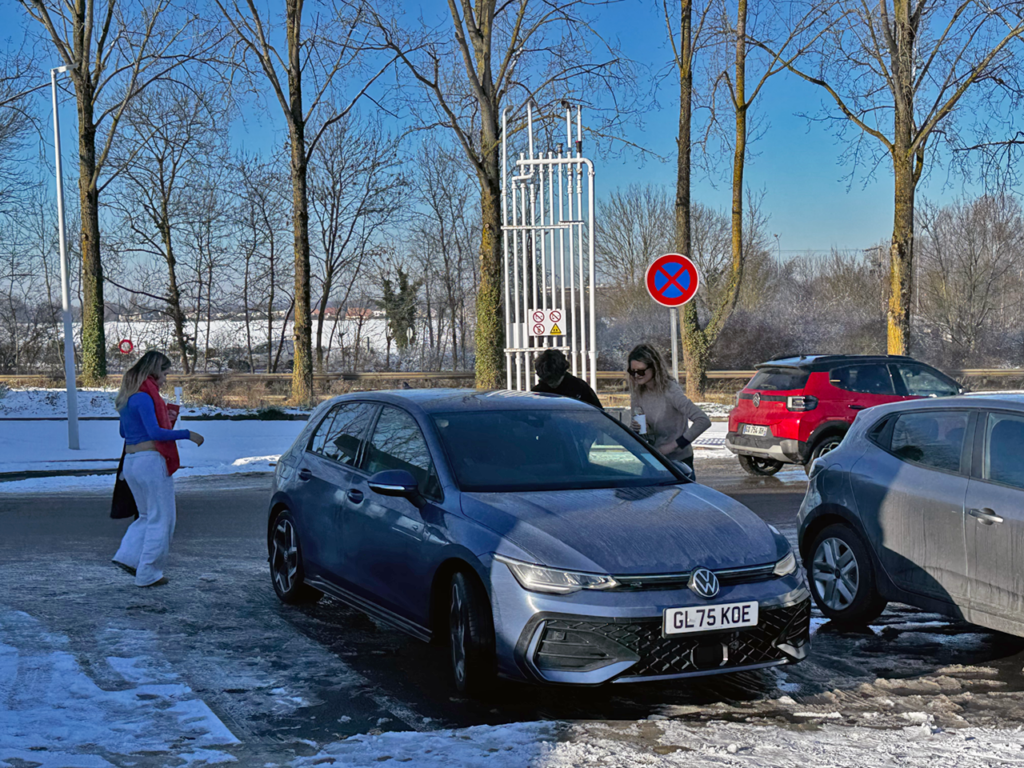
Here’s another thing that I had to perform during these holidays that felt almost as unnatural to me as trying to write a thought piece on a telephone screen: we were renting a car in Britain and also driving there, which I had done before, but I soon remembered it can be difficult to get used to it at the beginning especially jet lagged (our trip was in part cheap due to a long layover in Florida). To add to it, I wanted to keep the rental as affordable as possible, so, having learned to drive in Europe, I didn’t mind picking a stick-shift compact.
The VW Golf with an R trim (minus the engine) turned out to draw me back in time to my twenties, for the first car I owned was a metal grey and boxy, five-door 1984 Golf (commercialized as Rabbit in the US) that smelled like humidity, having come to Barcelona with its original owners from Belgium. Now, add to the jet lag, reverse cockpit, and stick shift the discomfort of having a few too many bags to carry despite being for and not five in the car, and a cold wave that turned roads in northern France icy.
Our youngest, a son, has acclimatized to the Bay Area to the point of refusing to remember how winter can feel in Europe once you’re inland and the ocean effect wanes, so he wore a t-shirt for the first two days, until his body understood that climate is more than a mentality, so the biting cold accomplished what we couldn’t.
As jet lag and other factors were hitting us on the road in the middle of nowhere, and as we saw the snow falling around us, my sister and brother in law called; they were spending a few days at my parents, though we were going to miss seeing them for a day, which encouraged us to plan the end of the trip (a return to Britain through the tunnel) visiting them at their home in England. They were calling about another sudden contingency, however, which felt almost like a bad joke: the whole of Christmas week had been rainy in Catalonia, and a storm on the 27th, as temperatures were falling after sunset, burned the entire electrical system at my parents’ home.
My sister was calling on the late evening of the 28th: my parents had been prompted to call the insurance and deal with the bureaucracy of trying to get a quick response to their emergency during a week when most people take time off, so it would be a few days until they could reconnect to the grid and have power again.
A strike of lightning
Reverting to the Middle Ages after a strike of lightning on the 27th of December must be quite unusual; what are the odds? (I’ll check this once I’m back on the computer and I can check the internet.)
My sister told me on the phone that my parents used the fireplace for heating, as well as candles and wireless lamps to light the rooms. Their central heating relies on natural gas but is autonomous and requires power to run; since this has never happened to them before, they’ve never considered a backup power source or a generator. Using a generator is so unusual around my parents that they couldn’t even borrow one.
Even if my parents are far from being power preppers, they’re always well stocked in food, which reaches its apex during Christmas, so the first night with no power they realized they risked to have the food in the freezers spoiled, so the morning of the 28th, self-conscious of the fact that it would take a few days for them o reinstall what had burned between the closest power link and their home meter, they told their neighbor from the house behind them. And despite barely speaking all year, their neighbors offered a power extension from their panel so my parents could run the essentials.
This temporary solution didn’t improve my sister’s last days of vacation, for they were sleeping upstairs, far from the fireplace, and wanted to shower and wash some clothes as well. In other words, they had been temporarily uprooted from modernity and knew they were always welcome at our nearby country home, so we told them to go there and feel at home.
Plus—I told them half-jokingly, though deeply serious inside—that we had designed the house to run and remain comfortable even if the surroundings suffered a sudden event that cut us off from the water or power grid. We use two wood-burning stoves, and the most-used one in the house, strategically located upstairs in the sleeping quarters, runs on pellets. Plus, power and water were working, of course; they only needed to turn on the heater to get a steamy shower a little later.
Our very dependent modern life
A week later, my sister and brother-in-law explained to me how luxurious the very basics had felt after just two days in the dark, sleeping in a cold, brick-and-mortar house. Going to a place that relied on fireplaces, one of them with an oven on top, was quite an experience for them. They not only enjoyed their stay there, but also washed and took a warm shower before leaving for the airport.
That brief return to an almost premodern way of living reminded me that resilience is often found not in scale or complexity, but in deliberate simplicity.
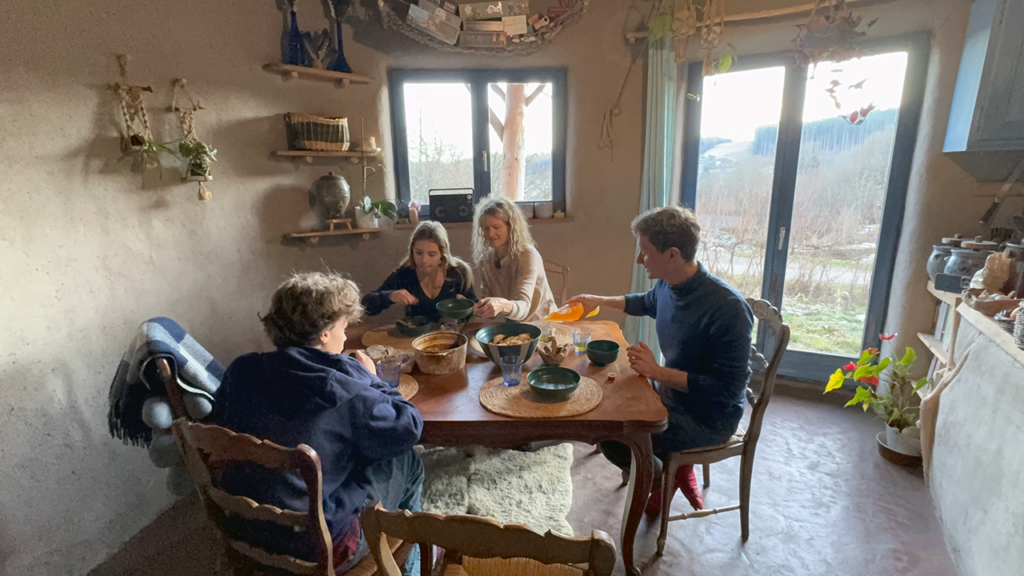
Feeling vulnerable as I drove an English stick-shift car, cold and jet-lagged, with the weight of responsibility for planning the trip, I found refreshing responses to the rising sense of helplessness many young people feel in our highly normative times. In a delightful little village from Les Vosges, a rural area of eastern France close to the German border, we met a young PhD in environmental studies who had built his own house, biked everywhere, and refused to dedicate his days to work a random day job to pay for things he didn’t need.
Instead, Mathieu used his time to bring meaning to his everyday activities: reading, working outside, foraging near his house, hiking the surrounding mountains, helping the village organize some interesting self-reliance initiatives, and (possibly) getting involved soon in local politics to bring change to his immediate area.
We asked how much money he needed to sustain his highly desirable and autonomous life. After buying his lot for 30,000 euros and building his house for under 20,000 euros, he can now live the life he envisions for around 200 euros a month (including the smartphone bill, gas, the food he can’t grow and store, car insurance, and the occasional outing). Some see poverty in this, we said. “I see personal freedom and more time for me to make a difference,” he said. Mathieu is in his early thirties and shows the personal discipline to recognize an opportunity in the system’s fragility around him.
Amid very tall British lorries
When unexpected things happen, only places designed with redundancies and capable of operating autonomously, whether with traditional analog systems or backup power, can provide the comforts we’ve grown accustomed to. As the world turns inward, less consensual and more fragmented, and extreme weather events compound the risks, we’d better pause and consider how our interdependence has made us weaker and more reliant on complex systems that lack proper backups.
It would only take a coordinated electronic attack to revert the highly normative world of today to a place where everything stopped working, and nothing can be easily fixed or run autonomously because it requires either the remote permission of companies or institutions, or parts and mechanisms that run on opaque black boxes that can’t be easily patched or replaced.
Little did we know that, back home in California, heavy rain had triggered a malfunction at a San Francisco power substation, plunging the city into several days of widespread blackouts and setting the stage for the event-metaphor of our time: tech automation. As the Waymo cars stopped in the middle of the road once the traffic lights went down, all the people in the city realized that they were in another sci-fi-Kafkaesque situation: the Uber driver who took us home from the airport at the end of the first week of January, 2026, a Franco-Moroccan single mum called Sara, explained that she couldn’t enter her apartment the first night it happened because her apartment building in the San Francisco’s Mission district doesn’t use keys but a digital keypad that stopped working during the blackout (the building administration decided to unlock all doors the day after and keep it during the event).
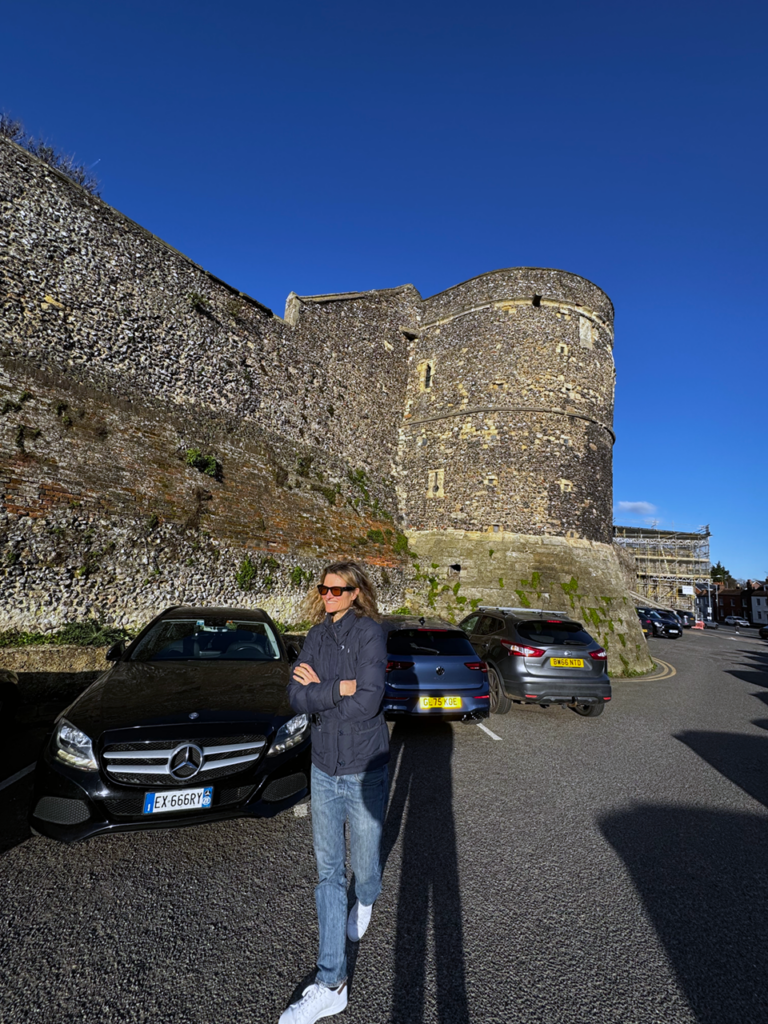
As all this was unraveling, we continued our trip in our English stick-shift car. After leaving the land of tall lorries (big semi trucks are really tall in the UK, a different normative must allow this) and left-side driving, we realized that it’s hard to take traffic circles when cars are coming from the left and you’re driving on the right side of the car, but me made everything work (with my copilot, usually my middle daughter, helping me take the highway tickets and pay the tolls from her side window).
Junkies of normality
It takes an unconventional vacation on a bad weather and the account of family contingencies throughout the holidays to acknowledge something we all feel one way or another: even when the institutions and systems around us look robust enough to sustain a sense of safety and even prosperity, we know things are weaker than they look, and when reality intrudes and becomes a bit messier than expected, we find ourselves facing moments of discomfort of upheaval.
These little contingencies not only affected the plans of many relatives in the previous days but also modified their sense of safety; for example, the couple involved in the accident decided not to drive on Christmas Eve and Christmas Day because they felt suddenly unsafe on the road, even though roads aren’t now less safe for them just because they were involved in an accident. A lightning strike prompted my sister and my brother-in-law to go spend the night at our country home so they could take advantage of the comforts of a more analog house and stay warm while my parents’ power was out. And fighting with insurance companies, whose professionals defer to the fine print to avoid as much coverage as possible, can accelerate the erosion of confidence in society’s perceived safety.
Perhaps this is a mere speculation, but many people, especially as they get older and notice a decrease in their physical and mental fitness, confound their self-perceived decline with a sense of societal decadence and of insecurity around them, which justifies the need for a supposedly needed return to order to counter the gloominess they feel around them. Studies show that socially connected older adults not only have better health and longer life expectancy, but are also more optimistic about their surroundings and the world. We should ask ourselves about who wants us to feel fearful, isolated, and prone to welcome exceptional measures to restore a sense of the world, and why.
Being aware of the fragility and interdependence of the systems we’ve built shouldn’t make us wary of the power of collaboration within society. History shows how democracies and authoritarian regimes have used the collective perception of a state of emergency to turn control not into an exception but the rule.
After seeing his German citizenship revoked in 1938 and becoming stateless, Walter Benjamin warned about the use of the state of exception, theorized in modern form by the German jurist Carl Schmitt, as the new norm in which people will gladly live when they feel threatened and are promised a return to an ideal state of things that never existed. Many decades later, Italian philosopher Giorgio Agamben, who had studied under Martin Heidegger, argued that this imposed emergency is used as an excuse for a form of governance that trickles down to controlling people’s lives rather than making them safer or more resilient.
Trading freedom for a feeling of safety
The oppressive ambient of Kafka’s plots (or lack of them) is more timely than ever. As advanced democracies have gotten even more technical and bureaucracy has gone digital, more subtle and effective ways of imposing a permanent state of exception have made anyone’s existence at once more constrained and, paradoxically, less engaged in civil participation.
Giorgio Agamben argues that, instead of using the state of emergency temporarily to tackle extraordinary events such as war or natural disasters, what we get isn’t a return to law once the systemic risk decreases, but an upgrade from emergency to normalized emergency.
Seeing these last days how easily people who live comfortable lives, looking at the world with optimism rather than immersed in permanent fear, get their daily routines so disrupted that it takes them days, if not weeks, to return to their self-perceived normality, I can see how easy it would be by bad actors to exploit the weakness that comes out of the comforts we think we are entitled to. If we lose them or feel we could, we might sign for outlandish societal experiments.
Thinkers like Agamben remind us of how easily many of us would trade freedom for safety even when we don’t think or sense we’re doing so, and how quickly people decide to look the other way when things turn real and we find ourselves immersed in permanent fear due to the impositions of the “exceptional conditions” that were supposed to bring us back to a consumer Eden. The little disruptions I saw during Christmas feel like a hiccup in the reality of many people’s lives today, but they made me realize we all live in the same precarious game and don’t like the underlying feeling.
Or, as Hannah Arendt (another thinker whose citizenship was revoked during one of many escalating, permanent states of exception praised by Carl Schmitt) put it: systems appear solid until we wake up one day and they clearly aren’t. And, under the special conditions of a permanent emergency, it is far easier to act than to think.
The rise of homes as assets
Polls show the growing disconnect younger adults feel, as they realize how hard it is to even qualify for a flourishing existence under today’s permanent state of exception. Modern life feels conditional, for it is represented as a race to attain abstract Shangri-la success, freedom, or even happiness, a supposed consumer self-realization that comes with the ability to buy status symbols, like the ideal home, a dream car, the perfect body, and envied vacations.
Soon, those lucky enough to repay their student loans or be on track to do so find that the most appealing places are out of reach, and have to settle for high rents. The conditional and highly normative nature of modern housing (for it requires a mortgage, a decent credit score, HOA rules, and zoning restrictions) can go wrong quickly, and many live in fear of eviction, foreclosure, rising rents, and the shadow of being both poor and feeling besieged by arbitrary norms, rules, and obligations.
Modern living doesn’t feel only conditional and revocable—difficult to attain and maintain. If we don’t behave and follow a never-ending list of norms, things fall apart very fast; when a lightning strike burns our house’s entire electric system, or we lose our family car in an accident, it already feels difficult for those who have the time and resources, but it can turn the world upside down if you live paycheck to paycheck. Our life is also highly surveilled, even if we choose not to pay too much attention to the freedoms we decided to give up to increase our supposed digital convenience; many depend on smart meters and connected cars, whereas we’re watched by private and public cameras, a growing list of apps, and many times by landlords and the optimization software they use. Third, our lives revolve around consumption and financialization; for example, houses become investment assets rather than shelters for people to live in.
Young precariat and our collective future
No wonder there’s frustration. Before they can even dream of buying a place where they could see themselves thriving, those who feel excluded from the housing market understand in their own daily experience that housing isn’t a right or refuge for all, but rather a precarious, temporary permission.
Simplicity feels radical, precisely because we’ve become so accustomed to convenience that we sometimes believe that having only a phone with no internet connection on board a plane crossing the ocean is the perfect excuse for doing nothing (other than snaking, drinking random things like tomato juice, and binge watching until our cortex feels numb).
Modernity has created incentives to keep us docile by overwhelming us, then scares us when we feel how easily systems can collapse. Instead, we can sharpen the tools we have at hand at every moment to make the most of every situation. Perhaps the cause for optimism lies in the will to cultivate its sources.
In a world optimized for convenience and control, resilience no longer comes from scale or speed, but from knowing how to live—briefly, modestly, and humanly—when systems stop working.