From the Alhambra to California backyards, an ancient architectural typology shows how patios, plants, and water create microclimates, social space, and a small refuge from the noise.
Eventually, even fish know they are in water, and so, we are self-aware of the need to normalize the outworn “this is fine” meme, in which a smiling cartoon dog sits at a table, coffee in hand, as the surroundings go up in flames.
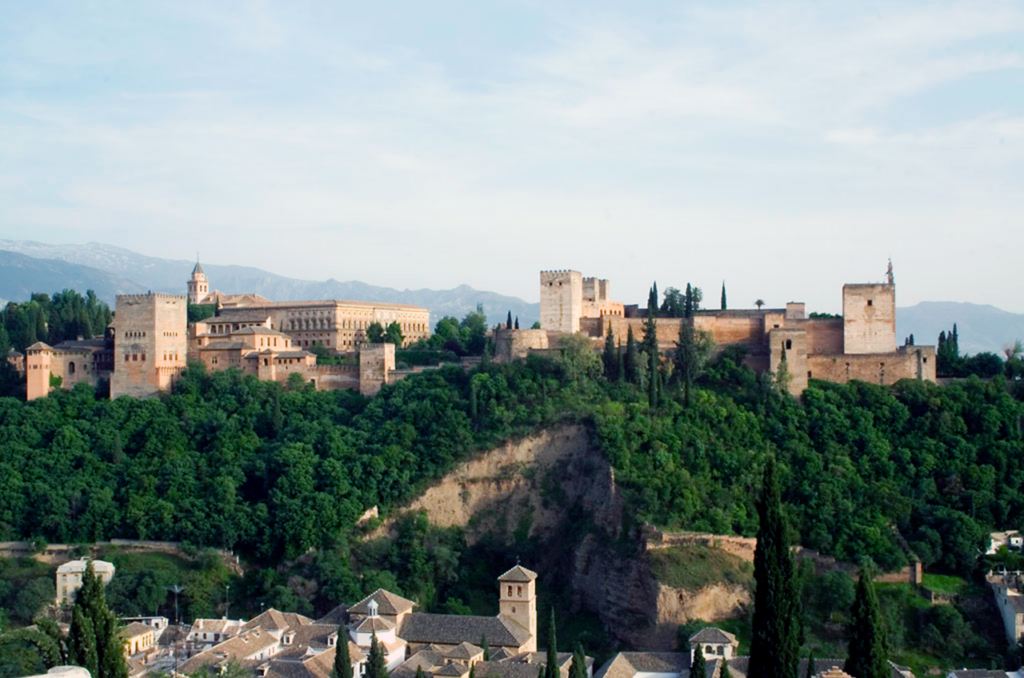
Unstable times remind us that vernacular architecture developed in response to social and environmental stressors. Courtyards, for example, were a way to stay cool and be “outside” while never leaving the home. But the courtyard may make sense even when it feels safe outdoors, and a hint of spring reminded me of it.
Talking about spaces of solace and contemplation: reading the news a bit too much might make one feel that the world isn’t as predictable as it used to be. At this point, many fear the growing numbness of habituation to what felt extraordinary not long ago, which prevents them from showing any sign of surprise as the events of one week surpass those of the previous week in cruelty or absurdity.
The zeitgeist may look like a mad party to us descendants of the boring, stable post-World War II reality, but our remote relatives would have had something else to say. During the early Neolithic, houses in the Jordan Valley added a courtyard as a space of activity and expression: cooking, sleeping, working, playing, gardening, child and animal rearing. This controlled environment contrasted with the growing risks and competition outside.
Courtyards as vernacular insurance
If our species evolved in a hostile environment for much of its history, then the instability outside—whether caused by violence or custom—influenced how we organize and live. In ancient times, many cultures developed courtyards to allow people to interact with one another and the outdoors without leaving the dwelling.
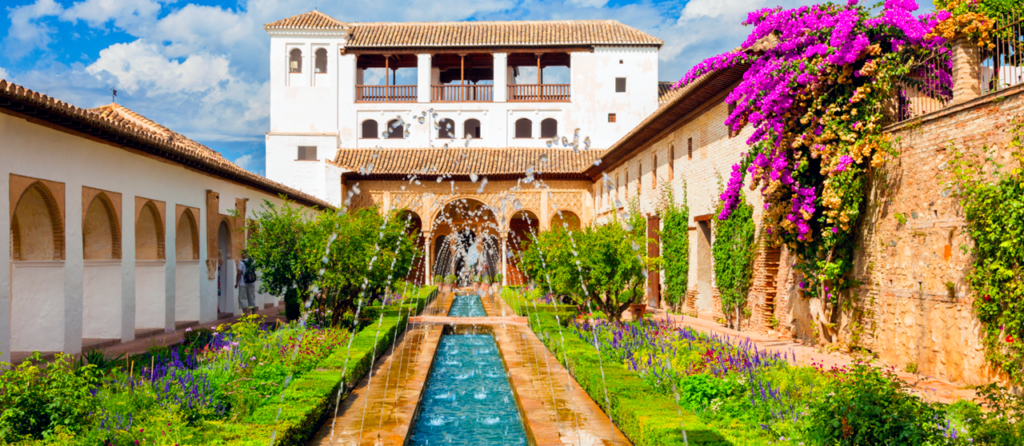
Then, courtyards evolved as spaces for interaction, yearning, and ultimately refinement. Anybody familiar with courtyards can assess this: over the years, I’ve been lucky to visit and hang out in patios that cooled down temperatures in the hot Mediterranean summer, and to visit Roman and Greek colonnaded central open-air spaces, Andalusian patios, and Islamic riads.
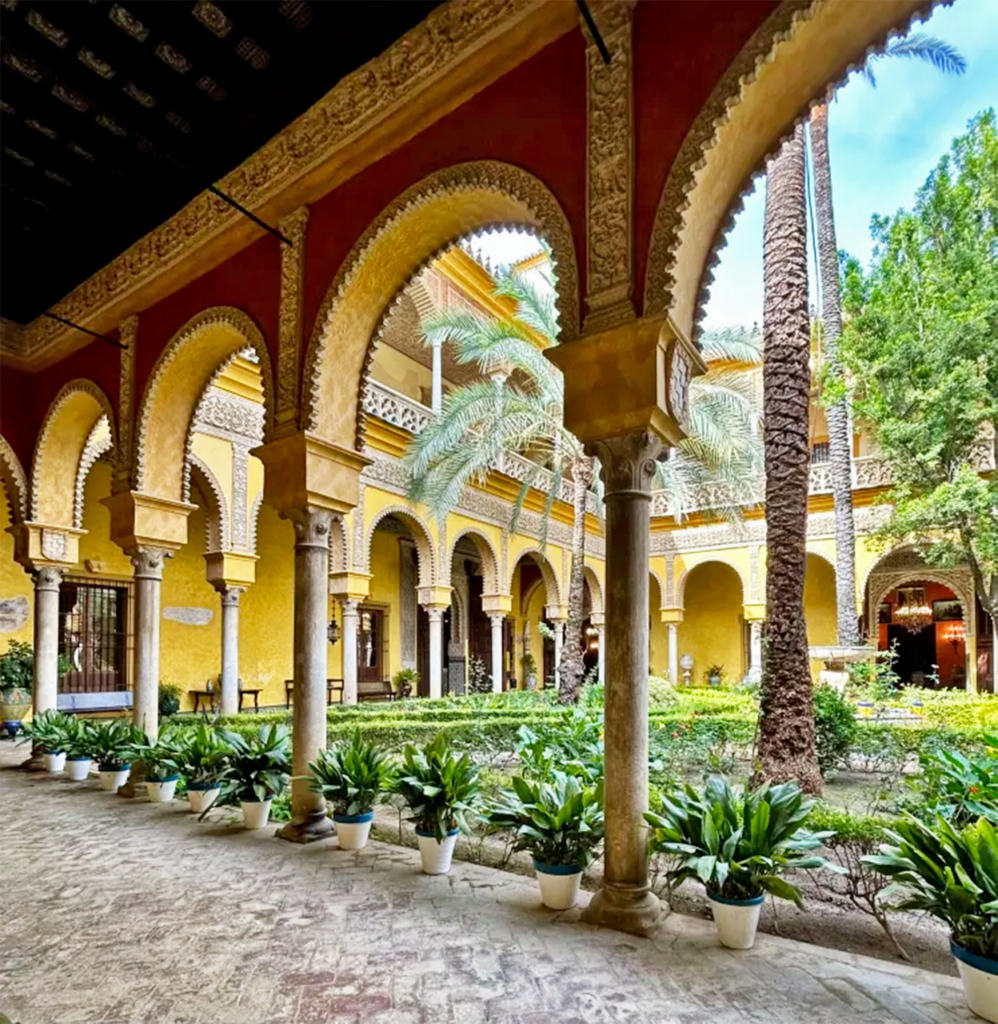
I can also understand why Spanish poet Antonio Machado, who spent his childhood looking at the courtyard of Seville’s Palacio de las Dueñas, where he lived while his father was the caretaker, began his most important book with the verses:
Mi infancia son recuerdos de un patio de Sevilla,
y un huerto claro donde madura el limonero;My childhood memories are of a patio in Seville
Antonio Machado, beginning of the poem Retrato; from Campos de Castilla (1912)
and a sunny garden where lemon trees ripened;
Micro-archetype
If we were to draw an archetype of such spaces blending heaven and earth, framing sky and soil, I would define the ideal courtyard as small and somehow humble. It’s calm and fresh, and relatively aromatic (depending on the season, whether it’s sunny, and the time of day). In the middle, a slender tree casts a shadow over a fountain that sends water into an open canal, which connects to a stone basin. Around the basin, flowers and fresh plants are getting sprayed by the fountain.
When 45-year-old Washington Irving visited the fortress complex of the Alhambra in Granada in 1828, he was so enchanted that he returned in 1829 to live in the palace for nearly three months. His accounts of the visit paint an enchanted ruin inhabited by Romantic, picaresque characters.
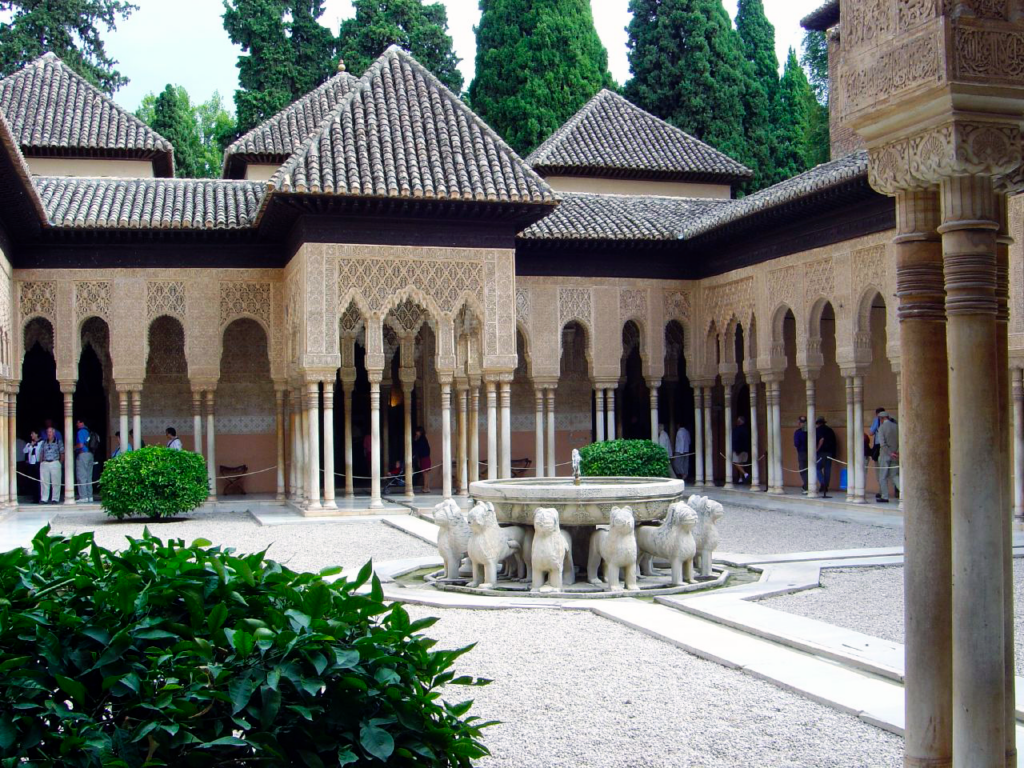
We also feel the pull of the Court of the Lions, paved with white marble and surrounded by 124 white marble columns.
“Passing from the Court of the Alberca under a Moorish archway, we entered the renowned Court of Lions. No part of the edifice gives a more complete idea of its original beauty than this, for none has suffered so little from the ravages of time. In the centre stands the fountain famous in song and story. The alabaster basins still shed their diamond drops; the twelve lions which support them, and give the court its name, still cast forth crystal streams as in the days of Boabdil.”
(…)
“The sounds in question had no doubt been produced, as I had afterwards an opportunity of ascertaining, by the bubbling currents and tinkling falls of water conducted under the pavement through pipes and channels to supply the fountains; but I was too considerate to intimate such an idea to the humble chronicler of the Alhambra.”
(…)
“An abundant supply of water, brought from the mountains by old Moorish aqueducts, circulates throughout the palace, supplying its baths and fish-pools, sparkling in jets within its halls, or murmuring in channels along the marble pavements. When it has paid its tribute to the royal pile, and visited its gardens and parterres, it flows down the long avenue leading to the city, tinkling in rills, gushing in fountains, and maintaining a perpetual verdure in those groves that embower and beautify the whole hill of the Alhambra.
“Those only who have sojourned in the ardent climates of the South can appreciate the delights of an abode combining the breezy coolness of the mountain with the freshness and verdure of the valley. While the city below pants with the noontide heat, and the parched Vega trembles to the eye, the delicate airs from the Sierra Nevada play through these lofty halls, bringing with them the sweetness of the surrounding gardens. Everything invites to that indolent repose, the bliss of southern climes; and while the half-shut eye looks out from shaded balconies upon the glittering landscape, the ear is lulled by the rustling of groves and the murmur of running streams.”
Tales of the Alhambra (chapter Palace of the Alhambra), Washington Irving, 1832
The Alhambra’s cooling machine
Irving had time to realize that the Court remained fresh thanks to a fountain supported by twelve lions; it’s not a mere water basin ornamented by statues, some researchers suggest it may have functioned as a kind of 14th-century water clock, using gravity to mark the hours: a steady, low-pressure inflow fills a basin, which rises and activates each of the 12 lions sequentially, one per hour, draining at noon through a siphon, filling four canals with water while cooling the space.
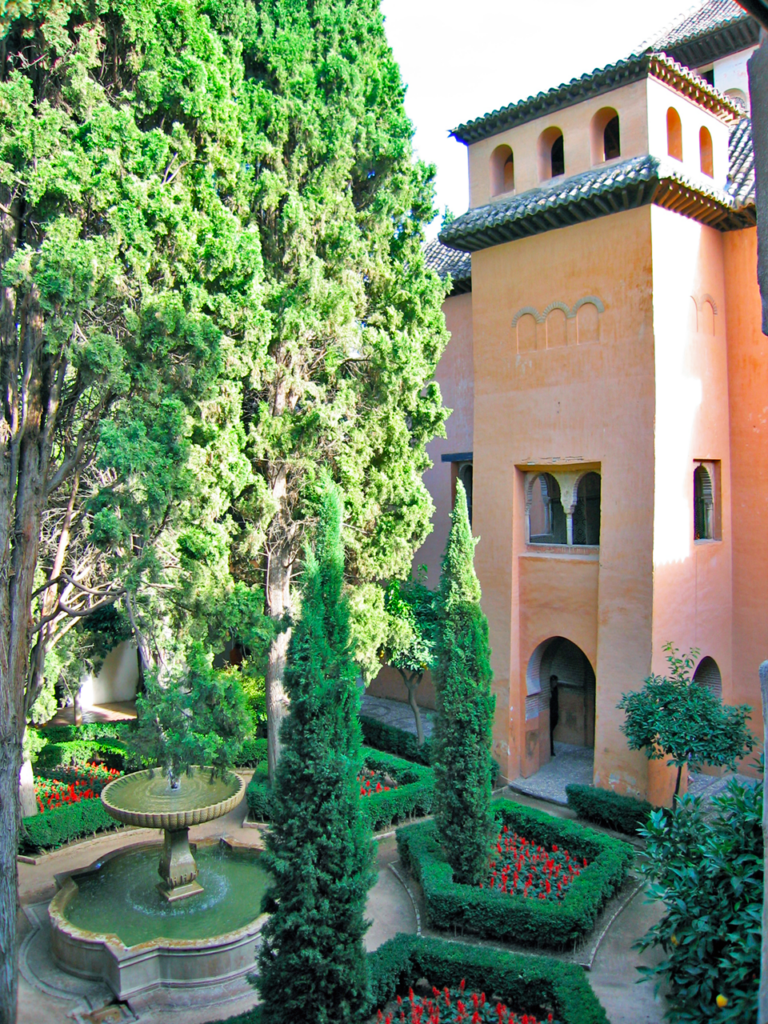
The four canals, arranged in a cross-shaped pattern that divides the courtyard into four quadrants, represent the four rivers of paradise. They are connected to the broader water system that flows to the surrounding halls in a sophisticated system that turns the palace into a fortress with its own microclimate, powered by patios, plants, and water.
But courtyards don’t need to reach the intricacy of the Court of the Lions to create a microclimate, and often somebody’s own miniature Eden.
Other cultures have also developed ways to benefit from heaven and earth without leaving the enclosure of their dwellings. For generations, the ancient Chinese siheyuan evolved as courtyard low houses whose quarters were arranged in a rectangle around a semi-private courtyard, a semi-public space combining protection and interaction.
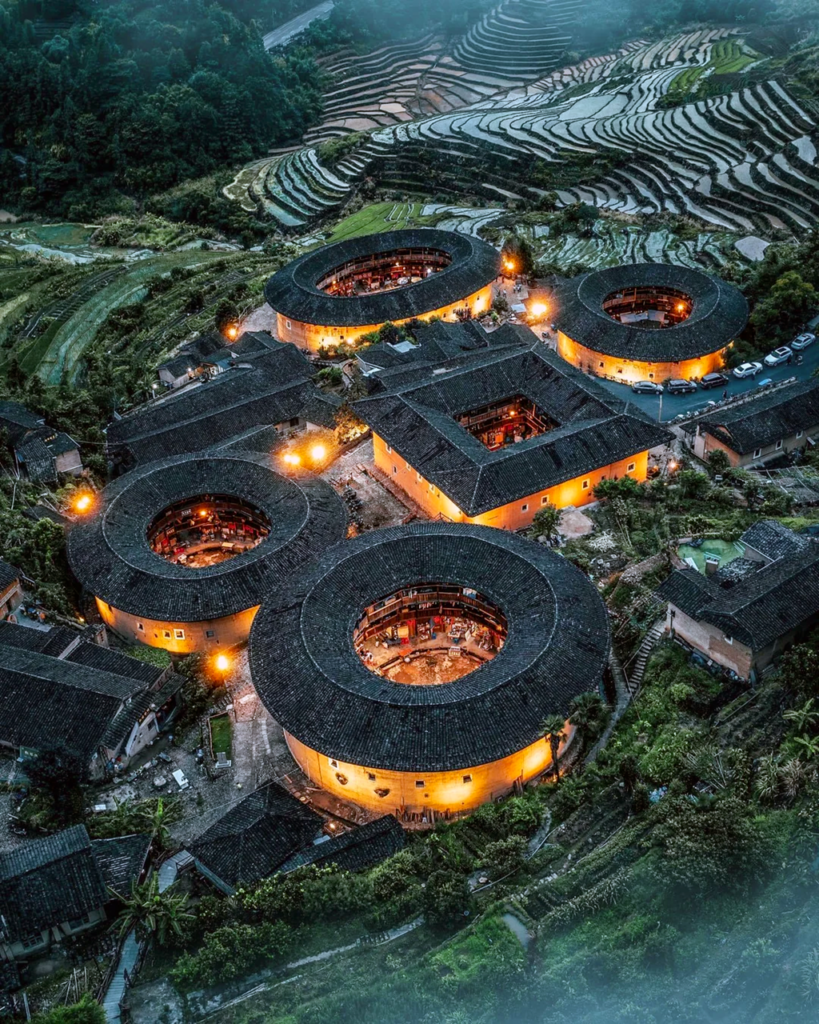
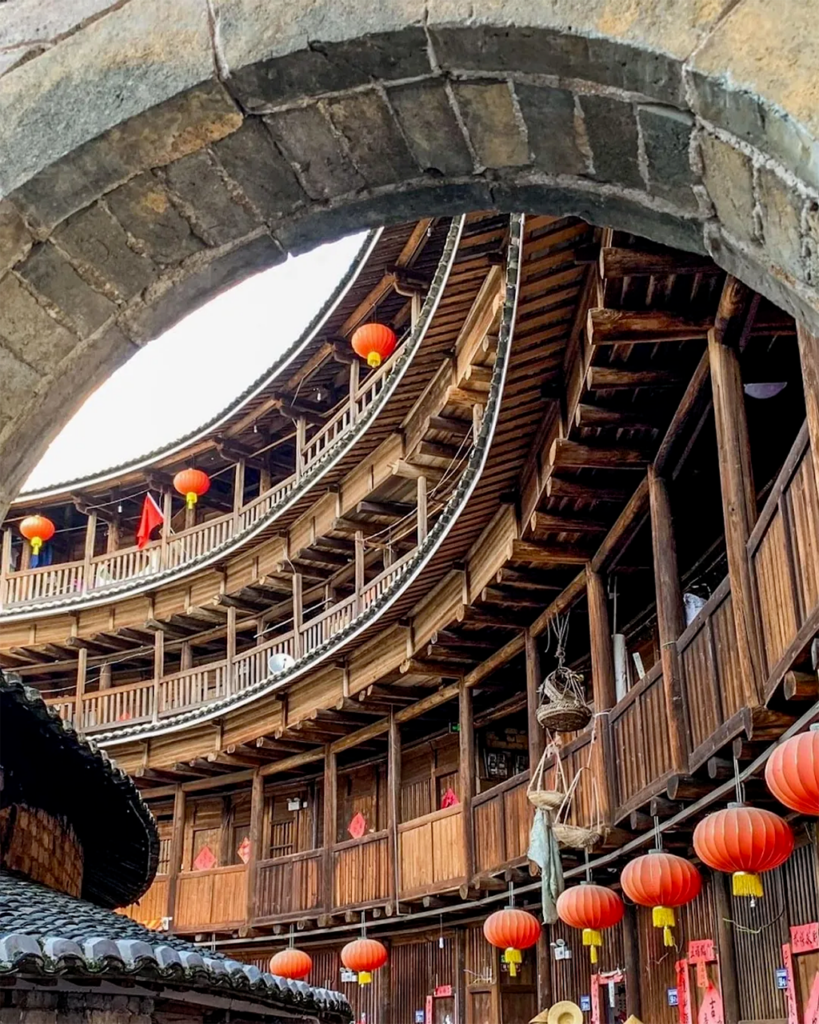
Also in China, the traditional Tulou from Fujian follows a similar pattern: massive, circular, multifamily buildings designed to repel bandits, in which life happens in the interior courtyard, which functions as a semi-private “public square,” a space private to the Tulou’s inhabitants.
Interior patios across time and cultures
Each courtyard house typology evolved to accommodate its locale. For example, Chinese dwellers built siheyuans with taller Northwestern walls to protect the courtyard from winter winds from Northern China. Likewise, roof eaves curve downward to gently drain rainwater, avoiding puddles, whereas a ridged rooftop provides shade in summer and collects sunlight in winter.
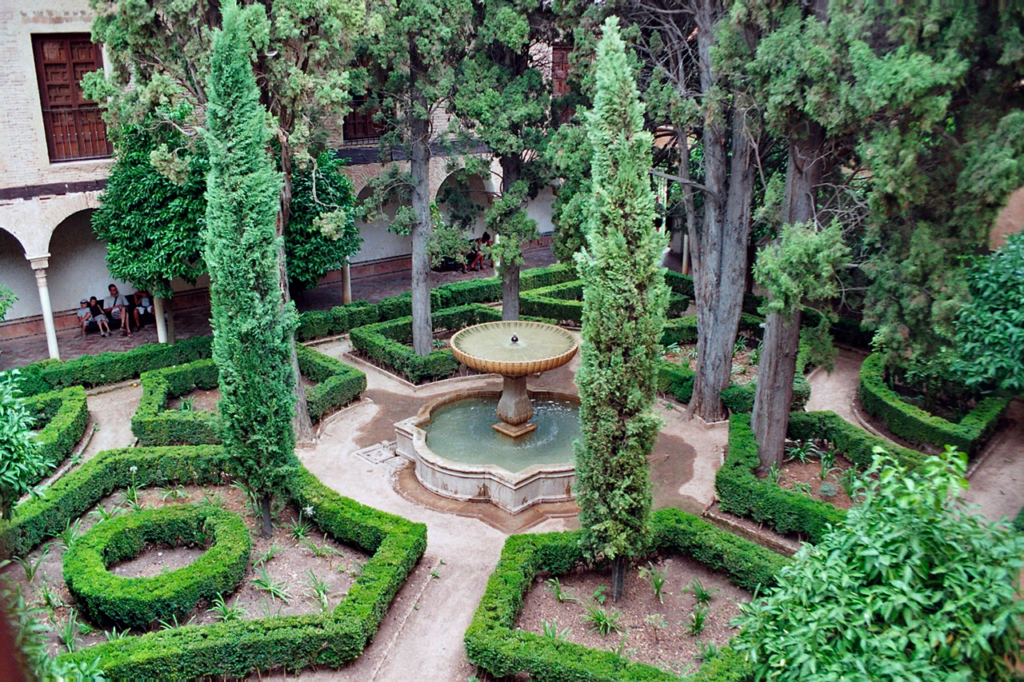
But there’s no need to travel to the Mediterranean or the Islamic world, or to marvel at images of rural China’s Hakka earth circular buildings (in ancient times, each one of them a “village” or hamlet on its own), to understand or benefit from the potential of the courtyard. This ancient design has withstood the test of time and place, and can adapt to any local vernacular, assisting architectural design through its simpler, elegant way of combining density, privacy, natural light, and fresh air without leaving the home premises.
Let’s consider the microclimate effect of courtyards in mild climates, as the transition between seasons makes us curious again about the mild weather outside, even though we sometimes prefer to stay “home” rather than go out. Like lush backyards—especially those with running water—, courtyards with water and greenery are natural climate regulators.
As proven by vernacular designs across the Mediterranean, the Islamic World, and ancient China, courtyards serve as spaces of cooling and heating: hot air from the house rises and escapes upward, cooler air enters rooms from the courtyard shaded areas, and plants and water create the most ancient and effective swamp cooler you can get.
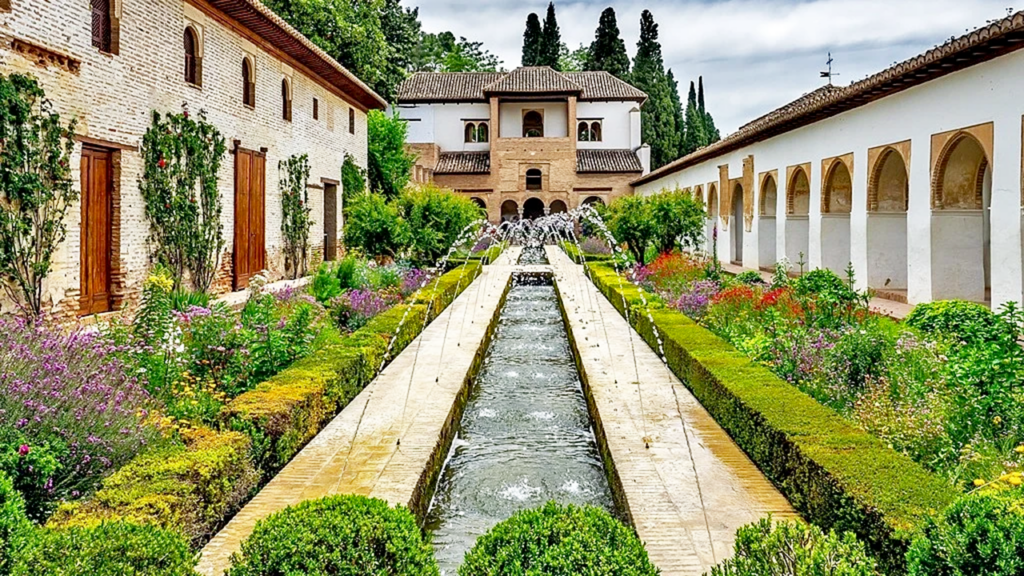
Childhood memories: water on clay and stone
Growing up in the Mediterranean (even though my family has roots in Atlantic Spain, which is greener and cooler), I saw and enjoyed many patios, especially in summer, while visiting old villages and towns where traditional ways were still present. Before it was too hot, and at the end of the day, old ladies would splash water with their hands around the courtyard floor to keep the space cool for as long as possible; there were always vines and other vegetation to allow kids to play in one corner while adults played cards and dominoes, knitted, chatted, listened to the sound of the Tour de France, Vuelta, or Giro coming from the TV somewhere.
Back then, one could still see botijos: water jugs made of porous pottery that did many things at once, now almost vanished: they looked great, kept water cool and tasty, and (through evaporation) were always cooler than the ambient temperature during the warm months.
Millennia ago, civilizations from Persia and the Fertile Crescent to Egypt used similar techniques—porous clay, coarse cloth, cross ventilation, water elements —to maximize the area of evaporation in courtyards and create microclimates that made life much more pleasant in such indoor-outdoor spaces.
Hence, since time immemorial, courtyards have been the smallest scale possible of the idea of oasis, or some sort of humble, controlled, makeshift family Eden.
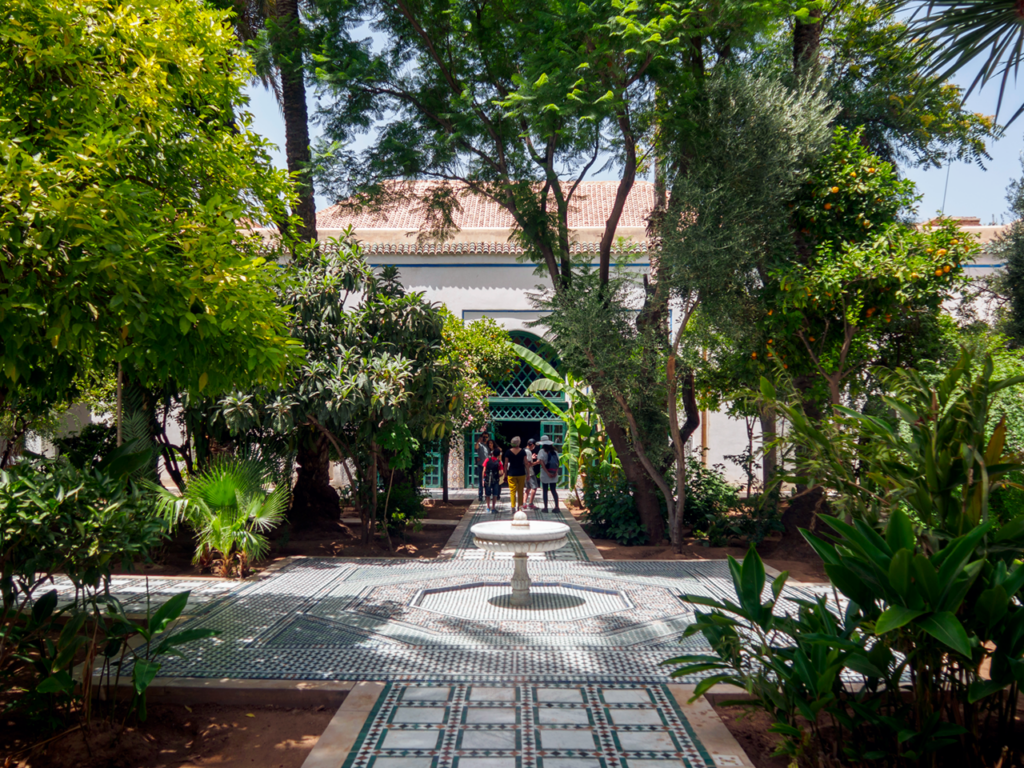
Here I am in California, thinking about courtyards the same way Michel de Montaigne thought about castle towers during the Wars of Religion, as the “this is fine” moment becomes eternal in this calamitous groundhog-day-zeitgeist. And, somehow, the spiritual and climatic microclimate generated by the courtyard comes to mind.
Hints of the California spring
After a few weeks of cold, rainy weather, early spring is knocking at the door in our backyard, a small respite area that resembles and behaves like a courtyard, protected in its perimeter by mostly a bunch of old, tall trees native of Australia from the myrtle family, called lilly pilly due to its narrow leaves and little purple fruits that Aboriginals collected and ate for tens of thousands of years.
As the days get warm and sunlight wrestles with the tight-canopied trees to warm the ambient, it’s a treat to sit somewhere in between the back of the house and the perimeter to read, daydream, or fight drowsiness after lunch, which is probably the ultimate luxury in our era of constant cerebral leasing in the name of engagement—whether for work, leisure, or mere rumination.
Want to take an imaginary break to let things go and focus on the moment, while you hear the trembling of a fountain amid arches, flowers, and bumblebees? Courtyards are an ancient invention that brings us solace. They also vindicate the value of being outdoors without being “outside.”
Since time immemorial, when communities needed to protect themselves from the outside while preserving a semi-public place to stay outdoors, courtyards have been used to cultivate enclosed gardens and engage with other members of the same group with access to the same house or building.
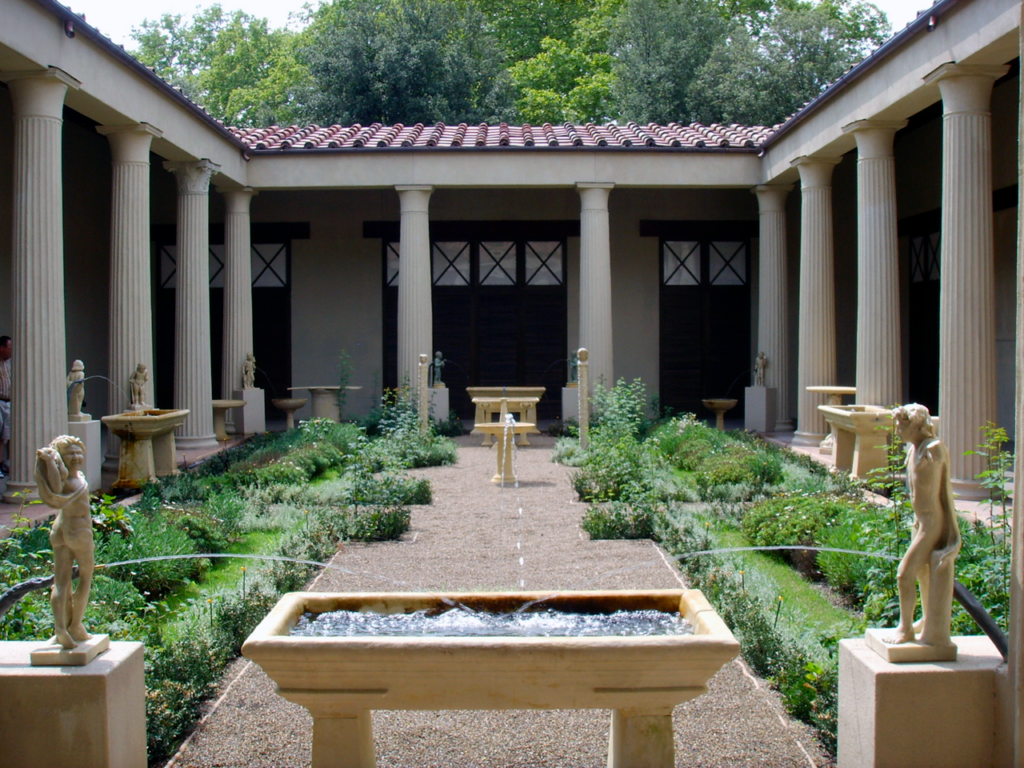
Yet interior patios didn’t only allow people to go “out” while staying within: during the hot months in vast areas of Eurasia, Africa, and the Americas (before and during the Columbian Exchange), courtyards often secured wells, fountains, or ponds surrounded by plants and fruit trees, providing evaporative cooling and a place to play and socialize to people of all ages, whereas in monastic environments, they allowed contemplation in a safe environment to the members to a given order.
Courtyards: a connection between life inside and outside
The connection I find between the courtyards of my childhood and California as days get brighter and the backyard recovers its full potential, is a seminal book that reminded many architects about the importance of making livable and enchanting architecture: not surprisingly, courtyards appear throughout Christopher Alexander’s A Pattern Language (1977), a practical architecture book praised for its adaptability to any imaginable circumstance.
See, for example, “Pattern 115 — Courtyards Which Live” (p.561), the main courtyard pattern. Alexander worries that, unlike the lively, delightful ancient courtyards, modern ones are often “dead” spaces, used as design artifacts to put things in perspective. To maximize their potential, Alexander argues that courtyards must connect rather than sit in isolation.
Also, they should have multiple doors, opening into and from surrounding rooms; like ancient courtyards, modern ones should provide sun, shade, and different micro-places (porch, edges, corners), and be made to inspire contemplation or reflection through a tree, fountain, sculpture, table, or any other memorable thing at the center.
A successful, welcoming courtyard shouldn’t be huge (less than 30 or 40 feet across) to feel intimate, while its edges should be memorable and accommodate plants and other elements. In other words, it should function like an outdoor room and not a leftover void nobody uses. Successful courtyards also have a small area with a view out to a larger open space.
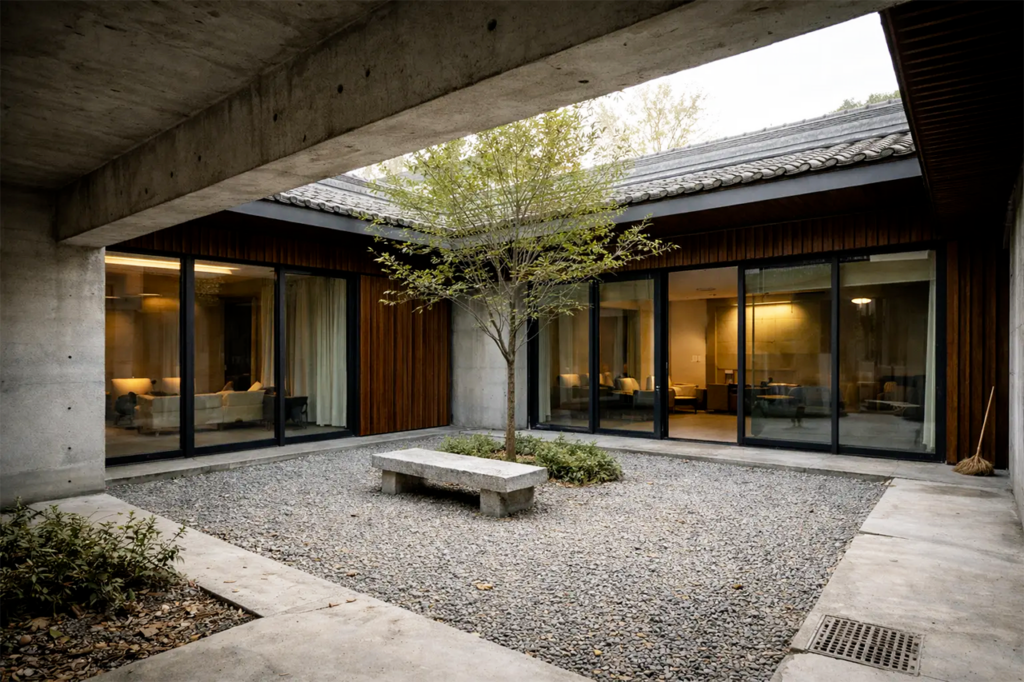
Interestingly, Alexander mentions courtyard again in so many cross references that we lose track: as a positive outdoor space (pattern 106), more private than a neighborhood green but more public than a private garden in the hierarchy of open spaces (pattern 114, an outdoor room (163), a garden wall (173), an opportunity to include arcades like cloisters, galleries, or verandas (119).
Among other things, properly designed courtyards invite use and feel alive, and do so because they combine the safety of the home—they are enclosed and protected by the outer walls and the dwelling itself—while at the same time letting the outdoors in, all using a relatively small size that brings a human scale to the assembly.
When we stopped cherishing courtyards
Despite the many advantages of the courtyard, several factors have contributed to its decline worldwide, including air conditioning and the view that non-livable, unroofed space within a dwelling is wasted space. In suburban North America, houses have increased in size, while backyards have shrunk despite new laws permitting backyard cottages; regardless of the climate where they are built, modern homes lose the opportunity to improve an indoor-outdoor environment with its own microclimate that in many places could be used for most of the year.
Historically, courtyards with water sources and plants provided passive cooling, allowing comfortable temperatures during the warm months without mechanical systems. It was affordable, enhanced the home’s beauty, fostered contemplative activities such as gardening, and created a semi-private environment that encouraged more interaction.
Growing up, small villages in Spain remained deserted after noon, when the sun was highest; by contrast, courtyards kept their activity, as they moderated the climatic extremes: in the country’s interior, the cool air of the summer night remained undisturbed by the hot wind outside; when temperatures rose with the day even in the courtyard, a bit of sprayed water kept the ambient cool compared with the reality outside until the night breeze arrived.
In the past, sumptuous courtyards were lined with perimetral arcades that provided shade to protect activity from the midday sun, while plants shielded the court walls from direct solar gain. During the colder months, the courtyard remained an important place at the core of the dwelling: the rooms that surrounded it drew more daylight in, and the sun was lower in the sky, making sunlight welcome during the day to warm the interior.
Echoes across the Mediterranean with a domus substratum
Before the invention of modern HVAC, such houses functioned like a giant air shaft, allowing air and light to flow through the rooms around the courtyard.
In hot-dry regions, the climate regulation followed three cycles: first, at night, the cool air descends into the open space inside the house and fills the surrounding rooms; second, around noon the solar radiation strikes the courtyard’s floor, and the cool air begins to rise, remaining mild (the courtyard behaves then as a chimney, keeping the radiation out); finally, during the late afternoon the courtyard and surrounding rooms get warmer but, as the sun sets, the air temperature falls rapidly, and cool air (heavier) begins to dissipate the late afternoon accumulated radiation.
As explained by Turkish architect Suha Özkan (foreword of the book Courtyard Housing: Past, Present and Future, edited by Brian Edwards, Magda Sibley, Mohammad Hakmi, and Peter Land), dwellings around courtyards are a plan configuration that goes back to early semi-urban developments during the Neolithic. They provided protection from other people and wild animals, and could be used as a private garden and a place for gathering.
Over time, it developed into a successful typology from China to Morocco:
“In a well-defined courtyard, the two natural elements—earth beneath and sky above—ensure direct contact with nature. It has always been an important aspect of the comfort of a courtyard to include a monumental tree or a calm and cool pond. In many house types, the kitchen also opens to this space with an oven or a tandoor where the fuel is kept, and smoke is let out of the house immediately. Cooking is a major household activity for women, and the preparation of food, cooking, and, according to the season, food processing, like drying, pickling, or other activities of food preservation, all take place in the courtyard. The courtyard has become a multipurpose room where most of the activities of the family take place. The courtyard also provides a climatically controlled space from many of nature’s unwanted forces, such as winds and storms.”
Architecture professor Attilio Petruccioli reminds us that Andalusian courtyard homes benefited from two models: the Arabic one, and one already present in Hispania since at least Roman times, as shown in ruins of villae like a domus in Italica (a major archaeological site in Santiponce, near Seville). It’s a reminder that courtyard houses make sense across cultures, especially in climates where families were required to protect harvests and themselves from the elements during the warm months.
Petruccioli addresses whether the courtyard is a universal archetype of dwelling. Whether it is or not is a matter of debate, but it’s clear that climate isn’t the only factor: the Roman domus was influential across the centuries, but courtyards remained relevant and evolved only in parts of Europe, North Africa, and the Middle East after the fifth century.
For example, the cold Po Valley and Milan developed a strong courtyard housing tradition, though “no trace of it can be found in parts of central Italy (including Rome), southern Italy (excluding the Naples area), and Provence. Climate is not the underlying reason for the courtyard house—for instance, Milan and Aleppo share the same building type but not climate.”
Whether Venetian, Turkish, Lebanese, or Egyptian, many courtyard house typologies benefited from a long tradition codified by Vitruvius in his treatise De Architectura regarding the best proportions and uses of the peristyle (interior courtyard) and also the semi-enclosed cavaedium or atrium, consisting of a central opening in the roof (compluvium) and a rainwater pool beneath it to collect this water (impluvium).
Lost memories of peristyles and atriums
In the Roman domus, the peristyle and cavaedium were at the center of a home system that slowly directed and collected rainwater for many uses, regulating light during the day and seasons, passively warming the rooms in winter, and cooling them in summer.
No wonder that the atrium was the most important room in respectable Roman houses. It lacked a “roof,” but it was by no means discounted as “wasted space.” As a fundamental part of the dwelling, it connected to the main entrance and was always central for the family regardless of their status: in modest homes, the atrium prevailed as the common room to organize and perform household activities; for richer families, the atrium was a reception room, pleasant and full of plants, water sources, statues, and elaborate finishings and furnishings.
Beyond the suggestive attraction of perfectly curated pictures of Andalusian patios or Moroccan riads turned boutique hotels, courtyards have a place in contemporary culture, especially if we want to promote indoor-outdoor culture and passive cooling even in dense areas: studies show that plants and sources of running water can dramatically reduce the growing phenomenon of heat islands, cheaply developing the opposite with no need of energy: cooling oasis as outdoor refuges even during hot days.
For those, like me, tempted to frame courtyards as easy-to-integrate, resilient architectural elements that protect us from a harsh climate and a menacing world, courtyards make sense even when we don’t see them as bunkers with flowers. They passively cool the houses and turn AC-dependent, sealed layouts into a pleasant sharing space between the sky and the soil. We can look up, and at the same time, we can get our hands dirty.
The comeback
Courtyards would make us bump into one another again. They also create a rhythm we internalized generations ago, one that is aware of where the sun is, how plants are doing, how fertile and wet—or dry-the soil is. And those lucky enough to have an unpaved backyard to improve, or a green space between the back of their house and the front of a recently added small ADU: there’s so much potential to bring all there is between sky and soil to that area.
If modern HVACs make us believe comfort can be bought and is delivered on demand (if we pay for it), courtyards remind us that comfort can be composed and cultivated. With us. By us. Like Ben Harper’s song, we could do it “with our own two hands.”
Which is why my mind often returns to that humble archetype: a tree, a bench, a patch of sky, a bit of water (with its murmur, no more pleasant to me than the fountain of the Court of the Lions was to Washington Irving). A tiny Eden, yes—but also a small civic space, a miniature commons, a private outdoors that still feels cohabited with the people inside your perimeter.
Courtyards make sense not because the world is burning and turning inwards, but because it always has. They are how cultures admitted danger without surrendering to it—how they kept the door shut while letting the seasons in.
Perhaps we should habituate not to the fire, but to the habit of building places where a person can sit, coffee in hand, and hear water instead of headlines—where the body remembers that air can be cool, light can be kind, and the outdoors can still be part of daily life, even when we don’t feel like going outside.
An indoor-outdoor, private-public place where Ivan Illich’s conviviality can thrive, so when we go out in the world, we’re ready to make the effort to stay on the positive side of things, even when it’s difficult to do so.