A World Cup that won’t get going, a cathedral that finally did, and why conciliation (not muscle) is the kind of power that lasts. Both individually and collectively.
As a European living in California, I’m a soccer (football, we say) fan almost by default, though this particular World Cup, which now opens, seems to have been conceived for a different moment.
It encompasses three countries at odds; it chastises the North American fans of a sport that never quite took off here with outrageously expensive tickets; and it was bound to feel unwelcoming to international fans, wary of traveling to a country that decided to unilaterally start a war not long ago and publicizes a crackdown on both local immigrants and many visitors it preemptively sees as a potential threat.
Now that the ball is rolling, however, there’s also the show, the drama, the irresistible pathos of seeing, once again, the world-scale popularity of the main soccer event. Even though soccer isn’t among North America’s top sports at the professional level, the World Cup is different.
Conceived for a different moment
Our son plays soccer and has become genuinely interested in the sport, but we live in the Bay Area, one of the 16 co-hosts across the United States, Mexico, and Canada, and we didn’t have luck with the teams in the group stage. He doesn’t want me to buy tickets to the early-stage competition, and the other matches for teams advancing are simply too expensive.
Other parents I know from soccer practice told me they got tickets early on despite the high prices; I doubt we’ll invest in going to see any of the matches near us, and I’ve hardly seen any excitement. It’s also true that we’re fairly far from Santa Clara at the heart of Silicon Valley, home of Levi’s Stadium.
It’s early on, but so far, one would say that the place isn’t feeling it with the intensity that FIFA would have achieved had it chosen a single country as host, and that the tickets are more affordable. Things can change fast, but if the event isn’t delivering yet the way it could have, it’s because collective events of such caliber aren’t built in boardrooms — they also need to be felt on the street.
The dissonant opening ceremony in Mexico City is a symptom of that, as gimmicky as it is soulless, at a moment when the three organizers show contradictory views of themselves and have to scramble with the fact that one of them, the United States, has ditched soft power and prefers to show America First muscle, which the world reads in and on itself as a collective crisis of self-esteem, not the other way around.
Paradoxically, other celebratory ceremonies happening this week (no, I’m not referring to SpaceX IPO) felt different, more positive and universal, and under normal circumstances this wouldn’t have been the case. As always, take this highly personal analysis with a grain of salt.
A show with a soul
Mostly through scrolling social media, many people will stumble upon the blessing of the Sagrada Família in Barcelona, a masterfully choreographed show that blends liturgy and audiovisual narrative to convey emotion in our time. It’s worth dedicating ten minutes to watch the whole live event.
The city and the surrounding backcountry wanted to showcase their commitment to a civilization-scale project started by architect Antoni Gaudí in the 19th century and still ongoing, and everyone, from the organizers to the choir singers to the technicians coordinating lights and drones, was up to the task as one.
Music, video production by the Catalan broadcaster TV3, and Barcelona’s ability to transmit collective emotion through a carefully planned narrative. Many people commented on social media that they had first watched a two-minute video, finding it delightful and emotive, while many others preferred the longer version even more, a testament to the post-TikTok moment we’re already living in.
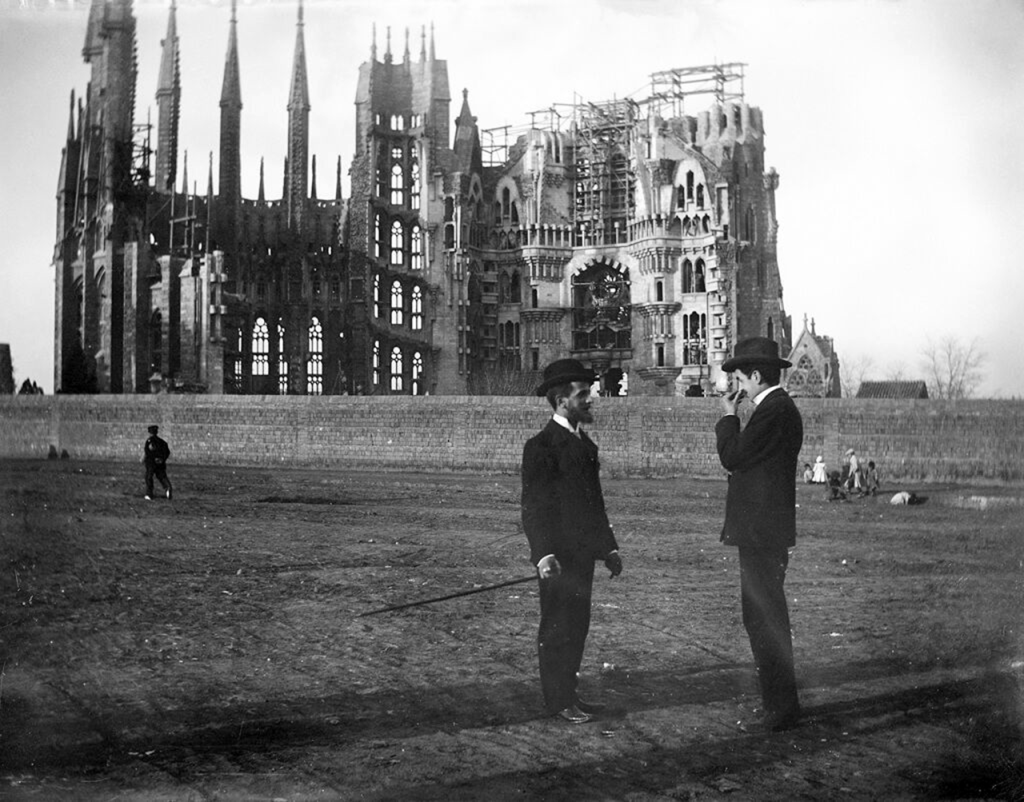
Whether we are pragmatic or we think that symbols are important to create a sense of collective purpose, one doesn’t need to be a Catholic, or a Christian, or any sort of religious believer, to understand that Gaudí’s task in the Sagrada Família, as well as Barcelona’s civil society commitment to privately fund a 144-year project to finish the mammoth endeavor, is a testimony of human vision and perseverance.
Beautiful, cathedral-like things get built because there’s an enchanting and enchanted, otherworldly pursuit of a bigger-than-oneself endeavor that requires collaboration, coordination, a shared vision, and leadership, both symbolic (Gaudí’s) and real (Barcelona’s and Catalonia’s civil society). One can say many things about such a temple, and minimalists will pinpoint the exuberance of ornaments, while the purists will decry that, after the genius architect’s death and the destruction of his models during the Spanish Civil War, the temple’s continuation was subject to interpretation by those in charge of carrying on.
I’d say: that’s the beauty of collective endeavors. Or, as put by a history professor at Germany’s University of Bonn, Evrim Binbaş:
“For a society to hold onto one end of a task without ever tiring or wearying of it for 150 years, and once the job is done, to show not just gratitude to the Creator of the universe but also loyalty to the artist without falling short. I can’t even begin to tell you how much I admired that.”
Intrinsic tensions of great places
Born and raised in Barcelona, I went to college with some of the people who helped put that live video production together, and I had heard for a long time that the June 10th event was a milestone that virtually everyone wanted to contribute to make special; in that sense, few places can assemble people together to put up a show when the situation is due, like Barcelona does. Perhaps this is because the city, dynamic and cosmopolitan, learned to prosper without a State, just as many Italian cities did early on, before the country’s late unification in the 19th century.
The lack of a strong public apparatus led Catalans to scramble for collaboration through guilds and early mutual funds, and agricultural gains from wine and grain funded an early, homegrown industrial revolution. Since then, an educated middle class has built a sense of self that can be as constructive as it is sometimes destructive (a few years back, we moved to France when our kids were toddlers, as there was only one topic of discussion on the streets and it was getting tiresome; yet, I’m a product of the place).
Some Catalan-affected (often chauvinistic) brains would try to simplify by appealing to the local tension between the concepts of “seny” and “rauxa.” Nietzscheans would say that this is merely a near-perfect crystallization of an old European story that propelled the most sublime and the most obscure moments of an entire continent, the tension between the rationality of Apollo and the aggressive sensuality of Dionysos. And Barcelona is an old Mediterranean harbor of humble merchants turned industrialists.
A Sagrada Família-type of endeavor: The Cathedral of the Sea
Since the early Middle Ages, many European merchant cities like Barcelona, with a clear epicenter at the Italian Peninsula but also beyond, competed against each other by trying to produce, through their craft and merchant guilds, temples and venues that looked beyond everyday reality, and that’s how Santa Maria del Mar, a Barcelona precedent of the Sagrada Família church, came to be in the merchant neighborhood of El Born.
An example of Catalan Gothic architecture, Santa Maria del Mar went up faster than the Sagrada Família (1329 to 1384) and was physically constructed by commoners: people from the nearby sea market, sailors, and merchants from La Ribera. It was built primarily with stone from the Montjuïc quarry; the church was funded by merchants who came to realize they needed a solution to transport the stone cheaply, as the boats couldn’t approach either site.
They carried the blocks in carriages, mules, and, according to chroniclers, on their very backs. As for the question of who paid for such a magnificent church, which would rival Barcelona’s also-unfinished cathedral (funded by the monarchy and the religious elite), Santa Maria del Mar was financed by the residents and local trade guilds, from the rich merchants to the very sailors and craftsmen volunteering their free time to finish it.
That’s why, for humble Barcelonians of the time and the backcountry people coming to town to buy and sell, that temple was their ultimate place, their Cathedral of the Sea (also the title of a 2006 book by a local lawyer digging in that early golden age for the city, when, in between plagues and invasions, it emerged as a powerhouse with no kingdom, scrambling around to make decisions in a proto-democratic Parlament, the Consell de Cent, or “Council of the One Hundred”).
A wedding and a banquet
When it comes to talking about Barcelona, it’s impossible to stay unrelated or completely impartial to its reality, for I’m from there and Kirsten and I started our family there; our children were born in the city, and our very wedding happened at the place where the Council of the One Hundred gathered in the early middle ages, the Saló de Cent in Barcelona’s City Hall. For that, and for the fact that the city also allowed us — just for the mere fact of being local residents — to use for our wedding’s banquet another symbolic building, Lluís Domènech i Montaner’s Castell dels Tres Dragons (Castle of the Three Dragons) in the city’s Parc de la Ciutadella, built for the 1888 Universal Exposition, we’ll always recognize the many amazing things the city can give.
But those were more innocent times, right before an economic crisis, a hurried, opportunistic local putsch for independence, a sense of being overwhelmed by unruly tourism, and a deep crisis rooted in tensions within the city’s kaleidoscopic reality and sense of self.
Putting on a show like the Sagrada Família’s highest point’s christening by the Pope is healing for the city in many ways; for one, it gives its inhabitants a mirror in which to see its amplifying collective talent in organizing world-scale events like World Expositions and the 92 Olympics, which brings a type of pride that can be transversal and shared, no matter the people’s credo, origins, political leaning. It also reminds people (often feeling bombarded by negative and contradictory, chaotic events like wars, nationalistic and fanatic tensions of different signs) of the power of celebratory events that show loyalty to a bigger-than-life, multigenerational idea that brings people in instead of excluding, and decides to highlight a message that is as profound as it is simple.
Proof of this: the music-and-light ceremony, presided over by the Pope and local dignitaries, from Spain’s king and queen to the president of the Generalitat de Catalunya (the regional government), reached its apex when music and light built up in a crescendo leading to a top-to-bottom light up of the temple, followed by a masterfully produced hover-over aerial image of the temple’s towers symbolizing key biblical figures; then, a musical transition told us something was about to happen.
And there it was, Antoni Gaudí’s three-dimensional figure drawn by drones, turning his sight to the temple’s main tower’s top, followed by a message as if it were hand-drawn by the architect himself: “Primer l’amor, després la tècnica.” First love, then technique. A message that showed a kind of magnanimity toward my home city, which I admire, and I’m glad it’s still around.
A way of towering over the noise of today, using choreography, high-definition video and sound, the best local team of TV producers to deliver the international signal to the planet, and light and drones. Just to deliver a message that transcends and forgets two local sins: opportunism and chauvinism. ‘Nough said.
The need for rehearsed pathos people can share
The show has proven that people want liturgy, choreography, solemnity, and high-stakes mise-en-scène when it’s due, and the moment was ripe in Barcelona: 100 years since the death of the architect who had projected the temple, the completion of the tower that makes Sagrada Família the tallest church in the world, and the visit of the Pope for the occasion.
Now, the cynics love to hate things that go well and can be conciliatory and magnanimous, rather than the short-term divisiveness that has taken over many high offices, aided by today’s fragmented, dopamine-inducing media consumption. It’s true that Antoni Gaudí’s life and personality (born in Reus, a proud small city that rivals nearby Tarragona in the back-country of coastal southern Catalonia, where merchants turned the benefits of selling wine and little else into an industrial powerhouse) was complex, encompassing both religiously traditionalist convictions — to the right of the Catholic church then — and technically revolutionary ideas. At the end of his life, he was profoundly pious (of the populist and mendicant type) and frugal. He was also a fanatic of symbols, anti-liberal and anti-modern. In a way, he was one of the most original Iberian Romantics.
It’s also self-evident that, as the sentence showcased in the June 10th show on the prioritization of ethics and humanism over technique, his construction was innovative and original to a fault. But no matter how divisive the aesthetic he embraced can be, with shapes and materials digging in Nature and Mediterranean syncretism, at times Orientalist, his work reminds us of the importance of sticking to a purpose and a vision, rain or shine. When taken to extremes, Gaudí’s all-in zeal and rationale can be divisive, but they deliver and defeat any agenda that tries to instrumentalize his commitment to Barcelona and his old-school interpretation of Catholicism.
Barcelona can do one thing extremely well, and it doesn’t need to invoke the magnetism of the city’s main sports club, FC Barcelona, to pull it off. It manages to include everyone in town, from working-class families to the professional class, to its diminished bourgeoisie if compared to the power of the nouveau-riche up-and-coming establishment in Madrid; also, unlike Central Spain, Catalonia lacks a powerful nobility and has organized itself around a transversal and educated civil society, and this structural difference shows in big events.
Self-sufficient wholes
That said, Spaniards can be generous and know how to put a party together, and Leo XIV’s visit was an opportunity to display that, in Madrid, Barcelona, the Canary Islands, or anywhere else. Spaniards can make people feel welcome, and they can do the opposite too, especially amongst themselves.
We are also good at ruining moments of potential self-pride by getting into the extremely boring, never-ending regional infighting, described by none other than José Ortega y Gasset, the only towering philosopher contemporary Spain has given (the other Baltasar Gracián, a witty Aragonese Catholic priest revered by Schopenhauer, belongs to the Empire era). In his book España invertebrada, written in 1921 as the country was fraying, Ortega gave the affliction a name, particularismo, and a definition that has aged with unfair accuracy:
“Particularism is that state of mind in which we believe we have no reason to reckon with others. Sometimes out of excessive esteem for ourselves, other times out of excessive scorn for our neighbor, we lose the sense of our own limits and begin to feel ourselves as self-sufficient wholes.”
There’s also a type of online nationalism that seems to be curated by bots from foreign powers trying to destabilize the Western world with self-destructive infighting and a defeatist rationale that doesn’t quite square with reality. Among the many self-inflicted wounds: adult males seem to have lost the appetite for reading fiction. Isn’t this documented fact off-topic? —one might ask. Yes and no: the wave of negativity that seems to plague their feeds could be countered by a narrative that seeks a harmonization of non-toxic collective and individual purpose, and events like the Sagrada Família’s inaugural ceremony or the World Cup are a reminder that energy can be channeled before it turns self-destructive — or simply atrophies, leaving people numb, dealing in alienation with one addiction or another.
The currency that compounds
In today’s world, haunted by digital tools and institutions favoring the quickest possible return on investment and instant gratification, symbols that spread collective purpose over the long term are particularly powerful, and the Sagrada Família, like once did Santa Maria del Mar in the same city, is an endeavor supported by many fighting as one for one set of goals that feel bigger than themselves, which is a purely “emergent” idea: the whole accomplishes a level of beauty and consciousness that is exponentially superior to the simple addition of its parts.
Gaudí’s architecture, especially the church funded by the people of Barcelona, many of whom were of humble origins, as well as visitor tickets (yes, the decried tourism), has also emergent qualities, the whole accomplishing more than its parts, and irreducible to them as a consequence.
Barcelona, of all places, just demonstrated the alternative on a global signal: conciliation over confrontation, a multigenerational idea that gathers people in rather than sorting them out, and a four-word benediction in Catalan — primer l’amor, després la tècnica — that towered over the noise without humiliating anyone to do it. That is the whole lesson, and it is not a soft one.
Which brings me to the thing I actually want to say. The Western world is exhausted (genuinely, bone-deep) by dysfunctional messaging, by the daily theater of division, by leaders who mistake the flexing of muscle for strength and read the resulting fear as respect.
Afraid of unleashing goodness
Whoever truly understands that conciliation, and not the muscle, is what the moment is starving for stands to win the only currency that compounds: soft power. And let’s not forget what soft power actually is. It is not the decoration laid over real power once the real work is done. Over any horizon long enough to matter, it is the foundation real power is poured on — the reason people, and the men among them, choose to stand behind you at all, instead of merely getting out of your way.
It’s an interesting zeitgeist; the message should have come from a unifying World Cup opening ceremony, but none of the three main dignitaries from each organizing country were there to begin with; each will attend a different opener in their respective countries (Sheinbaum decided to give her ticket, the symbolic No. 00001, to a fan of the sport that couldn’t have attended otherwise; a populist, lower-risk gesture over sitting in a stadium that has historically booed her predecessors when given the opportunity). There are ways of connecting with the collective unconscious that can be summed up constructively; this time around, it won’t be one of them.
Here’s an unpopular opinion: there’s a hunger for optimism. People are tired of manufactured division, but politicians and leaders of civil societies are too entrenched, too shortsighted to see it. Perhaps too afraid of unleashing goodness.
Soft power is currently underrated, but it could come back stronger than ever.