Two English trees died this year: one loved to death by crowds, one felled by vandals. What their afterlives, and a forsaken hamlet in Spain, say about impermanence and what we choose to regrow.
I was born and raised in an urban environment. But every weekend and on vacation, as far back as I can remember, we left the city to get in touch with a more rural environment, near forests and solitary big trees.
My dad’s family comes from a hamlet of a few old houses clustered around an ancient tree that actually stood on someone’s property, though that family, self-conscious of the symbolic importance of the tree for late-spring and summer gatherings, never used their little meadow exclusively.
A tree at the center of the hamlet
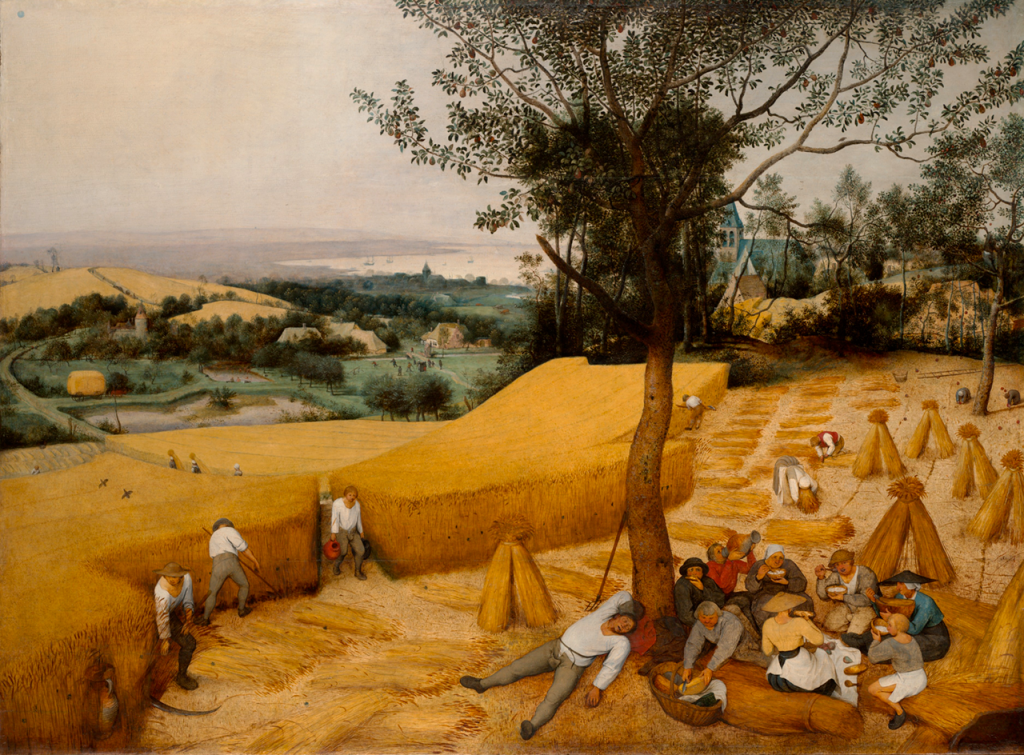
Every summer when I was a kid, all the adults of the hamlet gathered under that big tree, under which there was an old millstone they used as a table to play cards, checkers, or dominoes. It looked a bit like one of those Flemish and Dutch paintings of harvesters collecting grain and resting in the shade of a tree at noon, some simply gathering, others eating, and others napping.
Take, for example, The Harvesters by Pieter Bruegel the Elder (1565).
Such images are soothing to me, and I have the intuition that my visceral attraction to them has a lot to do with those summer scenes under the big tree at the very center of a small, forsaken little hamlet in northwest Spain, where all the adult residents (many of them elder and each other’s relatives one way or another) had their little chat, or played cards, some of them napping with one eye and looking after the noisy children with the other eye.
Entropy, and the awe that fades
This is also a story that has a lot to do with entropy. As I grew up, the tree looked less majestic and towering to me, perhaps because I had grown and also seen more places, perhaps because, as we grow, our ability to connect and feel in awe with other living things fades away as we are forced to be productive and associate casual leisure with something to reduce, optimize, or be ashamed of.
Finally, as I became an adult, another transformation happened to that little hamlet around a big tree with gathering powers: the old people who had stopped by every single day of the summer, talking and sleeping, snacking and playing with the kids, or playing cards or checkers, began to fade away, and the newer generations were too busy to stop by anymore.
The last time I revisited the place, now a tiny part of a whole administrative town where a cousin of mine (one that I used to play with growing up, whom people confused with me when we were kids) happens to be now the mayor, I saw that little private meadow that in summer welcomed all the neighborhood fenced, and the tree heavily pruned, diminished.
But this is not an allegation against private property, for the owner of that particular country house where the old big tree partially sits as a natural hedge between the meadow and an old, narrow road (a first cousin of my father, indeed) made the changes way after the old magic of the place had dissipated like the morning mist in a dream.
Coming back to an emptied village
No one on the street; most of them, simply gone of old age (many past 90), my own grandmother and aunts and uncles included; and the rest working and even living in the cities nearby, too busy to step out of their routine, treating the houses of their ancestors as weekend solitary retreats at best.
Also gone are the improvised soccer games that many kids from the whole village used to play in summer at the church fields and the nearby gathering area on a hill with a stone cross, as Spaniards have fewer kids, since the country has dealt with a birthrate below replacement levels for decades now.
There’s nothing more shocking for the kid we all preserve inside us than seeing a place that looked so alive and magical with adult eyes. The landscape, the houses, and the trees- everything seems different, and we suddenly realize that the physical places we feel connected to at one stage of life won’t stay like we perceived them forever, encased inside an amber ball; places evolve, and we do, too.
The Yellow Rain, and the two faces of country life
Many years ago, when I was in college (I think), I read a little, unassuming book by Julio Llamazares, called The Yellow Rain, which is of course a poetic depiction of big deciduous trees in the fall, which in France pop culture associates with a Jacques Prévert poem set to music by Joseph Kosma, and taken from there by singers like Yves Montand (which my two grandmothers loved, when the Spanish radio played him) and (figuratively) Serge Gainsbourg. Anyway, the book is an extended, poetic monologue of Andrés, the old and only surviving inhabitant of Ainielle, a crumbling, isolated village in the Aragonese Pyrenees.
The book is an archetype of the “España vacía,” empty Spain, the hollowed-out areas being left behind by depopulation following the mass exodus of the young to the cities. As the story is told from the perspective of the village’s last dying inhabitant, he is visited by the memories of his former neighbors and friends, reliving the past as the “yellow rain” of autumn leaves falls around him.
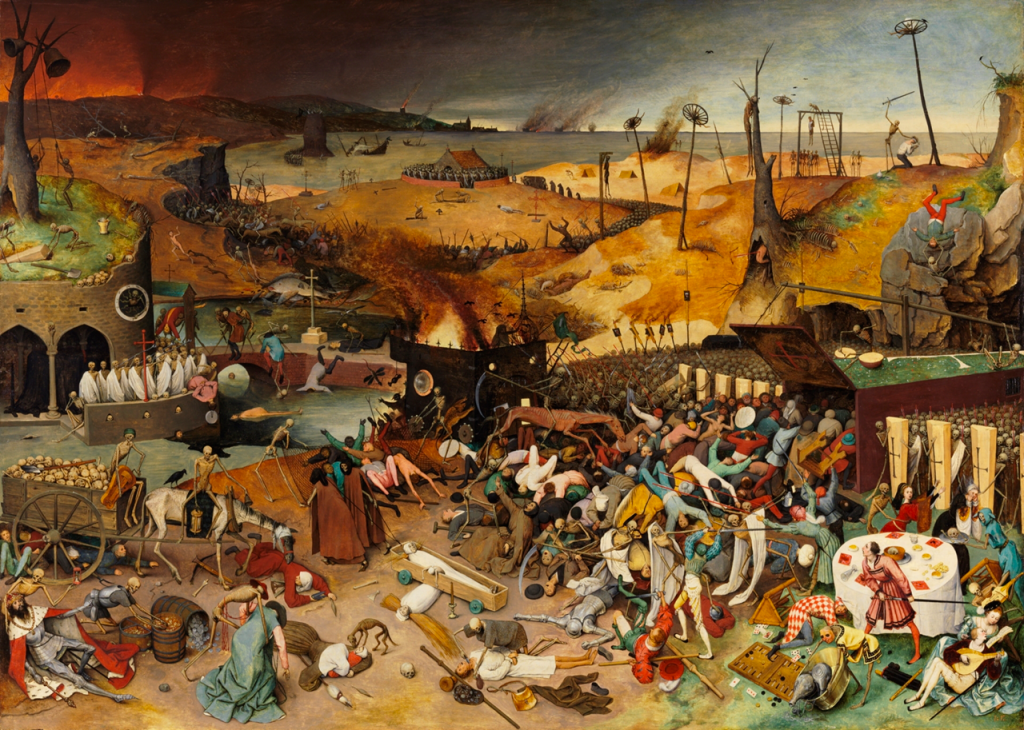
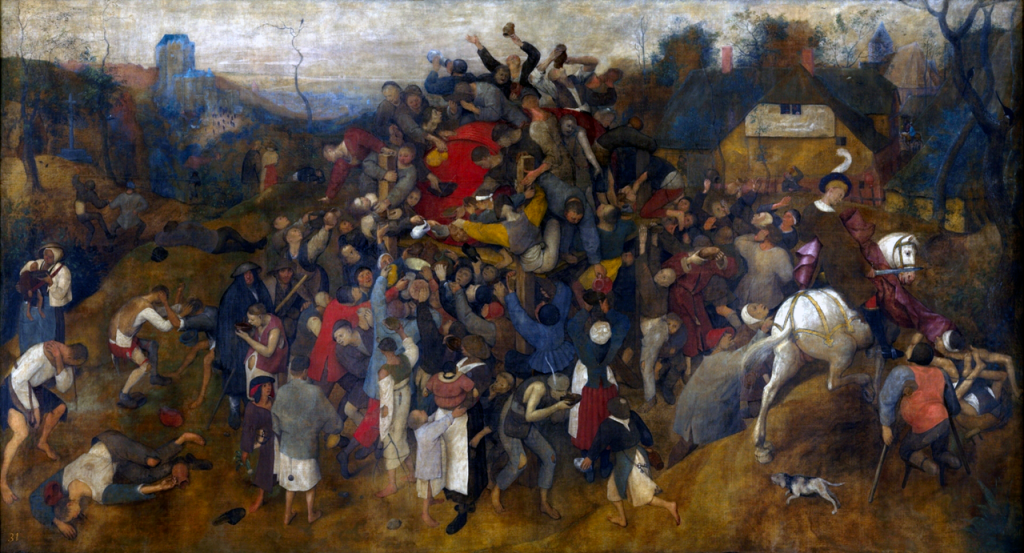
It feels once again like the old Flemish and Dutch paintings that European kings fought for during the Age of Discovery: there are the innocent scenes of humble but noble peasant life, a childlike way of being in the world, being the happiest being in the universe if, during harvest, one can have a bit of shade and an improvised meal in good company. And there are those other Flemish depictions of excess and damnation, like The Wine of Saint Martin’s Day or The Triumph of Death, both also by Pieter Bruegel the Elder, which I’ve seen many times at El Prado in Madrid. Or, of course, the depictions of Hieronymus Bosch, aka El Bosco, also in Madrid. Those aren’t contemplative, aspirational scenes of innocent country living, but crazy hellscapes, half Burning Man and half a cage fight streamed to your phone.
One imagines young Salvador Dalí in the 1920s, studying at Madrid’s Residencia de Estudiantes, where he coincided with future poet García Lorca and future filmmaker Luis Buñuel, using his leisure time to study the works of the masters at El Prado, and paying special attention to Goya’s Black Paintings and the intricate hellscapes of the Flemish masters.
The Major Oak, and the argument over how it died
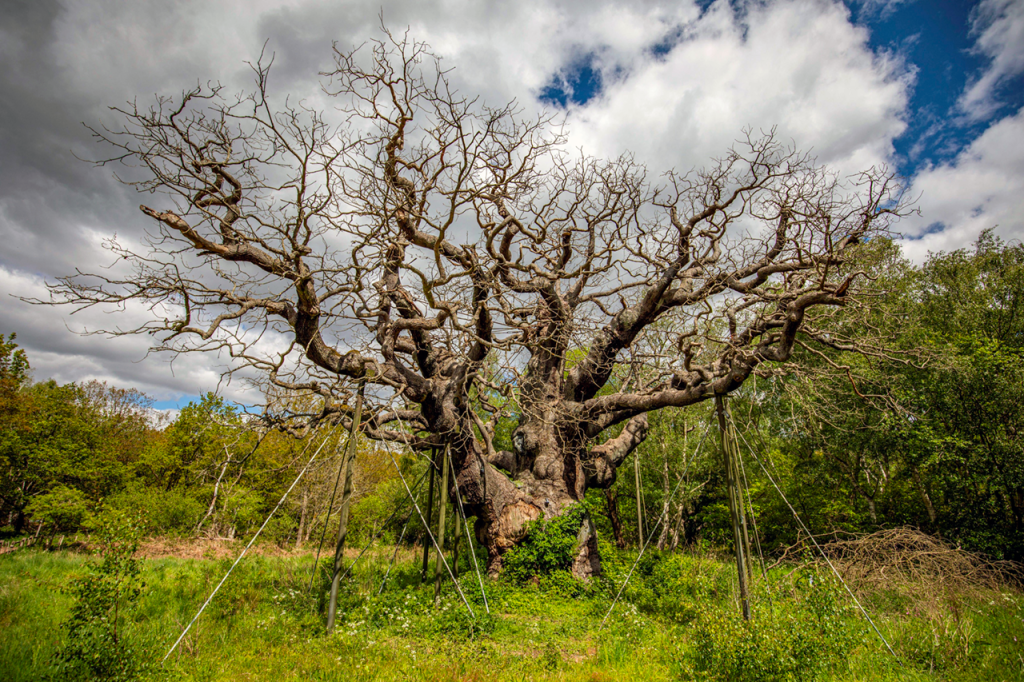
These memories came tumbling down as I read about England’s loss of an old, majestic tree, some say to old age, others to soil disruption from visitors and climate change. I also read comments from some skeptical readers pointing out that the same tree, known as the Major Oak, survived shocks such as Europe’s Little Ice Age and warmer periods in the past, so climate can’t be the whole picture. Others claim that misguided efforts to preserve this living memory of other times in England backfired. Many, in the end, reach a similar conclusion, pointing out one inescapable reality in our universe: entropy; perhaps the Major Oak has died of old age.
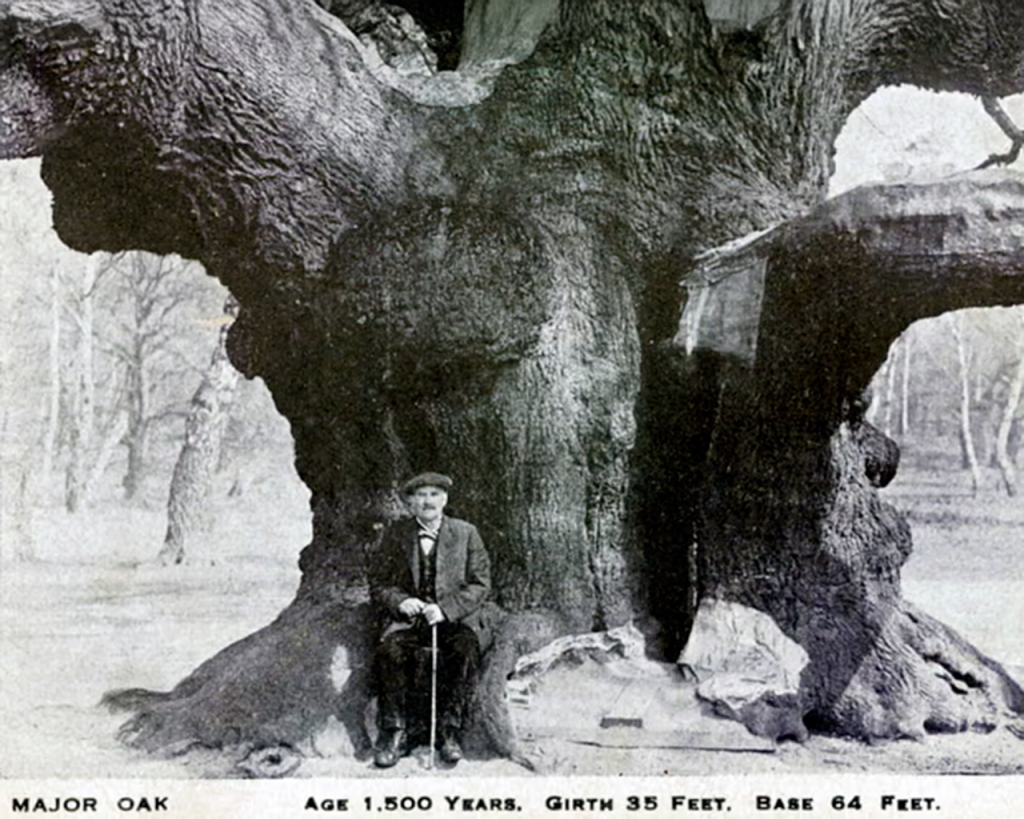
Perhaps. The tree that just died lived through relatively warm medieval centuries and endured the Little Ice Age did not die because a handful of English summers ran hot, an informed gardener may say (or, at least, that’s what I hear when I ask one I know about this). Old Age is part of the answer, and human impact (compacting the soil and applying various treatments to slow its accelerated decay) may also be counted. Whichever the combination of factors, the Major Oak is no longer alive, and such news makes some of us a bit sad, perhaps because we’ve come to see these events as a symbolic way of gauging the health of our surrounding natural landscapes.
It was between 800 and 1,200 years old, and its twisted trunk measured 36 feet in circumference. Here’s Lynsey Chutel’s first paragraph as she reports from England:
“The Major Oak, a tree that grew to tower over Sherwood Forest as the Black Death swept England and the Wars of the Roses sundered it, shading huntsmen who spoke of Robin Hood and outlasting the reigns of six Henrys, six Georges and two Elizabeths, among others, has died.”
Wired like a patient
To me, it feels a bit contradictory that its magnetism among people, as it became a landmark, could have sealed its demise, especially because of the symbiotic relationship between people and big trees ingrained in me since childhood. But yes, as a few become a mass, overcrowding can tip any idyllic scene into a story of accelerated demise.
In its last years, the Major Oak had been wired and held the way a hospital takes over a person whose heart doctors no longer trust: dendrometers were clipped to the trunk, reporting this silent being’s signal to a screen. Through 2025, the needles barely moved; this spring, the buds did not come, and the caretakers waited for nothing but a miracle that didn’t come. In the end, all they could do was pronounce it dead.
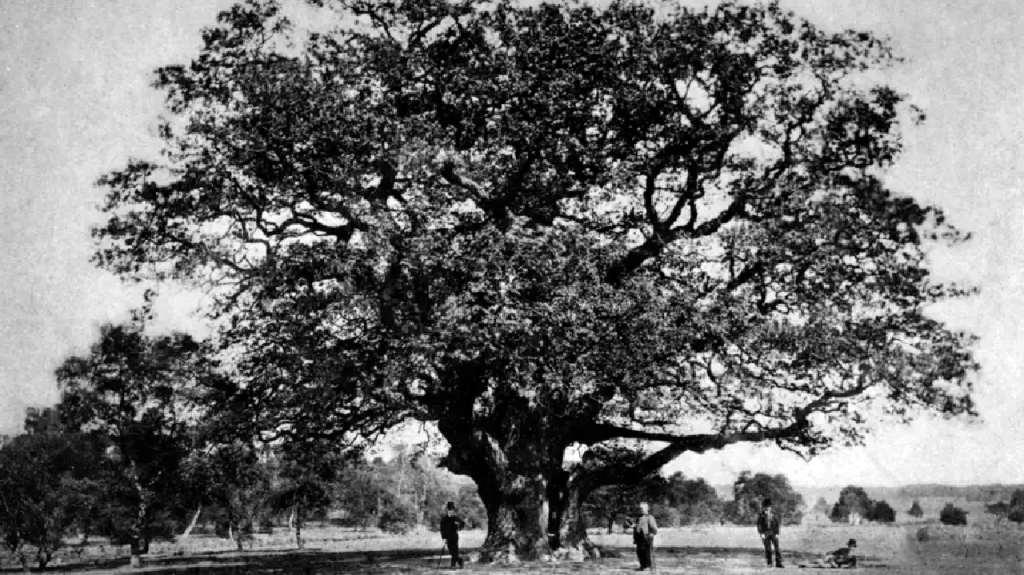
As one reads about the care the tree received, one can’t but agree with the preservationists who keep the locations of some majestic trees in the natural world as secret as they can, as disclosing their coordinates would certainly draw people to them and disrupt the area, or worse. Sometimes, however, keeping a symbolic tree’s location undisclosed is nothing but impossible.
Sycamore Gap tree, felled overnight
On September 28, 2023, Gary Pickles, a British park ranger, drove to the place to certify that it had indeed been chopped down after the Park received a call. Later on, he explained how his feeling of impotence quickly turned into anger as he approached the place, seeing the 100- to 150-year-old tree that had stood by Hadrian’s Wall, fallen to the side, discarded like a worthless, overgrown piece of wood.
The tree had been featured in the 1991 film Robin Hood: Prince of Thieves, bringing international recognition to that corner of the surviving Hadrian’s Wall. That it had been felled overnight with a chainsaw was a testimony of the risks of putting a living landmark in the spotlight.
Like many others, I remember the news not for its actual importance but for the absurdity of such a prank: who wants to carry in their conscience (even if not discovered) with such a display of stupidity? Sure enough, it was soon discovered that two men — Daniel Graham (39) and Adam Carruthers (32) — had driven 40 miles from Cumbria in the dead of night, under the cover of the storm. Both Graham and Carruthers not only did not regret their act but also bragged about it, which led to the footage of the act on their phones. Because of course.
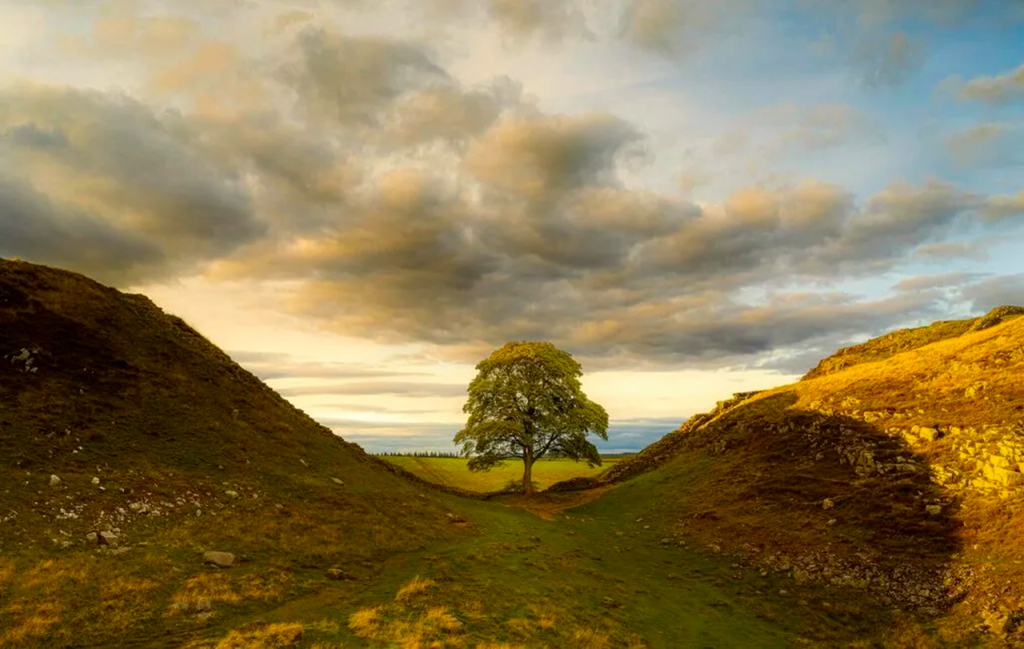
The Sycamore Gap tree was in the Northumberland National Park in Northern England, some 170 miles (273 kilometers) from Sherwood Forest, yet its popularity after its appearance in a movie also made it a target of our worst instincts as a species. It’s fair to say that the Sycamore Gap tree perished due to a contagious contemporary malady that spreads through mobile phones, using the meme and selfie virus variants. The felling of Sycamore Gap turned a gloriously pleasing tree for any landscape observer into a sad tale of contemporary nihilism, going from the old Flemish and Dutch dreamy paintings of idealized country life to the hellscapes of El Bosco.
Loved to close: the price of fame
Perhaps massification was only a tiny factor in the less traumatic — but tragic, regardless — demise of the Major Oak, and it’s no coincidence that its popularity and association with the same national pop-culture myth, Robin Hood, attracted too many people, too often, too close. And then the care arrived a little too late and was perhaps too deaf to the tree’s signal.
A few people can be a blessing for a tree, for they’ll take care of it and spot any concerning sign, and will mulch and water it when needed. Though this isn’t always the case: the old tree of the Sherwood Forest met a different type of human connection, one that can be more superficial and predatory, one that only seeks the event, the picture, the checkmark in a list:
“The footfall from millions of visitors had compacted the sandy soil to a depth of nearly four feet deep, making it rock solid and starving the roots of water and nutrients, said Reg Harris, an arborist who specializes in ancient trees.”
What the trees leave behind
And yet neither tree is quite done with us humans. Lynsey Chutel’s article announcing the Major Oak’s death let slip an inspiring sequel in a single line: we are a species that can quickly regret our excesses and be moved into action.
We know we can’t undo entropy but are also inspired by the regenerative cycles of nature; and so, after its death, the acorns of the Major Oak have already been planted all over Britain, so that the majestic organism that accelerated its decline in the last years can go on, in a way, through many anonymous saplings that will likely have a chance to grow old, casting a big shade at the edge of a meadow somewhere.
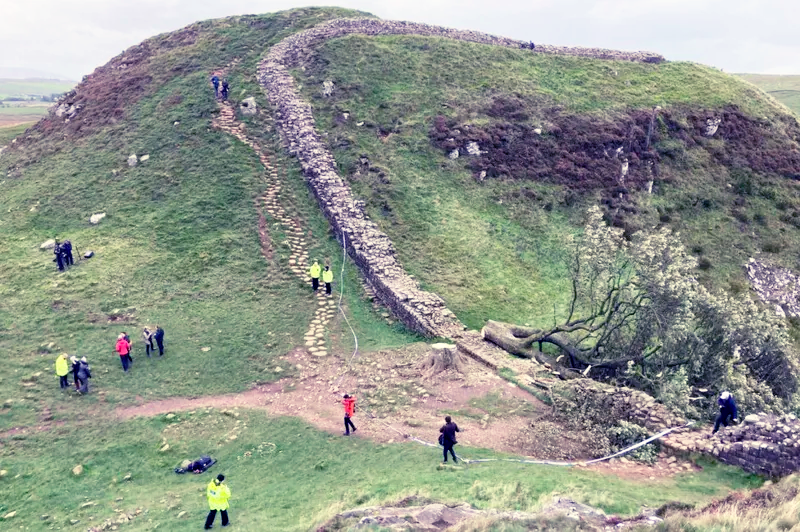
But these aren’t the only celebratory saplings giving some continuity to the landscape after a loss. When Sycamore Gap was cut down, locals and park rangers were resigned to coping and moving on, but then something unexpected happened: the tree stump was healthy, and new shoots quickly sprouted from the base.
Trees of hope
From seed gathered from the tree, the National Trust raised forty-nine healthy saplings: one for every foot of the height that the felled tree had reached, giving them away to be planted across the country. Though there were not as many saplings as people interested in giving the Sycamore Gap tree’s offspring a chance: nearly five hundred schools, hospices, and families wrote to ask for one.
The saplings went, among other places, to a children’s hospital, a center for motor neuron disease, a refuge for abused women, a small school near the gap, and to all fifteen national parks. Read the list of who asked for a sapling, and you are looking at the harvesters again — the people who gather under a tree and understand the tree’s needs, not the ones who film themselves while gathered in droves near their roots, or those who film themselves felling it.
As for the largest piece of the original trunk, it didn’t go to pulp either; it was carried indoors and set on display. Though many will wonder why they didn’t let it lie where it fell, nurturing the soil. Fairly enough, over the years we’ve fortunately met many people capable of celebrating a tree’s beauty by turning a stump into a piece of art, or a key piece of furniture, or the structural part of a house.
The stump, the trunk, and the millstone
Perhaps there are also “little trees of hope” for villages that once gathered around a centenarian tree. Those trees are still around, but they don’t shelter moments of conviviality the way they once did, sometimes in the name of progress and life acceleration.
It turns out we can see impermanence with different eyes; perhaps instead of trying to revive what is gone, we can create new ones from the old, like seedlings growing from a fallen tree. We can find inspiration in what we saw or what someone told us a place was once, to get the same inspiration somewhere else, or in the same place, under the same tree, next to the same millstone — despite the fact that many things won’t be the same as they were decades before.