Sometimes a stranger’s note brings a whole story flooding back: redwoods, copper surfaces, a tea house, sculptures people “use”… Remembering Bruce Johnson’s Sonoma County.
We just received a message from a watcher and reader in Sebastopol, a small creative town about an hour north of San Francisco.
Some of these messages make me think our work is making an impact by highlighting people’s hands-on work and values, which come through in every video edited by Kirsten, even when the viewer has to put things together, since our narrative style isn’t scripted.
This person, who messaged us through the contact form on our site, introduced himself as a member of the local commission that decides which public art is installed.
What are sculptures in public spaces for?
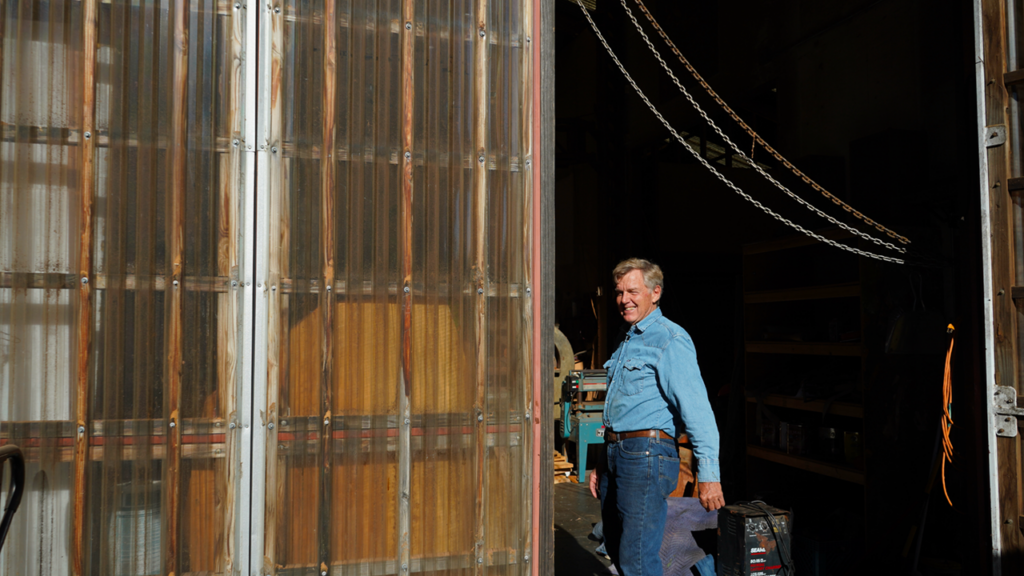
He let us know that Sebastopol will soon display a sculpture by local artist Bruce Johnson, whom we profiled on the site and Kirsten’s channel not long before he passed away in an unfortunate accident at his Timber Cove home studio. He was 75, but in person—his energy, intellect, enthusiasm, apparent physical ability—he felt much younger.
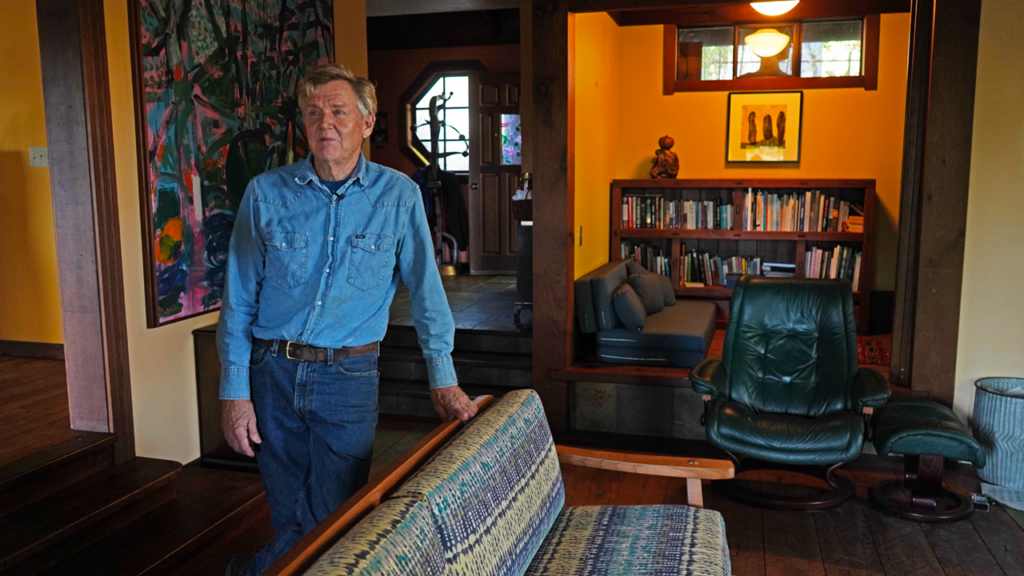
As the Santa Rosa Press Democrat reported back then (embedding Kirsten’s video at the end), apparently, one of his sculptures fell on him as he was trying to move it, and when an assistant discovered what had happened, it was too late to do anything.
The news hit like a blow. We had visited him in November 2022, and the accident happened in late March 2023. So, when somebody in the community let us know through a comment on his video, we quickly double-checked, found the note by the Press Democrat, and felt impotent, flabbergasted. How come such a powerful personality could leave us so suddenly and in such cruel circumstances?
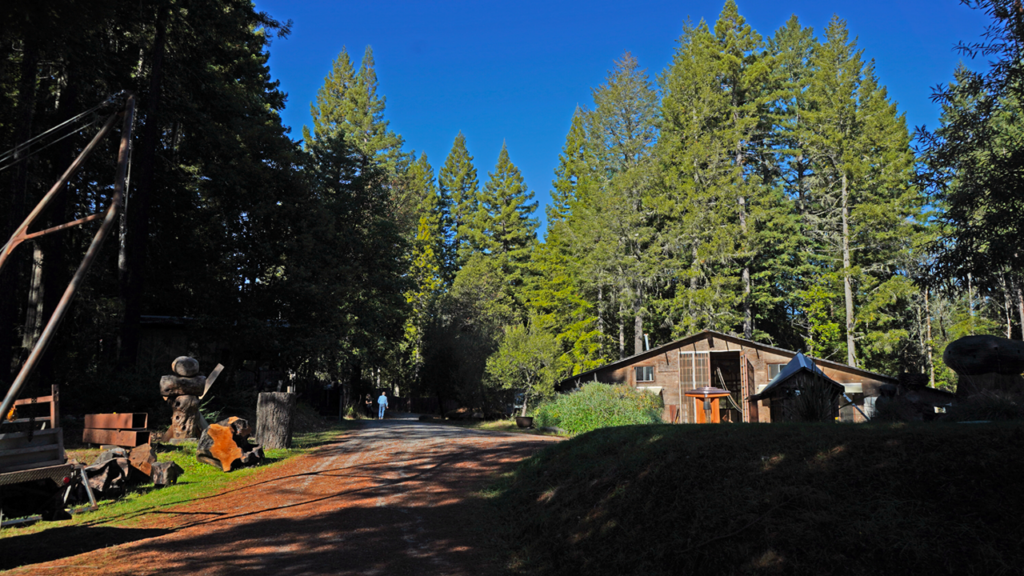
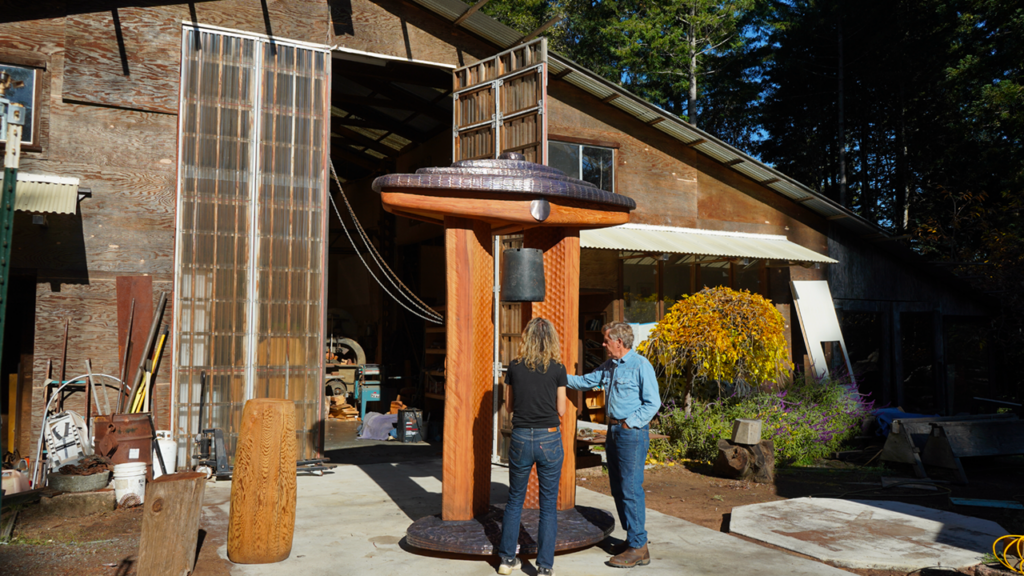
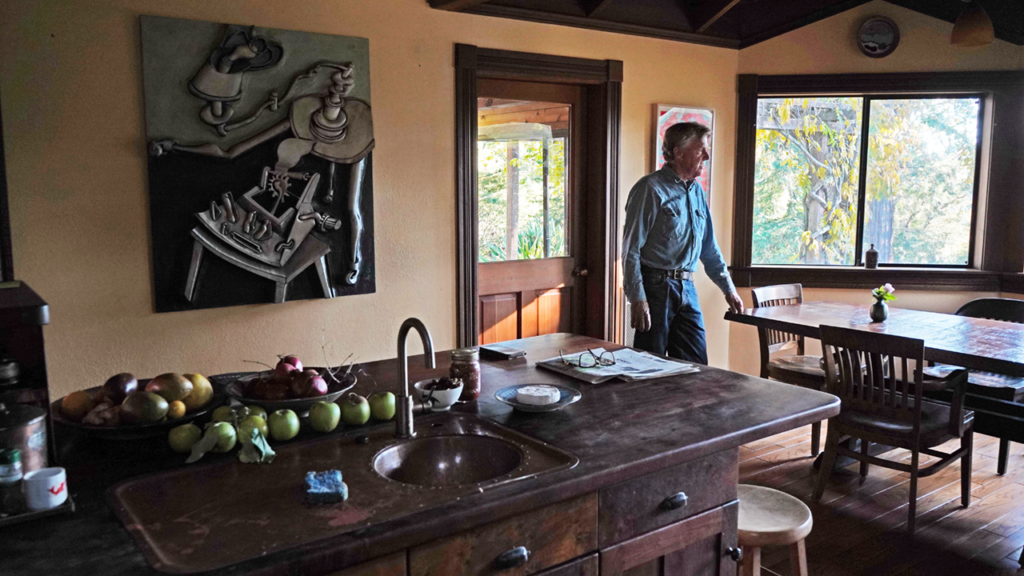
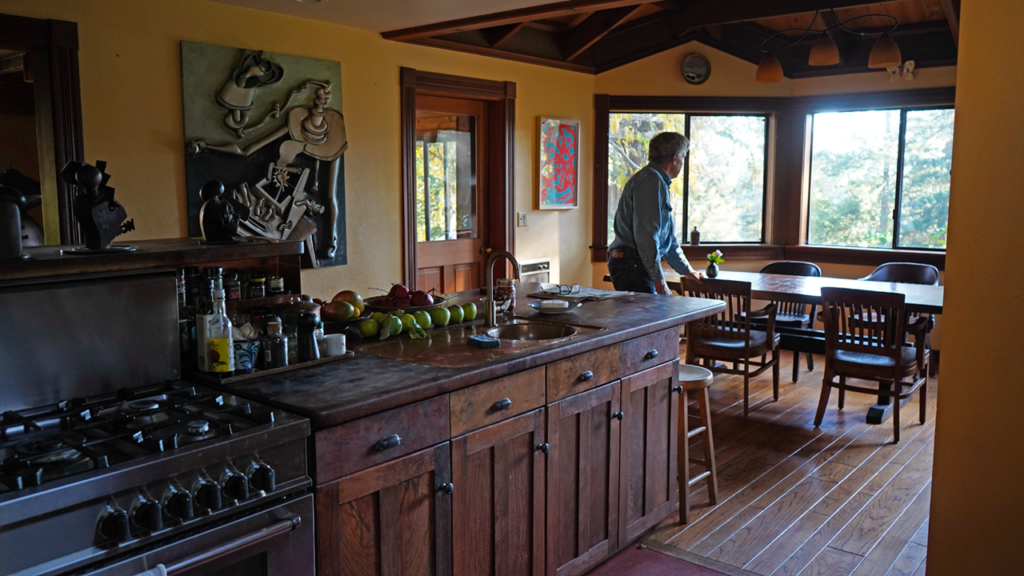
Back then, we shared a note on Kirsten’s channel, but showing mere condolences felt empty to us: we had just been with him at his studio, listening to his past, current, and many future projects, in awe of his examined life, as well as the raw elegance of his house, the organicity, Coastal-Northern-California character of his sculptures, the solemnity of the gong sculpture he had built by his house to celebrate the life of his wife, who had passed away in January 2021 after a long fight with illness.
First exposure
The recent message from someone in Sebastopol, saying he’s watched many of our stories, including the piece featuring Bruce Johnson, is one of the constant reminders of the uniqueness of some of our visits, which turn out to be very special. He had also watched a recent video profiling another Sebastopol local, the permaculture expert and author Erik Ohlsen:
“Wish I knew you were in town (I don’t do much on socials), would have loved to buy you a coffee!”
That’s the energy. We can’t complain. Especially when it comes to Sonoma County, which has a very special place in our work and hearts (Kirsten’s parents also live in this county between the rugged coast, the redwoods going into Marin County’s canyons, the many orchards that once covered the whole region, the warmer oak-tree rolling hills, and wine country valleys). We could dedicate our work to just exploring Sonoma County, from the unincorporated enclaves to the farms and the old downtowns, and it would take a few years to give a whole picture of it.
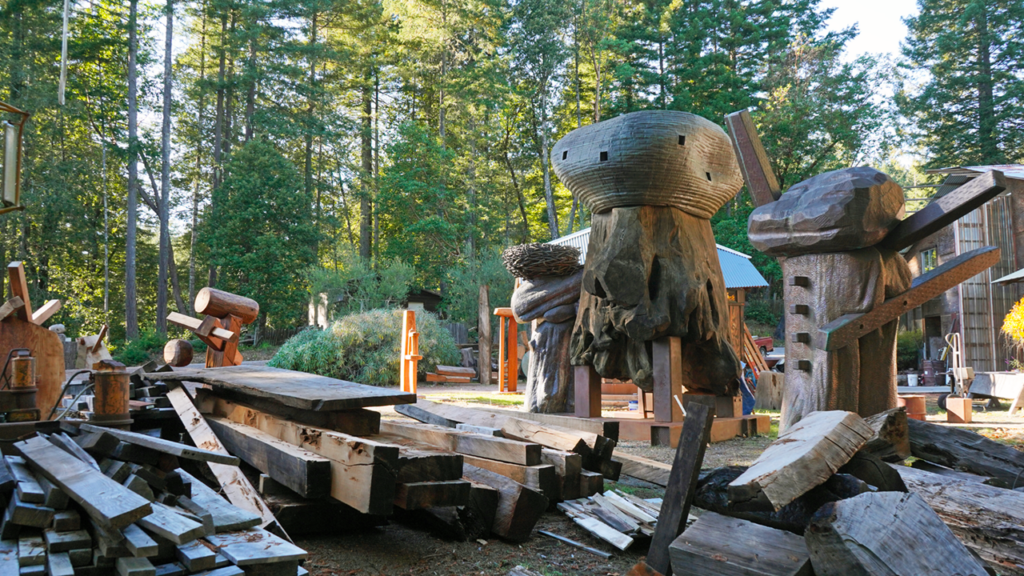
It would take me a while to explain why Bruce Johnson’s sculptures resonate with me, but it’s easier and feels more natural to say they are rooted in the landscapes of Northern California, specifically the stretch of territory once covered by redwoods north of San Francisco. On his personal website, the “about” page has been updated with one last line that captures his monumental sculptures: “His art, like the ancient redwood most of it was made of…lives on.”
I first came across one of Johnson’s sculptures when we didn’t know him. After living our entire lives as a family in Europe, frequently visiting the US, especially California, Kirsten’s home state, we moved there in 2022. We initially rented a place in Palo Alto (if only because Kirsten had grown up in that area during the pre-frenzy years).
The old tract home from the fifties we rented was located in Midtown Palo Alto, a working- and middle-class area until the early nineties; Midtown Palo Alto felt detached from any meaningful civic area or proper downtown, so we tried to at least walk to the well-equipped new Library branch in the nearby Mitchell Park, and, to get there from home, we needed to literally go by a wooden sculpture which seemed designed not only for people to contemplate but for animals and children to get on top and toy around with it: it was a giant wooden piece with many orifices, cavities, and twists.
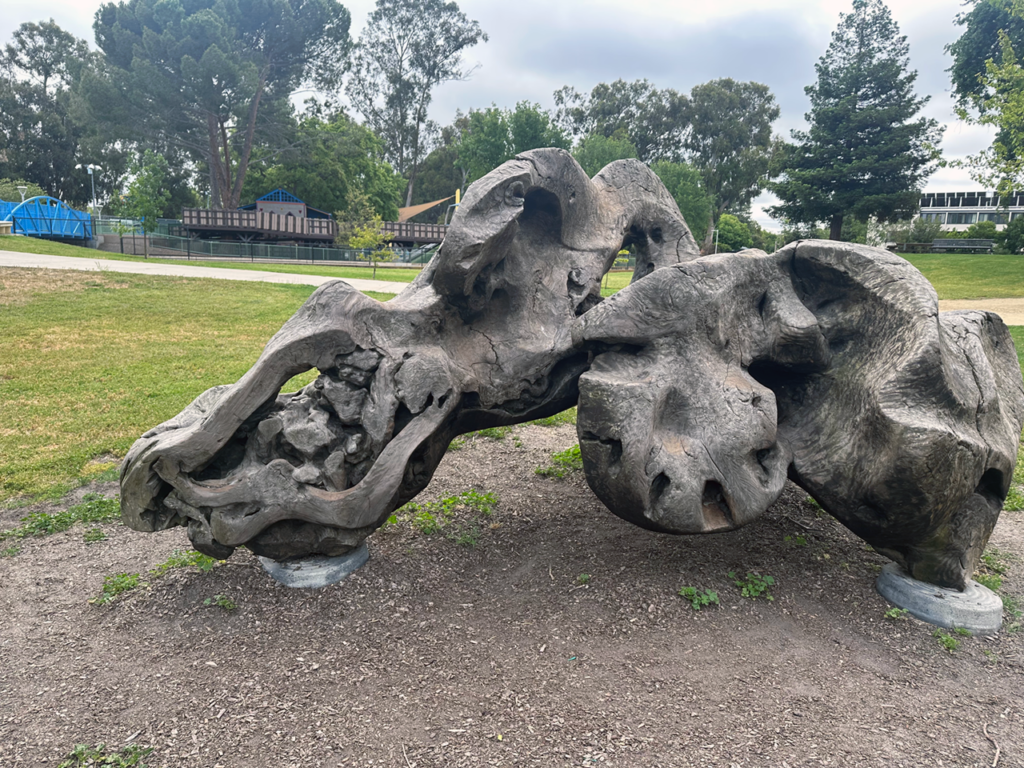
I realized it must be a reused redwood tree stump, but never approached the little plaque that—I correctly assumed—must describe the piece or at least have its name, as well as the author’s.
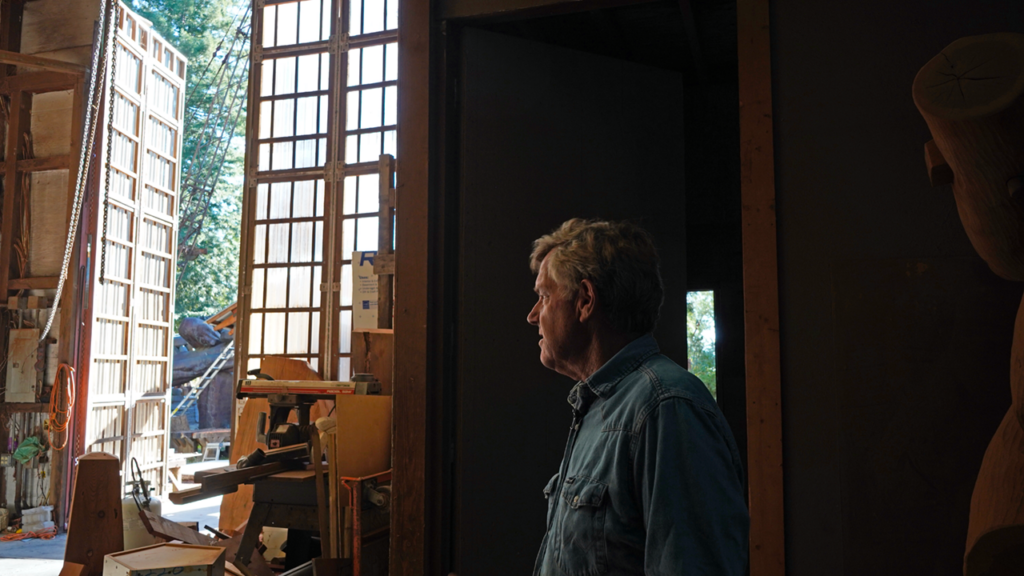
Designing and building a tea house
So, after being at Bruce’s, I decided to walk again to the library to return a book, and I stopped by this time. The large wooden sculpture made from a giant tree stump was called “After the Fire.” It had been created in 1982, and its author was… Bruce Johnson. It made sense. I looked up the sculpture after learning this and saw that Johnson had been burning, burnishing, and shaping a salvaged redwood root sourced from his area, drawing inspiration from nature.
Each time I walked by it and realized the sculpture always had children on it (climbing, crawling underneath it, jumping from it, playing tag around it) it made me smile, realizing that, instead of looking at the world from its ivory tower, the artist had descended to Mount Olympus and given the sculpture a tactile, playful, all-too-sensorial utility for children of all ages to benefit from it at a public park. The opposite of a cold marble piece standing, mausoleum-like, on top of a forbidden pedestal.
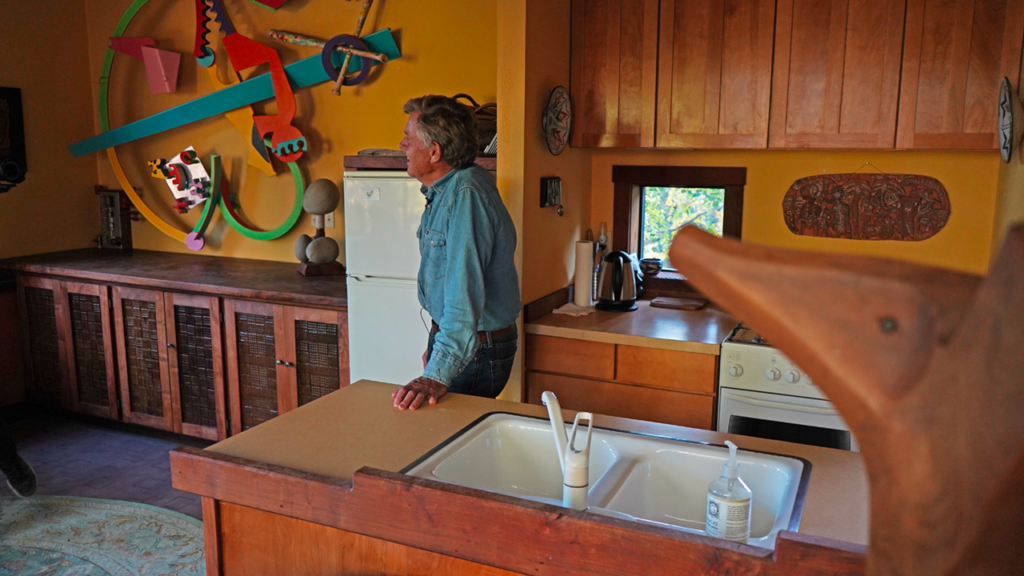
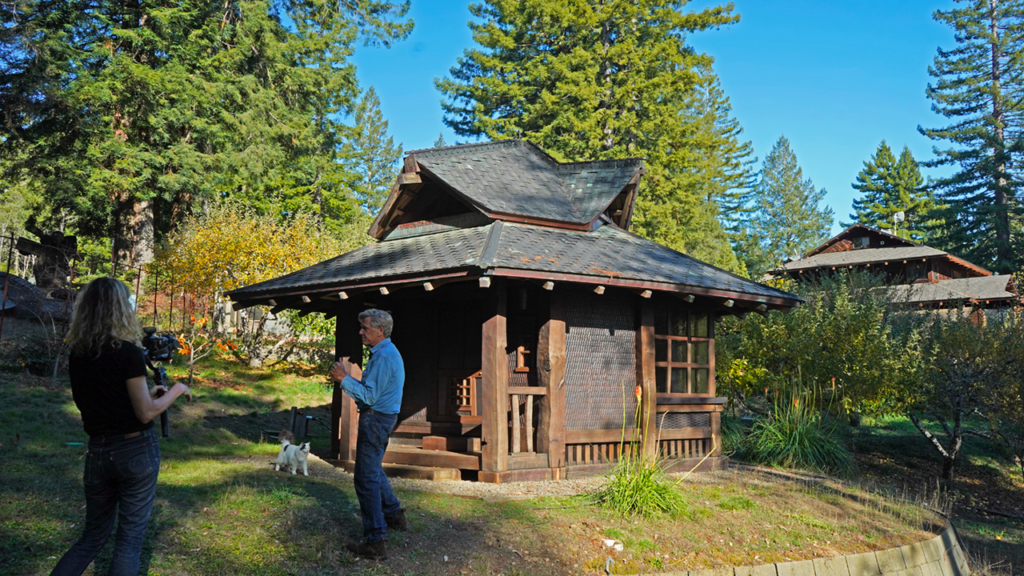
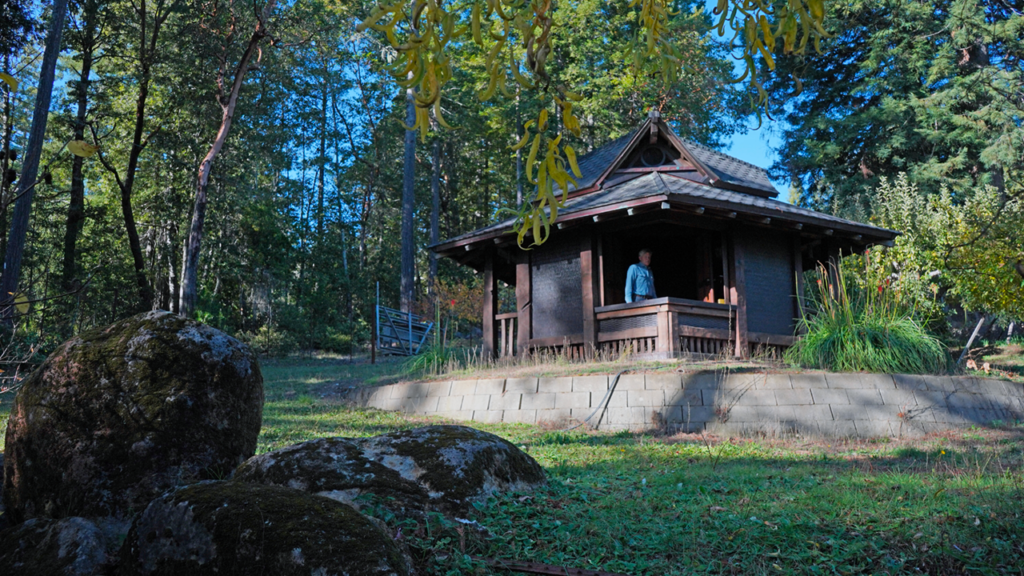
Johnson’s work with copper was equally mesmerizing; during our visit to his studio, the way age and light hit the surfaces of some of the pieces blew me away. I also enjoyed the more mundane decorations of his home, which belonged to coastal Sonoma as much as its flora and fauna. He had handcrafted a tea house (the Poetry House) with copper finishes inside, the most beautiful testimony to wabi-sabi principles I had seen. Bruce didn’t describe it with grandiosity, quite the contrary:
“What is a poetry house?” he asked. “It is a strange hybrid of a building, somewhat larger and more extravagant than a teahouse, but smaller and more humble than a temple; not as practical as a storage shed or as useless as an abandoned truck. Whatever the interpretation, this is how it came together.”
A connection with a San Diego organic artist
Interestingly, my nonchalant walks across the grass in Mitchell Park had not been my only intimate experience with Bruce Johnson’s remarkable work before visiting his place with Kirsten in November 2022. When we lived in Barcelona, and later in the Paris area, we visited California for extended periods; our children were very young and energetic back then, as were their cousins living in the US, and my in-laws were also younger.
We had many family reunions in incredible places, and I remember the times we stayed at a rental in Sea Ranch, perhaps the most special place for those who wanted to walk for miles overlooking the Pacific Ocean without interruption, for the whole upscale community of Sea Ranch was designed to prioritize a public coastal path over people’s private lots. On one of our last stays there, I walked on my own to the remarkable, very intimate Sea Ranch chapel more than once, and each time I approached it, I discovered a new, evocative shape of its cedar-shingle-clad roof soaring skyward.
It reminded me somehow of the driftwood I could see by the water when I ran early in the morning, of a mushroom or forest organism growing near a rocky meadow, but also a humble human temple to celebrate something, perhaps introspection. As I approached, it was empty and open, so I decided to enter and sit on one of its ergonomic, Gaudí-like wooden benches. And I marveled at the rest for a long while, both at the things built by a human hand and at the things evoked as light hit the different surfaces through the stained-glass windows, colorful windows.
As soon as I got back to the cabin we were renting, I read about the chapel’s author, James Hubbell, an architect and sculptor also fusing craft and nature through a deeply organic language. I read about his whimsical compound near Julian, about 60 miles inland from San Diego, not knowing that we would visit Ilan Lael not long after (unfortunately, after Hubbell’s death at 92).
People and places
I would learn many stories about the little chapel at Sea Ranch. Robert and Betty Buffum, Sea Ranch residents, had funded it, and when they commissioned their idea to James Hubbell, they realized that Hubbell needed to stay near the site during its conception and subsequent construction, so Pat and Lyle Ditzler, friends of the Buffums and local residents as well, offered a room at their place for Hubbell to stay. It was their recently deceased son’s room: in addition to being a naval aviator, Kirk was a zoologist and artist, his drawings and models scattered through the room amid seashells and Da Vinci-like sketches of birds’ wings.
So, in a beautiful turn of events, James Hubbell’s stay in Kirk’s room inspired the idea of lightness and flight in the chapel. The seashells, driftwood, and fungi that it reminded me of from afar as I walked there during our stays had something to do with a collaboration that, in the spirit of a chapel, transcended the living and aimed at the music of nature, the eternal.
So, when during our visit to Bruce Johnson, he mentioned he had helped James Hubbell build the Sea Ranch Chapel in the early eighties (as a “carpenter,” along with Tim Carpenter, Brian Smith, Tim McMurtry, and Don Jacobs), it all made sense. I told him how much the place had resonated with me, and I recall he must have said something along the lines of: “It resonated in me, too,” despite the fact that HE had built it.
Anybody driving by the Sea Ranch Chapel, which stays humbly on the side of Pacific Coast Highway 1 as it passes through the rugged, unincorporated community of Sea Ranch, should make a stop and pay a visit, open its mesmerizing stained glass door, and sit on the old redwood benches (carved, along with the shelves, by Bruce Johnson’s younger self), and perhaps the stories of the Buffums, of Kirk and his mourning parents, of James Hubbell “listening” to Kirk and to the location, of Bruce Johnson letting the natural beauty of Sonoma County speak through him. If that’s not mystical, then I don’t understand the meaning of that word.
People are inspired by places, places are inspired by people, or show their inscrutable beauty through the work of people; say, Salinas Valley and Jon Steinbeck, the East Bay and Jack London, Sonoma County and Bruce Johnson.
An email from a small museum
When we visited Bruce Johnson, we spent one of the most inspiring workdays of our lives, and accepted the challenge to try to convey his work to as many people as possible through Kirsten’s channel, even when “art” is sometimes considered too abstract, lacking utility, or too elitist. Bruce Johnson’s work could be described in many ways, but not as elitist or lacking utility.
On the contrary, many of his sculptures were megalithic objects to jump on as kids would do when finding a massive tree stump in the forest, and many others were buildings with intriguing cavities and beautiful craftsmanship with wood and timeless metals such as copper, capable of resonating in the spirit of a person today, and also in the spirit of somebody living in the Bronze Age or one of our descendants deep into the future.
In early June of this year, we received a message from a representative of the Museum of Sonoma County. They were opening an exhibition of Bruce:
“This show will honor his life and legacy. We would love to be able to have your wonderful documentary video on Bruce’s home and studio running in our exhibit, as one of the elements in the show.”
Kirsten replied right away, confirming that, of course, the museum could use her film. She also added:
I was aware that Bruce passed away and we were truly saddened to hear the news as we felt a real connection with him when we filmed. He had a real lack of affectation and was so genuinely excited about his art and buildings and life in general. Before his passing he emailed me about starting to work on a tiny house: “I think all of your tiny house videos may have contributed to my beginning an aluminum camper for my Tacoma” which he planned to start after he finished a” ‘tea space’ (not quite tea house)”.
She also added that they could use the video, and there was no need to pay any rights. We wanted to support the exhibition and the museum.
Prophets and their land
I remember that we both were really affected when I told Kirsten the news that someone had commented on the video about Bruce’s passing. Somehow, seeing him being remembered in the context of his work is what he’d appreciate as a legacy.
It’s truly difficult to be beloved as an artist in the place where one belongs (in Spanish, we commonly say, “nadie es profeta en su tierra,” no one is a prophet in their homeland). That Bruce was, and is, says a lot about the man.
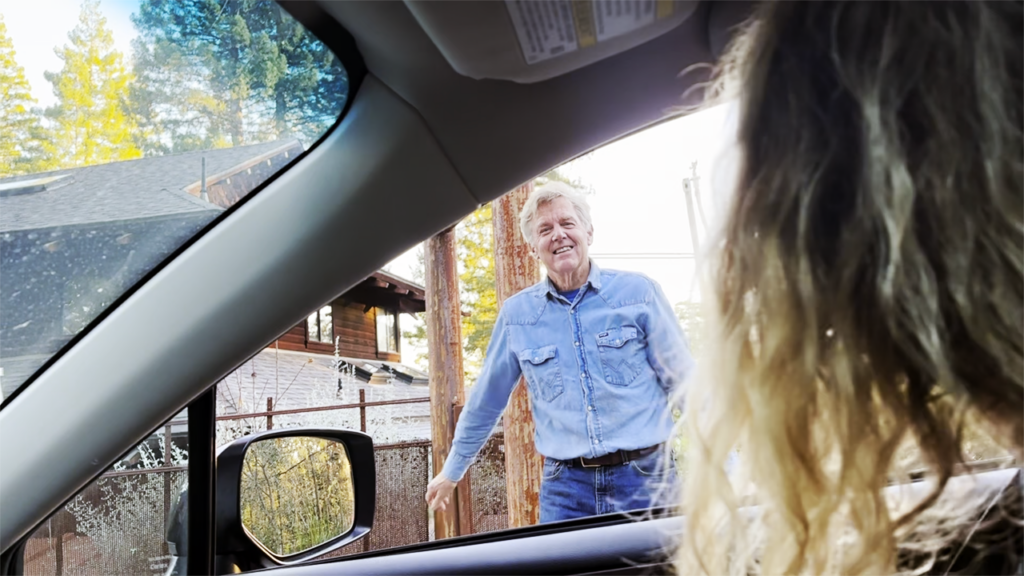
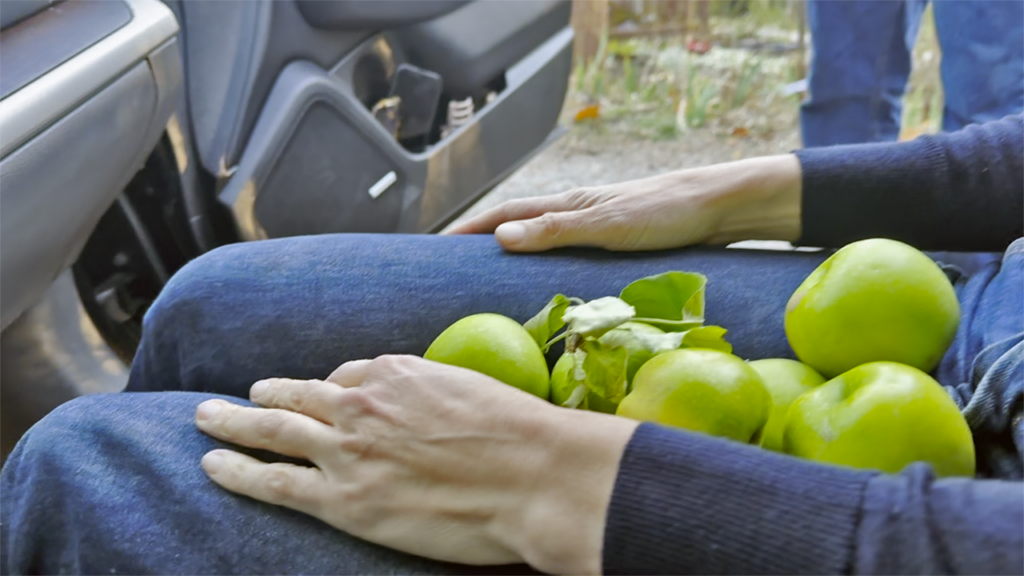
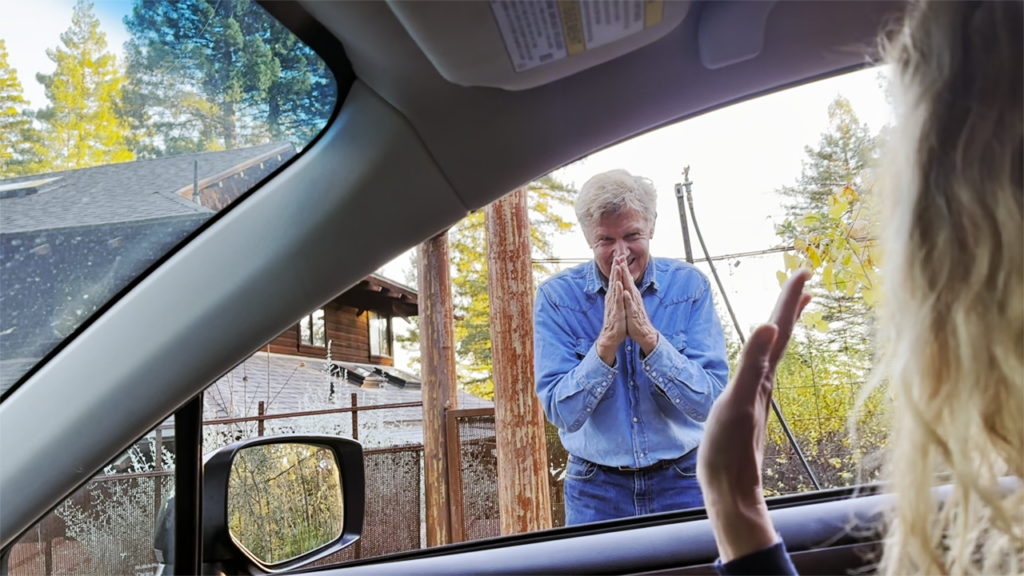
The day we visited was fresh and light golden. We left when it was already getting dark, being November. When we were driving away, Bruce approached the car. He had a bunch of green apples, the kind Kirsten likes, and when he offered them, she didn’t hesitate for a second. We chatted about something one last time, perhaps the video production and one future visit, and drove away.
We could tell he had revisited his work, his life, his wife, his children, and his grandchildren with our visit. And we had traveled with him.
The drive back home was pleasant. We still lived in Palo Alto back then, so it took us a while. We talked little in the car, thinking about Bruce’s work and his future endeavors. Kids were already out of school and extracurriculars, so we needed to get home and fix dinner.
Bruce Johnson’s statement regarding his work:
“I am an artist fully engaged in abstract contemporary sculpture.
I am a maker of objects with a craftsman’s touch.
I am a tool in the process.
I am moved by mass and scale.
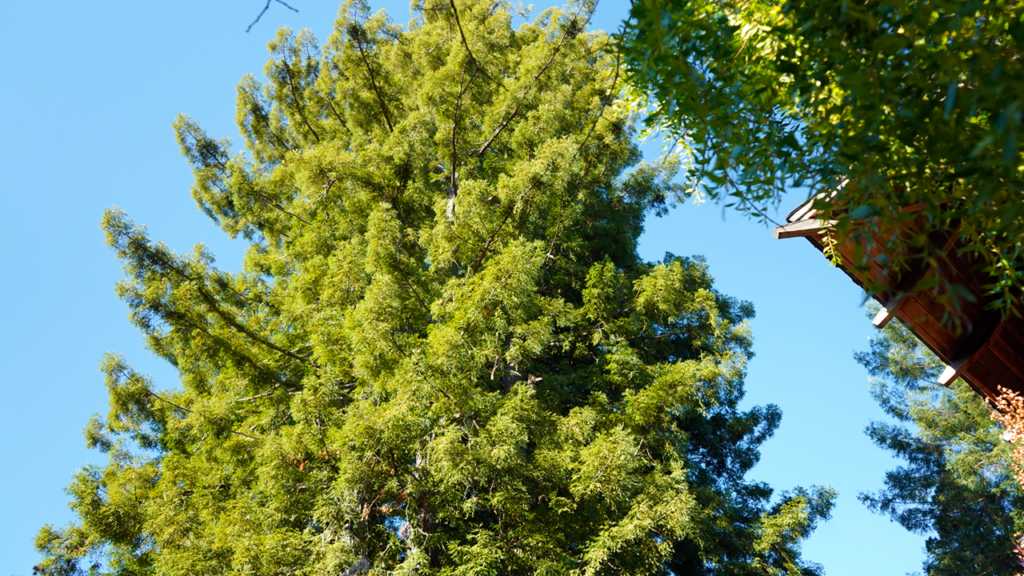
I love the energy and vitality of these big chunks of salvaged redwood and work to honor their spirit.
These sculptures are the echo of a vanishing ecosystem.
May they also be seen as small acts of preservation.”