What we lose when we stop naming the things we use and let systems optimize everything for us. On someone’s 1-million-km, 1988 G-Wagen, named Otto.
That we live in extraordinary times might feel like an understatement. But I wonder if every generation has felt a bit on the edge of something.

On December 7, 1957, attending the Nobel Banquet on his honor at the City Hall in Stockholm, Albert Camus expressed this more elegantly:
“Each generation doubtless feels called upon to reform the world.”
Since we’re talking about the bias of every generation of thinking their very own zeitgeist to be the one that really matters, it was another writer of Albert Camus’ very own time, although ten years older, George Orwell, who commented on the same idea, but with an ironic, witty twist, when in his Notes on Nationalism (1945) stated:
“Every generation imagines itself to be more intelligent than the one that went before it, and wiser than the one that comes after it.”
I doubt many people think we’re living a golden age of virtuosity in politics, education, the arts, or society itself, and it feels like we are about to offset a big chunk of our thinking and philosophizing to the agentic tools that quantify our tasks in tokens, or the monetization (gamification?) of computing effort. Offset a harder task, and you’ll pay—and proportionally pollute—more.
The acceleration that we are feeling
Everybody’s writing, talking, speculating about Claude’s unreleased frontier AI model, dubbed Mythos, which can apparently find vulnerabilities in the software and systems we’ve built over the decades, posing a risk that we used to see in the distant future, most likely (we thought) by the time quantum computing would become a reality.

But that possibility is already here, and if it feels a bit like an acceleration, well, perhaps it’s because it is one. Claude Mythos is now being tinkered with by 10 strategic companies and one foundation, Linux. All are headquartered in the US and cover networks, GPU architecture, operating systems, one bank, and the US government, with the goal of patching any potential weaknesses before others exploit them.
And so, this risk, which can be very real if we consider the already impressive capabilities of the latest released models, turns out to be not only a warning of AI models’ advance but also an elegant way to state that, given the evolution path toward artificial general intelligence (AGI), things could get messy fast if the tools were to fall in the wrong hands.
But many things have quickly come to depend on how AI performs in the future, from stock valuation to the future of jobs, wages, personal autonomy—or lack thereof. The evolution won’t be stopped or as closely controlled as many experts would like.
Everything functions, and that’s a big part of the problem
Our current technological landscape feels a little bit like the metaphor used by the controversial German philosopher Martin Heidegger in his posthumous interview published in Der Spiegel in 1966 (published after Heidegger’s death in 1976), Only a God Can Save Us, because the humanities have become a commodity of our way of framing reality in which everything is a resource awaiting deployment.
The interview took place in 1966, and started where it ought to be: Heidegger’s convoluted relation with nazism (as virtually any public figure of his country and generation, by the way). Heidegger was born in 1889, which made him 14 years older than Orwell and 24 years older than Camus.
The three of them saw Europe enter two fratricidal wars that ended up involving the world and killed millions of people, and two of them, Orwell and Camus, dedicated their lives to the task of thinking and writing about the contradictions of their time, whereas Heidegger had to live with the contradictions and decisions that led him to acquiesce with nazism, renegating from his very own mentor in Freiburg, Edmund Husserl, as the Third Reich targeted Jews early on, and having to live with it the rest of his life. That said, Heidegger’s philosophy and his critique of the modern world (bureaucratic, headless, driven by utility and inertia, uprooted from tradition and substance) continued to influence subsequent generations.
By the time the sixties arrived, Orwell and Camus were dead (the author of 1984 died of tuberculosis in London in 1950; Camus died in a car crash in 1960, as his friend and editor Michel Gallimard drove the car that was bringing them to Paris from the French countryside), and Heidegger was in his period of “enforced withdrawal” from academic life, given the context of the post-WWII denazification proceedings; like Albert Speer, also known as “the architect of the Third Reich” and author of an influential autobiography of the era, Heidegger served as an example of how even many (most?) highly educated people in Germany fell for the reality distortion field of the nazi era.
From philosophy to cybernetics: the new center of gravity
But the sixties were looking ahead, not back, and the world wasn’t anymore centered in and around Europe; instead, it was managed by two superpowers spreading across North America and northern Eurasia. It was also an era of change and acceleration; the Cold War was at its peak after the 1962 Cuban Missile Crisis, and the space race would culminate a mere three years later with NASA’s successful—and televised for the world to remember—moon landing.
It was an era in which mainframe computers were still rudimentary and cumbersome, and Doug Engelbart’s The Mother of All Demos at Stanford, which highlighted the path towards modern personal computing, happened more than two years later, on December 9, 1968. Yet, to Heidegger, it was clear we had entered an epoch of acceleration that he rightfully called cybernetics.
Europe wasn’t at the front seat anymore, once many of the brightest scientists left Mitteleuropa for the Soviet Union and, especially, the United States, and the things that were about to happen—or so Heidegger thought—were to take place in new centers. Silicon Valley, transitioning from an agricultural valley to a military and research complex, was beginning to take shape.
When I read the interview many years ago, I noticed the difference in tone between the optimism and naïveté of the interviewer, Georg Wolf, and the philosopher’s premonitory restraint. Wolff pushed back and countered Heidegger’s pessimism with a love declaration to the technical era:
“Everything functions. More and more power plants are being built. Production is flourishing. We live in prosperity. What is really missing?”
To the old and ostracized (yet still influential) philosopher, what was missing was implied in the interviewer’s description of modernity’s acceleration:
“Everything functions. That is exactly what is uncanny. Everything functions and the functioning drives us further and further to more functioning, and technology tears people away and uproots them from the earth more and more.”
He wasn’t answering this at random: his seminal work, Being and Time (1927), was all about tool analysis. He argued that we don’t relate to things as abstract stuff we observe, but as tools we use, stuff “at hand,” so when a craftsman is using a tool, it disappears into use and fuses with its user: there’s no isolated tool anymore, but a tool in use, revealing a transparent value. Only when the tool breaks (Heidegger argued) does it become an “object” to be analyzed and questioned.
Things with name, purpose, soul
Decades later, in 1954, Heidegger elaborated on where he thought modern society was going. In The Question Concerning Technology, he contrasted the mentality of the craftsman (which brought forth and revealed technical activity through personal agency) with that of modern technology, which forced, extracted, and controlled “users.” In other words, craftspeople had finally been substituted by mere users of technology they didn’t control.
If Heidegger was sure about cybernetics taking the place of philosophy already in the 1966 Der Spiegel interview, he was also positioning himself as somebody outside the new thiking, because the new reality was eroding concepts such as home and rootedness, and soon everything would be a bit nameless, placeless, or what the contemporary philosopher Byung-Chul Han (an expert of Heidegger himself) has called “the inferno of the same.”
When places are replaced by non-places, and everything dilutes into a very generic sameness, to try to practice some type of craft and keep all sorts of old-school agency becomes the biggest act of rebellion, especially now, once AI has shown that it can write and think and do many other things for us. Instead of. Excluding us. Soon, even the internet will stop mining people’s attention and focus on alluring AI agents (who will do things for us) with snippets of code that we won’t perceive, nor are we supposed to. The transition to the agentic web has already started.
There’s a small act of resistance that predates the current reduction of the world to functioning systems, and most likely will survive any trend that tries to erase who we are or we want to become: we can build things, use things our way, customize things, and name things so their nickname reminds us that they are important to us and they contribute to our version of the human experience. They are still our tools, and we feel agency when we use them because they amplify our potential rather than trying to erase or replace it. They have a name and particular traits that feel like embedded time for us, as we share experiences and memories using them.
Günther and Otto’s symbiosis
Naming things is a very different act from categorizing them. A personal name reminds us that a particular thing is not interchangeable; we have, or like THAT one, we’ve established a deep relationship when we use it, and it has a specific existence, not a categorical one interchangeable with any other similar object.

The smallest act of resistance could also be the oldest one. You name the thing. You say, this one, specifically. You are not referring to the Platonic category, or the generic model, or the ideal of the thing. It’s “this one.” And so, the first thing Don Quixote does, as a protagonist of the first modern novel, is to name his horse. It’s an important endeavor, and it comes before saddling up. Cervantes understood that, by naming the tired farm animal Rocinante, he was entering a world in which adventure was possible again.
Like Cervantes’ character, many of us have tried the same act of resistance, personalizing the things we cherish so they become our loyal life companions in a context of planned obsolescence that forces us to constantly shed our possessions to give way to new ones.
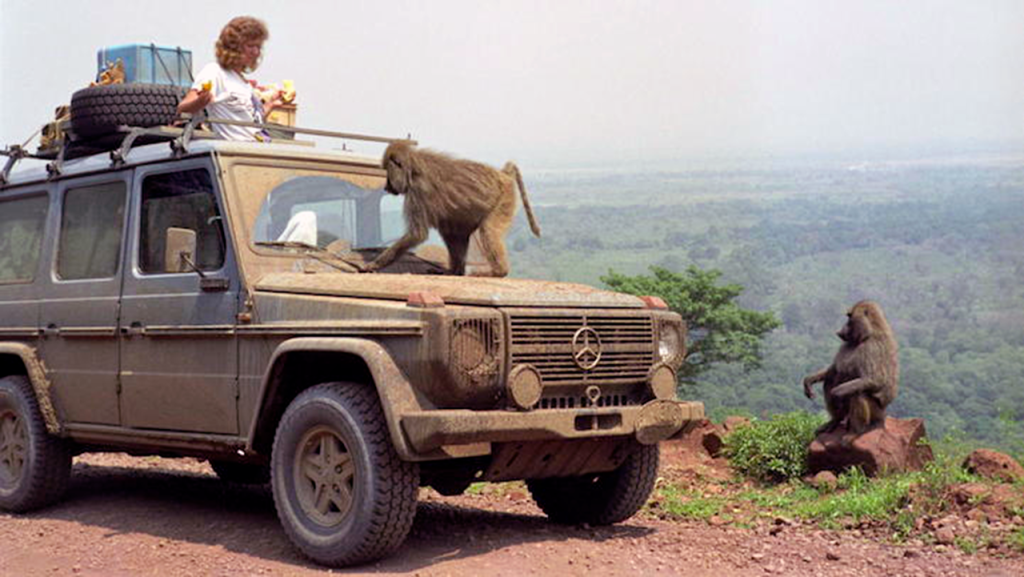
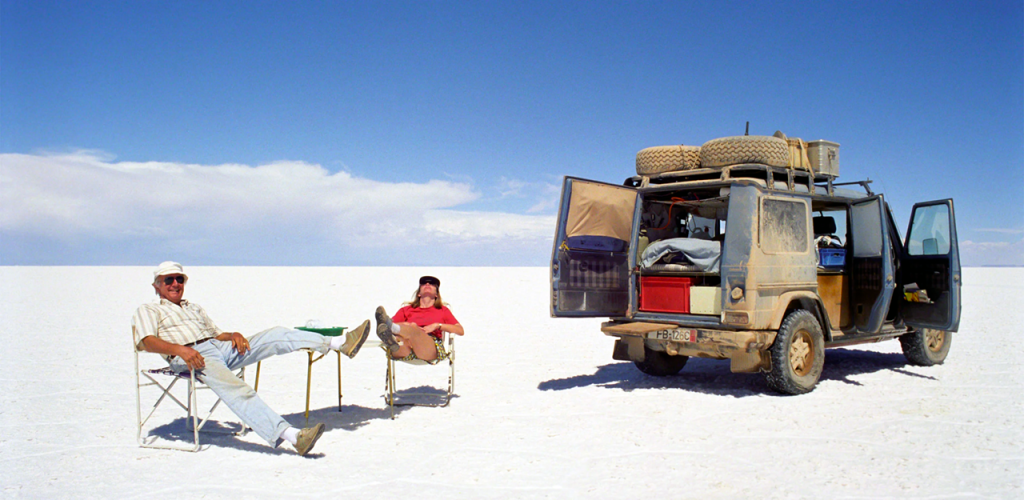
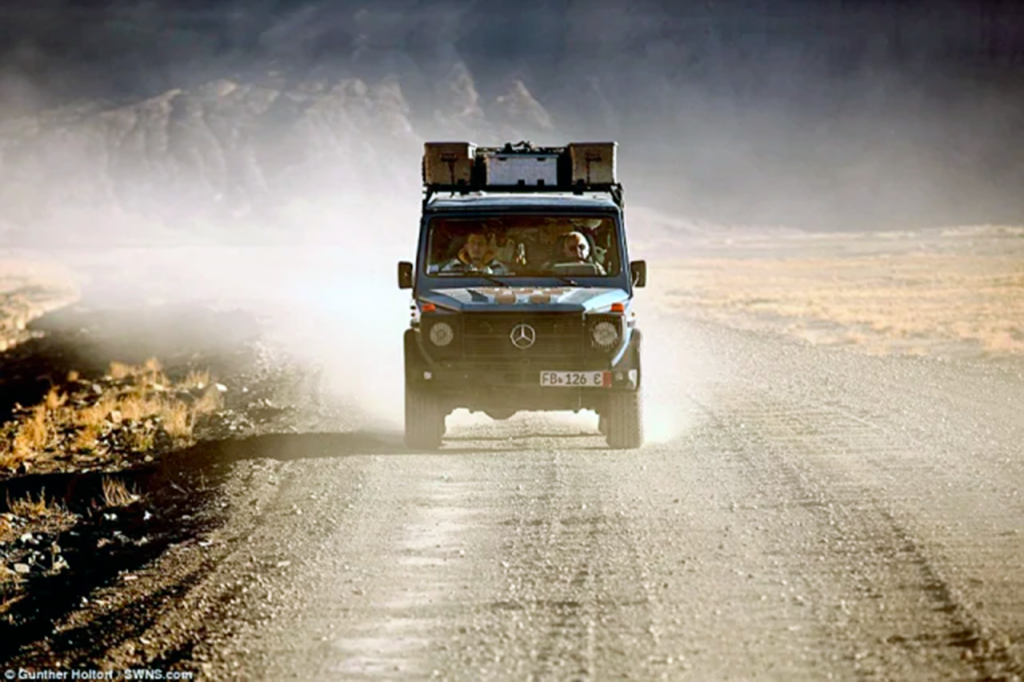
I recently came across the story of Günther and Christine Holtorf aboard their car, named Otto. First, I saw a picture circulating online of an old, blue Mercedes G-Wagen 300 GD with an almost identical appearance to our 1989 G-Wagen, model 230 GE, which we keep in Spain. Perhaps that’s why it caught my attention first, but this one looked like a particular type of car. One with a name.
The picture shows a mature couple hanging out in camping chairs next to a dusty, packed G-Wagen in the middle of the desert. It turns out that Günther and Christine traveled for decades in their car, many times across the world, and it feels natural that they had developed a connection with the car that had facilitated the adventure.
Ode to old school odometers: the machine that outlasted its own counting
The story of Günther and Otto had begun many years before that picture. After a corporate career with Lufthansa and then the logistics company Hapag-Lloyd, Günther Holtorf had had enough institutional travel with schedules he didn’t control, so he quit in 1988 at 51. That’s when he bought the car and decided to take a trip to Africa with his then-wife. But, upon their return to Germany, Günther and Beate divorced.
Günther was 53 and decided to place an ad in his paper of choice, Die Zeit, looking for a companion for a new trip. Christine, a single mother from Dresden, replied, and he just asked: Why don’t we do a little bit of travel. In November 1990, they set off together, again for Africa. It was the beginning of a 26-year journey, covering approximately 900,000 kilometers across 179 countries.
Otto, their car, treated them well. Günther, in return, did his part in the relationship with his machine, delivering an oil change every 5,000 kilometers, replacing spare parts before they wore out, and rarely cruising faster than 80 km/h (50 mph). The car never broke down. Unlike the lavish Mercedes Sprinter rigs of today’s vanlife, they carried only the essentials: non-perishable food, a spare wheel, a few clothes, cameras, cooking and sleeping gear, and a few camping utensils.

When I read an article about the Holtorfs and their companion Otto once they decided to finish their 1989-2014 journey, I recognized the character and quirkiness of a car I’ve come to cherish myself (despite the fact that mine isn’t Otto). After covering almost 1 million kilometers, Günther’s car was still running on the original engine, whereas I had to change mine once.
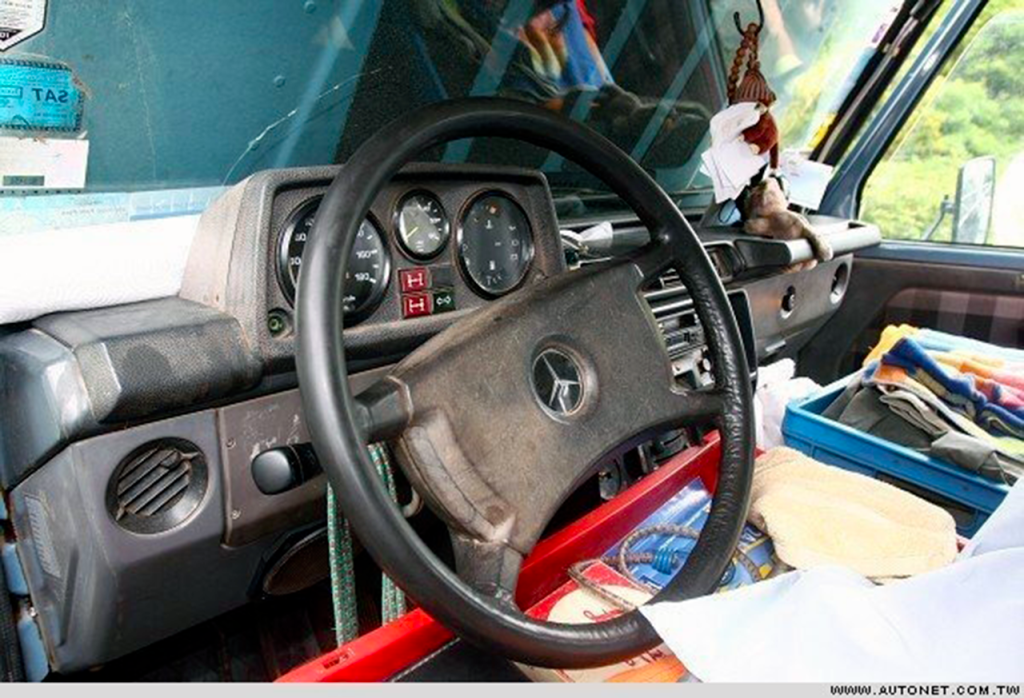
As it happens, in my car, Otto’s odometer topped out at 99,999 kilometers, so every time another 100,000 kilometers went by, Günther took the car to Europe, where a mechanic pasted a new sixth digit in front of the existing five. Since I have mine, I’ve encountered this issue only once. I bought it when it showed a little over 16,000 kilometers (who knows how many times it had topped 99,999). I broke the engine at 32,000, and now I’m past 33,000, so I’ve already put 100,000 kilometers on the new engine.
Geländewagen diaries
One could think that Günther and Christine had a fortune to live their lifestyle, but the funding was modest: they lived off savings, his pension from the two corporate jobs he’d held, and the royalties from the sale of a street map of Jakarta that Holtorf published in 1977, a 400-page city atlas that eventually sold 150,000 copies.
As for Otto, well, he took care of them, as they took care of him. First, they spent five years in Africa, traveling through the Sahara, Central and West Africa, and the continent’s deep interior. Then, they shipped the car to South America and followed suit, then to Central America and North America. Then Otto was shipped to Australia and New Zealand. Then Asia. The Caribbean. In total, 26 years of adventures, including a cruise through Cuba and North Korea (Holtorf became the first Westerner to drive in North Korea).
In his interviews over the years, Günther Holtorf has talked about many things, but especially about their experience, which didn’t require social media at all, nor any digital device, for that matter. Theirs was an analog adventure aboard Otto, and I have to confess that I like to drive our old G-Wagen because I find the same feeling returning when cruising slowly from a more Spartan, analog car I understand and can maintain and fix.

I can imagine Günther, as he has explained, crossing the Sahara under a full moon with Beethoven playing on Otto’s cassette deck (I can tell you: you have to play it loud, because the engine noise is very present in such a car from the 80s). In a car without a computer, a GPS, without a digital screen or cellular signal at all, crossing the Sahara. A durable, repairable, analog machine with a name, advancing like Rocinante, with a moving horizon ahead.
“There is no way you could do that kind of driving in a new one. This car was built in the late ’80s and is as simple as it gets. With all the electronics and computers in today’s vehicles, it would be impossible to maintain it yourself while in the middle of nowhere.”
Günther was talking about cars, but he could have been talking about our lives.
I (sometimes) drive Otto’s sibling
Now, as it happens, things weren’t perfect during their trips, especially after, in 2003, Christine was diagnosed with cancer. During the first two years after the diagnosis, they could still travel, but then she had to undergo a more aggressive treatment and had to stay home many times. Her son Martin accompanied Günther during some of the trips in those years. Until her final trip to the United Kingdom, in the summer of 2009 (she died in June 2010).
But the trips didn’t stop, and Günther and Otto cruised along, with Christine’s photo hanging from Otto’s rearview mirror, swinging back and forth depending on the terrain they were crossing. Günther finished visiting the many places he had planned to go with Christine in October 2014, when he retired to his home by a small lake in Bavaria. He died in October 2021, at 84.
I wonder what my 50s bring on, not far from now. Günther, Christine, and Otto are an inspiration to me, and to many: Otto is now on permanent display at the Mercedes-Benz Museum in Stuttgart, which I consider to be almost a waste, for I’m sure Otto still has a say driving dirt roads while Beethoven blasts in the cassette recorder.
Now, as it sits in a museum, Otto has become yet another artifact: an object awaiting observation instead of someone’s cherished, customized, worn-out tool. Which is, of course, exactly what Heidegger feared would happen to everything.
When asked about philosophical enframing, Martin Heidegger didn’t offer a program, but the recommendation to cultivate a readiness (through thinking and poetry) for something that couldn’t be forced or manufactured, because it’s embedded in our very own experience.
Negotiating, not optimizing
Günther Holtorf’s adventures belong in a pre-social media, pre-vanlife world, when adventures were organized around Quixotic idealism and one could drive Otto as Don Quixote rode Rocinante, cruising at 80 km/h with no GPS, no sponsors, no digital presence, and Christine’s photo hanging from Otto’s rearview mirror, swinging back and forth.
The modern world was still there, with borders, bureaucracies, shipping containers, diesel prices, conflicts, but Günther and Otto moved through it, negotiating with it rather than optimizing for it.
Only a god can save us, Heidegger said. He was probably right that no human institution will reverse the trajectory. But he also said something quieter, less quoted: that nearness doesn’t consist in shortness of distance. That the frantic abolition of all distances brings no nearness at all.
After covering over 900,000 kilometers, Günther returned home in Bavaria, knowing that he’d maintained his companion Otto as someone who cared for his Rocinante.
It’s perhaps not a model most of us can follow. But it is, perhaps, a direction we can face.